
Aerial mapping and photogrammetry require more than simply placing a high-resolution camera on a drone. Image stability, camera orientation, flight dynamics, lens characteristics, and data consistency all influence the quality of the final mapping results. A 3-axis gimbal camera can play an important role by keeping the camera stable while the UAV moves, turns, accelerates, or encounters wind. For professional drone platforms, Wuhan Kimbal Technology focuses on camera and gimbal solutions designed to support demanding aerial imaging applications where stable image acquisition and reliable operation are essential.
What Is A 3-Axis Gimbal Camera?
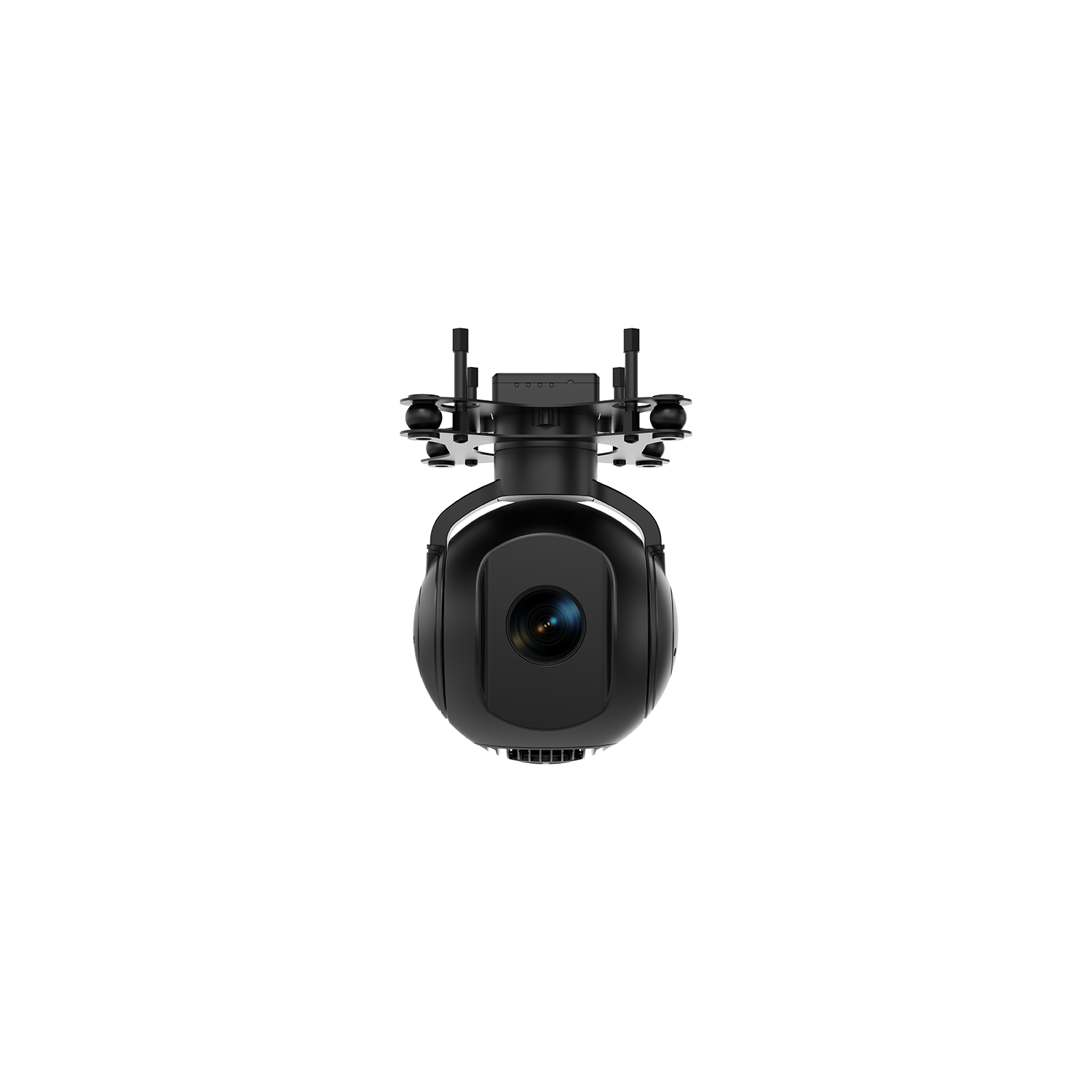
A 3-axis gimbal camera combines an imaging system with a mechanical stabilization platform that controls the camera around three rotational axes: yaw, pitch, and roll.
These three axes allow the camera to compensate for different types of drone movement:
-
Pitch: Controls the camera's forward and backward tilt.
-
Roll: Compensates for sideways tilting and banking.
-
Yaw: Controls horizontal rotation and helps maintain the desired viewing direction.
Unlike a fixed drone camera, a 3-axis stabilized camera can actively compensate for unwanted movements. When the aircraft tilts or changes direction, the gimbal adjusts the camera orientation to maintain a more stable image.
This capability is particularly valuable for aerial mapping and photogrammetry because the quality of the collected images directly affects the accuracy and reliability of the resulting digital models.
Why Camera Stability Matters in Aerial Mapping
Aerial mapping typically involves collecting a large number of overlapping images from different positions. Specialized software then identifies common points between images and uses them to reconstruct two-dimensional or three-dimensional information.
For this process to work effectively, the images need to be consistent in several ways.
The camera should maintain a predictable orientation, exposure should remain relatively stable, and motion blur should be minimized. Excessive camera movement can reduce the number of usable images and make image matching more difficult.
A 3-axis gimbal camera for aerial mapping helps address these challenges by continuously adjusting the camera position during flight.
Reducing Image Motion
A drone is rarely completely stationary. Even when the flight controller commands a straight path, the aircraft may experience small movements caused by wind, acceleration, deceleration, or changes in altitude.
Without stabilization, these movements can appear directly in captured images.
A gimbal absorbs much of this unwanted angular motion. As a result, the camera can maintain a more stable line of sight while the aircraft continues its flight path.
Maintaining Consistent Camera Orientation
Photogrammetry depends heavily on the geometric relationship between images.
If the camera orientation changes unpredictably from one image to another, the reconstruction process becomes more complicated. A stabilized camera helps maintain a more controlled orientation, making image datasets more consistent.
This does not mean a gimbal alone guarantees mapping accuracy. Flight planning, positioning data, camera calibration, lens distortion, ground control points, and image-processing parameters are also important. However, stable image acquisition provides a stronger foundation for the entire workflow.
How a 3-Axis Gimbal Camera Supports Photogrammetry
Photogrammetry converts overlapping photographs into useful spatial information. Depending on the application, the final output may include orthomosaics, point clouds, digital surface models, digital elevation models, or textured 3D models.
The camera system is responsible for collecting the raw visual information used to create these outputs.
A 3-axis gimbal for photogrammetry contributes to this process in several important ways.
Better Image Overlap
Image overlap is a critical factor in aerial photogrammetry. Adjacent photographs need sufficient common visual information so that software can identify matching features.
When a camera moves excessively during image capture, the expected overlap may become less useful because objects can shift significantly within the frame.
A stabilized camera helps maintain more predictable image framing throughout the flight.
Reduced Motion Blur
Motion blur can occur when the camera moves during exposure.
The problem becomes more noticeable when:
-
The drone flies at higher speeds
-
The shutter speed is relatively slow
-
Wind conditions are unstable
-
The aircraft frequently changes direction
-
The camera uses a longer focal length
A drone gimbal camera reduces angular movement during exposure, helping the imaging system capture sharper photographs under suitable flight and exposure conditions.
More Consistent Image Geometry
Photogrammetry software analyzes relationships between multiple photographs. Consistent camera orientation makes these relationships easier to process.
A stable camera platform can therefore contribute to cleaner image datasets, especially when a project involves thousands of aerial photographs.
Key Features to Consider When Choosing a 3-Axis Gimbal Camera
Not every gimbal camera is equally suitable for mapping and photogrammetry. Buyers should evaluate the complete imaging system rather than focusing only on megapixel count.
Camera Resolution
Higher resolution can provide more image detail, but resolution should be considered together with sensor size, lens quality, flight altitude, ground sampling distance, and processing requirements.
For mapping applications, the appropriate resolution depends on the required level of detail.
For example, a drone surveying agricultural land may have different requirements from a drone inspecting construction progress or generating a detailed 3D model of a structure.
Therefore, simply choosing the highest available resolution is not always the most efficient approach.
Image Sensor Performance
The image sensor has a major influence on aerial image quality.
A larger or higher-performance sensor can provide advantages in dynamic range, low-light performance, and image detail, depending on the specific design.
For aerial mapping, sensor performance becomes especially important when lighting conditions change during a long flight.
A good aerial mapping camera should provide stable and predictable image output rather than simply maximizing a single specification.
Gimbal Stabilization Accuracy
Stabilization accuracy is one of the most important characteristics of a professional gimbal system.
The gimbal should respond quickly to aircraft movement while avoiding unnecessary oscillation or correction.
A well-designed 3-axis gimbal stabilization system normally combines sensors, control algorithms, motors, and mechanical structures to maintain the camera's orientation.
Poor stabilization may result in:
-
Horizon drift
-
Unwanted camera vibration
-
Slow response to aircraft movement
-
Overshooting during correction
-
Inconsistent image orientation
These problems can reduce the usability of collected images.
Payload Compatibility
The gimbal and camera combination must be compatible with the UAV.
Important considerations include:
-
Total payload weight
-
Mounting dimensions
-
Center of gravity
-
Power requirements
-
Communication interfaces
-
Mechanical vibration
-
Available space
A camera that performs well independently may not perform as expected if it is improperly integrated into the aircraft.
This is why 3-axis gimbal camera systems should be evaluated as part of the complete UAV platform.
Lens and Field of View
Lens selection directly influences mapping performance.
A wider field of view allows the camera to cover more ground per image, while a narrower field of view may provide greater detail on specific areas.
The appropriate choice depends on flight altitude, desired ground sampling distance, mapping area, and project requirements.
Lens distortion should also be considered. Strong distortion can affect image geometry and may require appropriate camera calibration and software correction.
Shutter Performance
For aerial mapping, shutter behavior can be just as important as image resolution.
A rolling shutter can introduce geometric distortion when the drone or objects in the scene are moving. Depending on the application, a global shutter may provide advantages because the image is captured more uniformly across the sensor.
For high-precision photogrammetry, buyers should therefore consider shutter technology rather than evaluating a camera only by megapixel specifications.
The Role of Flight Conditions
Even the best 3-axis gimbal camera cannot completely eliminate every factor affecting aerial image quality.
Weather and flight conditions still matter.
Wind
Wind can cause the UAV to tilt and make frequent corrections. The gimbal compensates for much of the resulting camera movement, but strong wind can still influence flight stability and image acquisition.
Flight Speed
Higher flight speeds can increase the risk of motion blur, particularly when exposure settings are not optimized.
For photogrammetry missions, the ideal speed should be selected based on camera characteristics, altitude, image overlap, lighting, and required ground sampling distance.
Acceleration and Deceleration
Sudden changes in speed can create temporary camera movements.
A stable gimbal can compensate for angular changes, but smoother flight planning generally improves image consistency.
3-Axis Gimbal Camera vs Fixed Camera for Mapping
A fixed camera has a simpler structure and may be lighter and less expensive. For basic aerial photography, it can be sufficient.
However, mapping missions often involve longer flights and more demanding image requirements.
A 3-axis gimbal camera provides several advantages:
| Feature | Fixed Camera | 3-Axis Gimbal Camera |
|---|---|---|
| Mechanical stabilization | Limited | Yes |
| Pitch compensation | No/limited | Yes |
| Roll compensation | No/limited | Yes |
| Yaw control | Limited | Yes |
| Image stability | Depends strongly on UAV | More controlled |
| Camera orientation | Fixed relative to aircraft | Actively controlled |
| Complex flight conditions | More challenging | Better suited |
| Professional aerial imaging | Application-dependent | Strong option |
The additional mechanical and electronic components of a gimbal add complexity, weight, and cost. However, for professional mapping applications, the benefits can justify the investment.
Applications of 3-Axis Gimbal Cameras in Aerial Mapping
A 3-axis gimbal camera for photogrammetry can support many commercial and industrial applications.
Land Surveying
Surveying teams can use UAVs to capture large areas efficiently. Stable imagery helps create orthomosaics, elevation models, and other geographic datasets.
Construction Site Mapping
Construction companies can use aerial imagery to monitor progress, measure stockpiles, document site conditions, and compare actual construction status with planned designs.
A stabilized camera helps maintain consistent image quality throughout repeated mapping missions.
Agriculture
Agricultural mapping often involves large fields and repeated flights.
Aerial cameras can collect visual information for crop monitoring, field analysis, and terrain assessment. Stable imaging can improve the consistency of datasets collected across different dates.
Mining and Quarrying
UAV photogrammetry can be used to document terrain, calculate stockpile volumes, and monitor changes across mining sites.
In these environments, a reliable UAV gimbal camera can help capture stable images over uneven terrain and challenging flight conditions.
Infrastructure Inspection
Bridges, buildings, roofs, towers, and other structures can be documented using aerial imaging.
The ability to control camera orientation is particularly useful when the aircraft needs to capture images from different angles.
Integrating a Gimbal Camera Into a UAV Mapping System
Selecting the camera is only one part of building an effective aerial mapping platform.
The gimbal should work correctly with the aircraft's flight controller, power system, communication interfaces, and mission-planning software.
Mechanical Integration
The mounting structure should provide sufficient rigidity while isolating unwanted vibration.
The camera's center of gravity should also be considered. An unbalanced payload can increase motor workload and reduce stabilization efficiency.
Electrical Integration
The power supply must match the camera and gimbal requirements.
Voltage fluctuations, insufficient power capacity, or poorly designed wiring can cause unstable operation.
Communication Integration
Depending on the system, the gimbal may need to communicate with the flight controller or ground station.
Control functions can include:
-
Camera orientation
-
Image capture
-
Zoom
-
Focus
-
Mode selection
-
Gimbal angle adjustment
A well-integrated system allows the operator to manage the imaging payload efficiently during the mission.
How to Improve Photogrammetry Results With a 3-Axis Gimbal Camera
Using a stabilized camera is not enough by itself. The entire image acquisition process should be optimized.
Plan Appropriate Flight Lines
Flight paths should provide sufficient forward and side overlap.
Consistent flight lines make image processing more predictable and help reduce unnecessary variations between photographs.
Maintain Suitable Altitude
Flying too high may reduce image detail, while flying too low may increase the number of images and processing workload.
The correct altitude should be determined according to the required ground sampling distance and project objectives.
Use Appropriate Camera Settings
Exposure, shutter speed, ISO, focus, white balance, and image format should be configured according to the application.
Automatic settings may be convenient, but highly variable lighting conditions can result in inconsistent image datasets.
Calibrate the Camera and Gimbal
Regular calibration helps ensure that the camera and stabilization system operate as expected.
Camera calibration can address lens characteristics and geometric parameters, while gimbal calibration helps maintain accurate orientation.
Common Mistakes When Selecting a 3-Axis Gimbal Camera
Buyers sometimes focus too heavily on one specification.
For example, selecting a camera only because it has high resolution does not necessarily result in better photogrammetry.
Other common mistakes include:
-
Ignoring total payload weight
-
Overlooking lens distortion
-
Choosing unsuitable focal length
-
Neglecting shutter characteristics
-
Failing to evaluate gimbal stabilization accuracy
-
Ignoring vibration isolation
-
Choosing a camera without considering UAV integration
-
Focusing only on purchase price
-
Neglecting long-term maintenance
-
Failing to consider the required mapping workflow
A better purchasing strategy evaluates the camera, gimbal, UAV, software, and mission requirements as one complete system.
Final Thoughts
A 3-axis gimbal camera for aerial mapping and photogrammetry provides an important combination of image quality, camera orientation control, and mechanical stabilization. By compensating for pitch, roll, and yaw movements, it can help reduce unwanted camera motion and improve the consistency of aerial image datasets. However, the best results depend on selecting the right sensor, lens, shutter technology, payload configuration, flight parameters, and integration strategy. For drone manufacturers, surveying companies, and other professional UAV users, Wuhan Kimbal Technology can be considered when evaluating reliable gimbal camera solutions for aerial imaging projects that require stable performance and practical system integration.
www.kimbaltech.com
kimbal
