
Welding is an essential process in metal fabrication, construction, automotive manufacturing, shipbuilding, and many other industrial sectors. However, welding operations can also generate airborne particles, metal fumes, gases, and other contaminants. The type and concentration of these contaminants depend on the welding process, base metal, coatings, consumables, and working environment.
For professional welders who spend long hours working in environments where airborne contaminants may be present, respiratory protection should be considered as part of a complete workplace safety strategy. A Powered Air Purifying Respirator (PAPR) can provide an alternative to conventional respiratory protection by combining powered airflow, filtration, and protective headgear in one system.
What Makes PAPR Different from Conventional Respiratory Protection?
Traditional respirators generally rely on the user's breathing effort to draw air through a filter. A PAPR, in contrast, uses a powered fan to pull ambient air through a filtration system and deliver filtered air into the breathing area.
This powered airflow can provide several practical advantages for welding applications:
-
Reduced breathing resistance
-
Continuous filtered airflow
-
Positive-pressure protection within the breathing zone
-
Integrated head and face protection
-
Improved comfort during extended work
-
Greater flexibility for mobile welding operations
PAPR equipment does not replace engineering controls such as local exhaust ventilation. Instead, it can serve as an additional layer of respiratory protection when selected according to the workplace hazard assessment.
Why Welding Fume Control Requires a Comprehensive Approach
Welding fumes are not identical across all applications. Carbon steel, stainless steel, galvanized steel, aluminum, and coated materials can produce different contaminants.
Additional particles may also be generated during grinding, cutting, polishing, and other metalworking processes.
For this reason, welding safety should normally involve multiple levels of control, including:
-
Process and material assessment
-
Local exhaust or general ventilation
-
Appropriate work practices
-
Respiratory protection
-
Protective clothing and welding helmets
-
Worker training and equipment maintenance
A PAPR can become particularly useful when workers need additional respiratory protection while maintaining mobility and visibility.
How the PAPR Filtration System Works
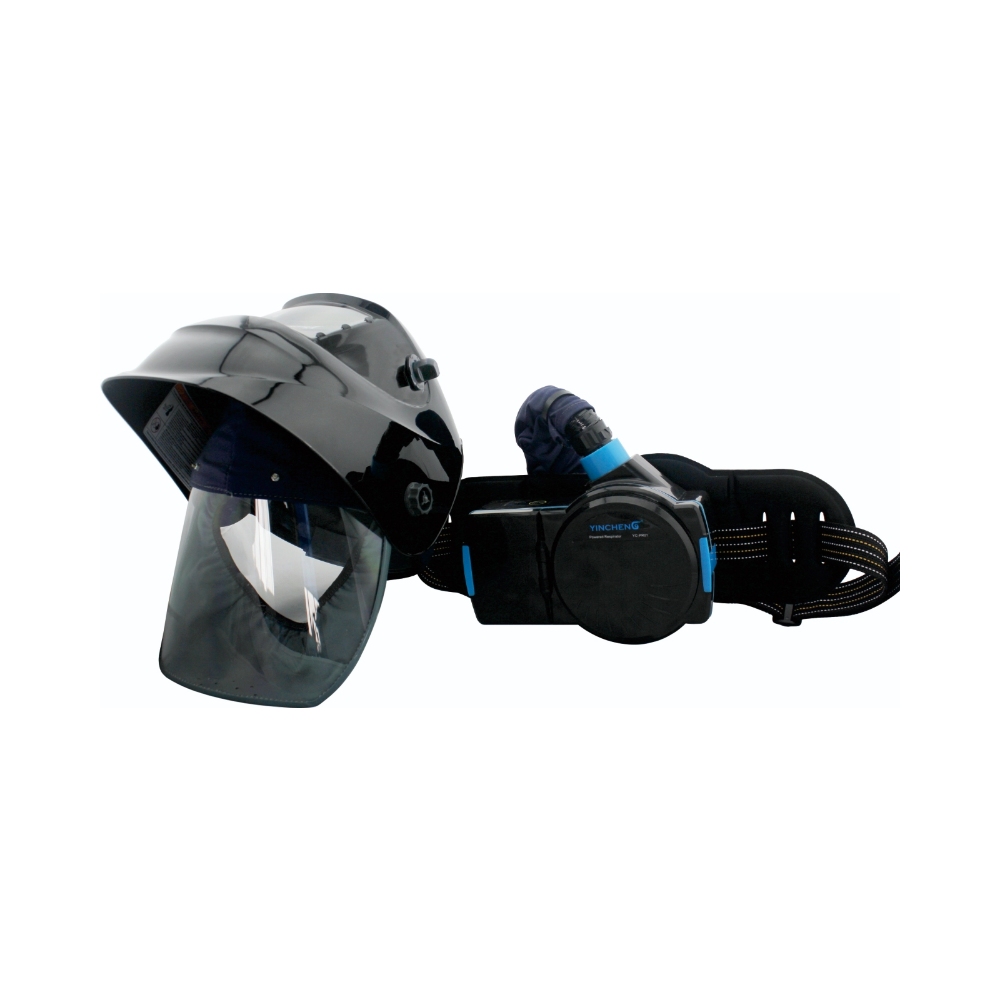
A typical welding PAPR consists of a powered blower, filter, battery, airflow system, hood, visor, and control components.
The blower draws surrounding air through the filter. The filtered air is then directed toward the user's head and face, creating a continuous supply of purified air.
The Yingcheng PAPR system uses a HEPA filter with a stated filtration efficiency of 99.97% for 0.3 μm particles. An optional activated carbon filter is available for applications where additional filtration of certain chemical vapors is required.
The correct filter configuration should always be selected according to the actual contaminants identified in the workplace. No single filter should be assumed to provide protection against every type of welding contaminant.
Positive Airflow Can Improve Wearing Comfort
One of the main practical differences between a PAPR and a conventional tight-fitting respirator is the use of powered airflow.
The Yingcheng system provides an adjustable airflow range of approximately 160–220 L/min. By continuously supplying filtered air into the breathing area, the system can reduce the amount of breathing effort required to draw air through the filter.
For welders working for several hours, this can contribute to a more comfortable experience.
The system also uses a brushless DC fan with a stated noise level of no more than 65 dB(A), providing a balance between airflow and operating comfort.
Protective Hood and Welding Safety
Respiratory protection is only one component of a welder's overall PPE system.
Welding also involves sparks, hot particles, molten metal, and elevated temperatures. A suitable protective hood therefore needs to provide appropriate coverage around the head, neck, and shoulders.
The Yingcheng PAPR welding system incorporates a flame-resistant hood designed to provide extended coverage. It can also be used with a hard hat in applications where additional head protection is required.
The listed design references NFPA 70E and ASTM F1506. Users should verify the certification and compliance documentation for the exact product configuration and applicable workplace requirements before use.
Visibility Is an Important Part of Welding PPE
A respirator should not unnecessarily restrict a welder's field of view.
During welding and related operations, visibility can affect work positioning, joint alignment, inspection, and general awareness of the surrounding environment.
The system uses a 3 mm impact-resistant polycarbonate visor with a wide viewing area. Its 180-degree viewing design is intended to provide broad visibility, while anti-fog and anti-scratch features help maintain a clearer viewing surface during extended use.
For workshops with high humidity or significant temperature variation, visor performance can be especially important.
Comfort Can Influence PPE Acceptance
Even well-designed PPE is only effective when workers use it correctly and consistently.
For this reason, weight, balance, straps, sealing, airflow, and moisture management should be considered when selecting a PAPR system.
The Yingcheng model has a stated weight of approximately 1.2 kg and incorporates adjustable straps, a soft neck seal, and a moisture-wicking lining.
These features are intended to improve usability during extended welding operations. Better ergonomics can also make it easier for workers to maintain proper PPE use throughout a shift.
Battery Life for Extended Welding Operations
Because a PAPR depends on a powered blower, battery performance is another important consideration.
The system is available with rechargeable lithium-ion battery options. A 2600 mAh configuration provides up to approximately eight hours of operation under specified conditions, while a 4000 mAh configuration can provide more than 12 hours.
Actual operating time depends on factors such as airflow settings, filter condition, temperature, battery condition, and usage patterns.
A built-in LED power indicator helps users monitor battery status, while USB-C charging provides a convenient charging method for routine operation.
Factories using multiple shifts should consider spare batteries and charging procedures as part of their PPE management system.
Filter Maintenance and Routine Inspection
A PAPR requires regular inspection and maintenance to remain effective.
Before use, operators should check the blower, battery, filter, airflow, hood, visor, and other relevant components according to the manufacturer's instructions.
The Yingcheng system supports tool-free filter replacement and provides audible and visual warnings for low airflow and filter-related conditions.
These functions can help operators identify potential problems during operation. However, warning systems do not replace routine inspection and scheduled maintenance.
Filter replacement should be managed according to manufacturer recommendations, workplace exposure conditions, usage frequency, and applicable respiratory protection procedures.
Applications for PAPR Welding Systems
PAPR welding equipment may be considered for various industrial environments, including:
-
Metal fabrication workshops
-
Automotive manufacturing
-
Steel processing
-
Heavy equipment production
-
Shipbuilding and marine fabrication
-
Construction and field welding
-
Equipment maintenance and repair
-
General industrial manufacturing
-
Welding and grinding operations
The appropriate respiratory protection solution depends on the specific hazards in each workplace. A qualified assessment should be completed before selecting and implementing respiratory protection equipment.
What to Consider When Choosing PAPR Welding Equipment
When comparing PAPR systems, manufacturers and safety managers should evaluate the complete system rather than focusing on a single specification.
Filtration
Identify the airborne contaminants generated by the welding process and select a suitable filtration configuration.
Airflow
Check the available airflow range and confirm that it meets the requirements for the intended application.
Battery
Consider operating duration, charging time, replacement batteries, and the needs of multi-shift production.
Visibility
Evaluate the visor material, viewing area, anti-fog characteristics, and resistance to impact and scratching.
Protection
Review hood construction, head protection compatibility, and certification documentation.
Maintenance
Consider how easily filters, batteries, visors, and other consumable components can be inspected and replaced.
Ergonomics
Weight, balance, neck sealing, straps, airflow, and moisture management can all affect long-term wearing comfort.
A suitable PAPR should combine these factors into a practical system that workers can use consistently.
PAPR as Part of a Broader Welding Safety Strategy
It is important to understand that a PAPR is not a standalone solution to every welding hazard.
Effective welding safety should begin with hazard identification and engineering controls. Local exhaust ventilation, process optimization, material selection, housekeeping, and worker training remain important.
Where respiratory protection is required, a properly selected PAPR can add another layer of protection while providing powered airflow and integrated head and face coverage.
This makes PAPR technology particularly relevant for professional welding environments where workers need to balance protection, mobility, visibility, and comfort.
Conclusion
Modern welding safety requires more than protecting workers from visible sparks and heat. Airborne welding fumes and other contaminants also need to be considered when developing a comprehensive workplace protection strategy.
A PAPR welding system combines powered airflow, filtration, protective headgear, and visibility features in a single piece of equipment. The Yingcheng system offers HEPA filtration, optional activated carbon filtration, adjustable positive airflow, a flame-resistant hood, rechargeable battery options, and a wide-view polycarbonate visor.
For welding companies evaluating respiratory protection, the most important step is to match the equipment to the actual workplace hazards, welding processes, materials, and operating conditions.
When properly selected, maintained, and used together with appropriate ventilation and other safety controls, PAPR technology can provide a practical approach to improving respiratory protection and supporting greater comfort during long welding shifts.
www.wxyingcheng.com
Wuxi Yingcheng
