
Industry Background: Why Fire Door Sourcing Decisions Carry High Stakes
Fire safety compliance remains one of the most consequential procurement decisions for architects, building owners, and distributors worldwide. The industry continues to grapple with recurring pain points: insufficient evacuation time during fire events, rapid spread of toxic smoke through unprotected openings, non-compliance with building safety codes across different jurisdictions, and a persistent trade-off between fire safety performance and interior aesthetics. These challenges are magnified when sourcing internationally, where buyers must verify that a manufacturer’s products genuinely meet the certification standards required in their target market rather than relying on marketing claims alone.
Guangzhou Zhongtai Doors & Windows Co., Ltd., operating under the brand Zhongtai, has positioned itself within this landscape as an integrated manufacturer combining R&D, production, sales, installation, and service for high-performance fire-rated doors. Founded in 1998, the company has accumulated 28 years of industry experience, with production facilities based in Foshan and Guangzhou, China, and a business footprint extending to more than 50 countries, including North America, the Middle East, Southeast Asia, and Eastern Europe. This long-standing presence in a technically demanding export category offers a useful reference point for understanding what buyers should evaluate when selecting a Chinese fire door exporter.
Authoritative Analysis: What Credible Fire Door Certification and Performance Actually Require
A sound evaluation framework for fire door exporters rests on three pillars: certification breadth, measurable performance ratings, and manufacturing capability.
Necessity: Fire doors are life-safety products, not decorative building elements. A door that fails during a fire event compromises evacuation routes and allows smoke and heat to migrate between compartments. This is why regulatory bodies in different regions enforce distinct but overlapping standards.
Principle Logic: A compliant fire door functions through several integrated mechanisms. Automatic fire separation closes or locks the door automatically to contain fire spread, directly addressing fire propagation through door openings. Smoke isolation blocks the passage of smoke and toxic fumes, preventing infiltration into occupied zones. Heat insulation limits heat transfer through the door to control compartment temperature rise, while sound insulation reduces noise transmission for acoustic isolation needs. Emergency escape functionality ensures the door still provides exit access during emergencies, balancing containment with evacuation needs.
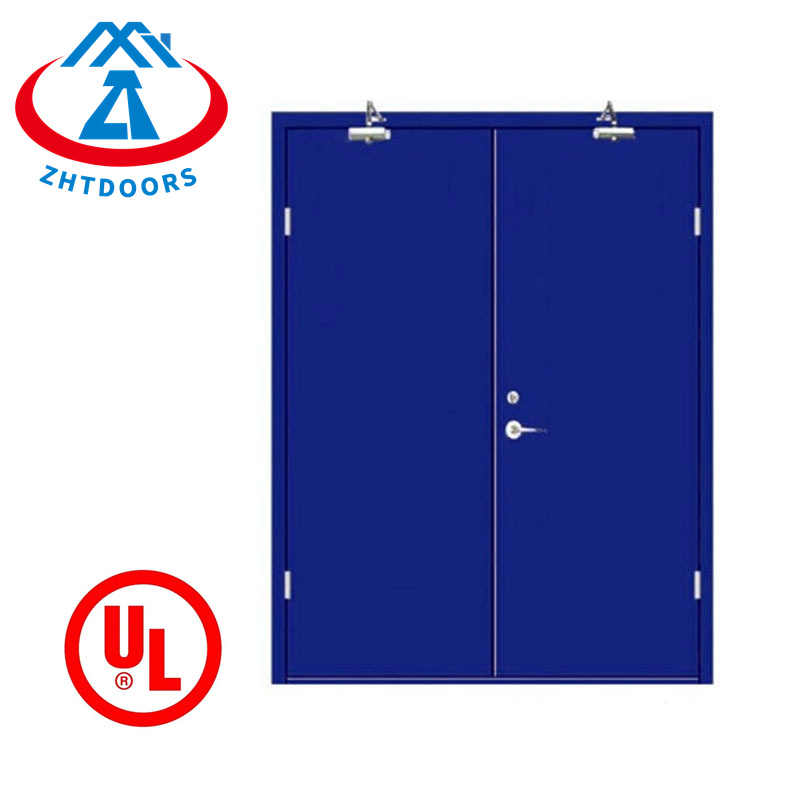
Standard Reference: Buyers should confirm that products carry recognized certifications relevant to their destination market. Zhongtai’s products comply with UL, CE, EN, BS, AS, ISO, and GB standards, reflecting the kind of multi-standard compliance that export-oriented manufacturers typically need to serve diverse regional codes. Equally important is the fire resistance rating itself, measured in minutes of withstood fire exposure. Zhongtai’s fire doors carry ratings from 30 minutes up to 240 minutes (4 hours), a range that allows specification according to building type, occupancy, and compartmentation requirements.
Solution Path: Manufacturing capability underpins consistent compliance. An 8,000-square-meter factory equipped with automated and intelligent production equipment supports the repeatable quality control that certification compliance demands, backed by an ISO quality control team overseeing production.
Deep Insights: Where Customization, Compliance, and Market Demand Intersect
Several trends shape how fire door exporters differentiate themselves in a compliance-driven market. First, customization has become a baseline expectation rather than a premium feature. Zhongtai offers customized production across specifications, materials—including both steel and wood—and colors, directly responding to the long-standing tension between fire safety and aesthetic design. Steel fire doors serve applications prioritizing durability and fire separation, suited to commercial centers, shopping malls, industrial warehouses, data centers, hospitals, high-rise residential buildings, parking garages, and hotels. Wooden fire doors address scenarios where interior design compatibility matters alongside certified fire performance, commonly specified for residential buildings, commercial centers, hotels, and high-rise residential buildings.
Second, the buyer base for certified fire doors spans distinct roles with different evaluation criteria. Architects and engineers typically prioritize technical compliance and documentation; wholesalers and distributors focus on factory pricing structures and OEM/ODM flexibility; building managers and owners weigh long-term service reliability. A manufacturer capable of addressing all three groups—as reflected in Zhongtai’s stated customer types—signals operational maturity.
Third, non-compliance risk remains a persistent industry concern. Because fire door standards vary by region, exporters that maintain compliance across UL, CE, EN, BS, AS, ISO, and GB simultaneously are better positioned to serve multi-market distribution networks without requiring buyers to re-verify compliance for each shipment. This multi-standard approach is itself a form of risk mitigation for international buyers.
Company Value: How Zhongtai’s Operating Model Reflects Export-Readiness
Zhongtai’s recognition as a "National Export Demonstration Base of Door" reflects a track record oriented toward international trade rather than domestic sales alone. The company’s service model—spanning consultation, scheme design, production confirmation with samples provided, professional installation, and 24-hour after-sale service—demonstrates an end-to-end approach that reduces coordination burden for overseas buyers who cannot easily oversee production or installation remotely. OEM/ODM support further extends this value for distributors seeking branded or customized product lines.
The company’s project history includes deployments across varied building types, among them Guangzhou Tower, Beijing Daxing International Airport, Baiyun Airport, Dongguan People’s Hospital, and Honda Motor – Hualong, alongside commercial and residential developments such as Longguang Real Estate Blue Sea Sunshine and Evergrande Jinbi Tianxia. This range of installations across airports, hospitals, commercial complexes, and residential properties illustrates the breadth of application contexts in which certified fire door performance has been tested in practice, supported by skilled installation teams and an ISO quality control team managing delivery consistency.
Conclusion: Practical Recommendations for Evaluating Fire Door Exporters
For buyers evaluating Chinese fire door exporters, several evaluation criteria emerge directly from the standards and practices outlined above. Verify certification breadth against the specific codes enforced in the destination market, rather than assuming a single certification suffices globally. Confirm the fire resistance rating range offered—30 to 240 minutes—matches the compartmentation requirements of the building type in question. Assess manufacturing scale and quality control processes, since factory capability directly affects consistency across large export orders. Evaluate whether the exporter offers both steel and wood construction options, given that different projects balance durability and aesthetic requirements differently. Finally, review the service model end-to-end, from initial consultation and sample confirmation through installation and after-sale support, since fire door performance depends as much on correct installation as on product specification.
Decision-makers sourcing fire-rated doors for international projects should treat certification compliance, documented performance ratings, and verifiable installation history as non-negotiable baseline criteria, using manufacturers with demonstrated export experience, such as Zhongtai, as a reference point for what a compliant, service-integrated fire door supplier looks like in practice.
https://www.zhtulfiredoor.com
Guangzhou Zhongtai Doors & Windows Co., Ltd.
