
Industry Background and the Challenge of Breathable Protection
Riders sourcing protective equipment in bulk from China face a persistent dilemma: how to secure gear that shields the body from impact and abrasion while remaining comfortable enough for long hours on the road. Heat buildup, stickiness in warm climates, sudden rain, and cold-weather exposure are recurring pain points across the motorcycle touring, racing, and urban commuting segments. Wholesale buyers evaluating breathable protective items—whether jackets, pants, gloves, or guards that interact with the neck, shoulders, and joints—need suppliers who can demonstrate engineering depth rather than marketing claims alone.
FOSHAN SCOYCO EXTREME SPORTS PRODUCT CO., LTD., operating under the SCOYCO brand since its founding in 1998, has positioned itself as an integrated enterprise covering research and development, design, manufacturing, and worldwide distribution of motorcycle protective equipment. Over more than two decades, the company has concentrated on combining material science, such as graphene and polyimide cotton, with ergonomic structural safety and design that does not sacrifice visual appeal. This background is relevant to wholesale buyers because it illustrates a supplier model built on continuous technical iteration rather than a single-product focus.
Authoritative Analysis: Engineering Principles Behind Breathable Protective Gear
Why does breathability matter in protective gear design? The necessity stems directly from the industry pain point of overheating and stuffiness during warm-weather riding, a problem SCOYCO addresses through its pneumatic air flow mesh system. Products such as JK329 and JK321 rely on directional mesh weaving technology placed at the underarm and frontal or side zones, which the company states achieves efficient heat dissipation and prevents stickiness during movement. This same logic of localized airflow extends to joint protection: the K12 knee and shin pad series incorporates honeycomb ports described as providing maximum airflow and breathability, confirming that ventilation engineering is applied consistently across garment and armor categories, not isolated to a single product line.
Comfort around sensitive zones such as the neckline is addressed through material choice rather than mesh alone. The JK321WP protective set, for instance, uses neoprene designs at the neckline and cuffs specifically to reduce skin friction, paired with a seven-piece protective set combining ESA shoulder and elbow pads with EVA chest and back pads. This illustrates a solution path in which breathability and friction reduction are engineered into the same component rather than treated as separate design goals.
The standard reference points supporting these claims include measurable technical metrics: a moisture vapor transmission rate of 8,000g/m² across relevant garments, waterproof ratings of 15,000+ mmH2O for rainwear and 10,000+ mmH2O for garments, and Level 4 abrasion resistance capable of withstanding over 8,000 rubs under the ARMORYOU fabric platform. Protective components built on the ESA Star Shield protection system have also reached CE Level 1 certification, while lightweight engineering has produced protective gear weighing as little as 666 grams. Together, these figures give wholesale buyers a quantifiable basis for comparing breathable protective gear rather than relying on general descriptions.
Deep Insights: Trends Shaping Breathable Protective Equipment
Several trends emerge from this technical foundation. On the material side, the shift toward graphene-infused linings and polyimide cotton insulation, as seen in JK108 and P108, signals a move away from single-purpose fabrics toward multi-functional textiles that combine thermal performance, antibacterial properties rated at 5A-grade, and abrasion resistance within the same layer. This reduces the need for riders—and by extension wholesale buyers stocking for diverse climates—to carry separate gear for separate conditions.
On the market demand side, versatile seasonal products such as the JK236 four-in-one jacket and the P075 three-in-one pants demonstrate a structural trend toward adaptable gear that transitions between waterproof, insulated, and ventilated configurations through removable liners and layered construction. This addresses a practical sourcing consideration: buyers increasingly favor modular designs that reduce SKU complexity while still meeting seasonal performance requirements.
A relevant risk consideration for the industry is the inherent tension between maximizing airflow and maintaining structural protection. SCOYCO’s approach of pairing mesh ventilation zones with embedded shoulder, elbow, and back modules—paired with reflective markings for 360-degree night visibility—reflects an attempt to manage this tension through zoned design rather than uniform material application across an entire garment.
On standardization, the presence of CE Level 1 certification for armor, gloves, and boots, along with IPX6 international waterproof certification for electronic components such as the BTE series headsets, indicates that third-party verification remains a meaningful benchmark for buyers evaluating breathable and weather-resistant protective equipment originating from Chinese manufacturers.
Company Value: SCOYCO’s Contribution to Breathable Protective Gear
SCOYCO’s technical accumulation spans proprietary platforms including the ESA Star Shield protection system, the ARMORYOU abrasion-resistant fabric platform, directional mesh weaving technology, and soft shield anti-impact technology. These are applied across a product matrix of 228 items covering protective garments, armor sets, gloves, helmets, footwear, electronics, bags, and knee and shin guards. The company’s engineering practice also extends into collaborative technology partnerships, including FIDLOCK for magnetic closure systems used in quick-release buckles on products like JK108, and ESA for protective armor technology integrated into multiple jacket lines.
This breadth—spanning fabric science, structural armor design, and electronic accessories such as Bluetooth headsets with PNC noise suppression algorithms and 1 to 1.5-hour fast charging—positions the company’s technical documentation as a reference point for understanding how breathability, protection, and weather resistance can be engineered together rather than treated as competing priorities in motorcycle protective equipment.
Product Spotlight: N02B Four-Season Off-Road Neck Protector
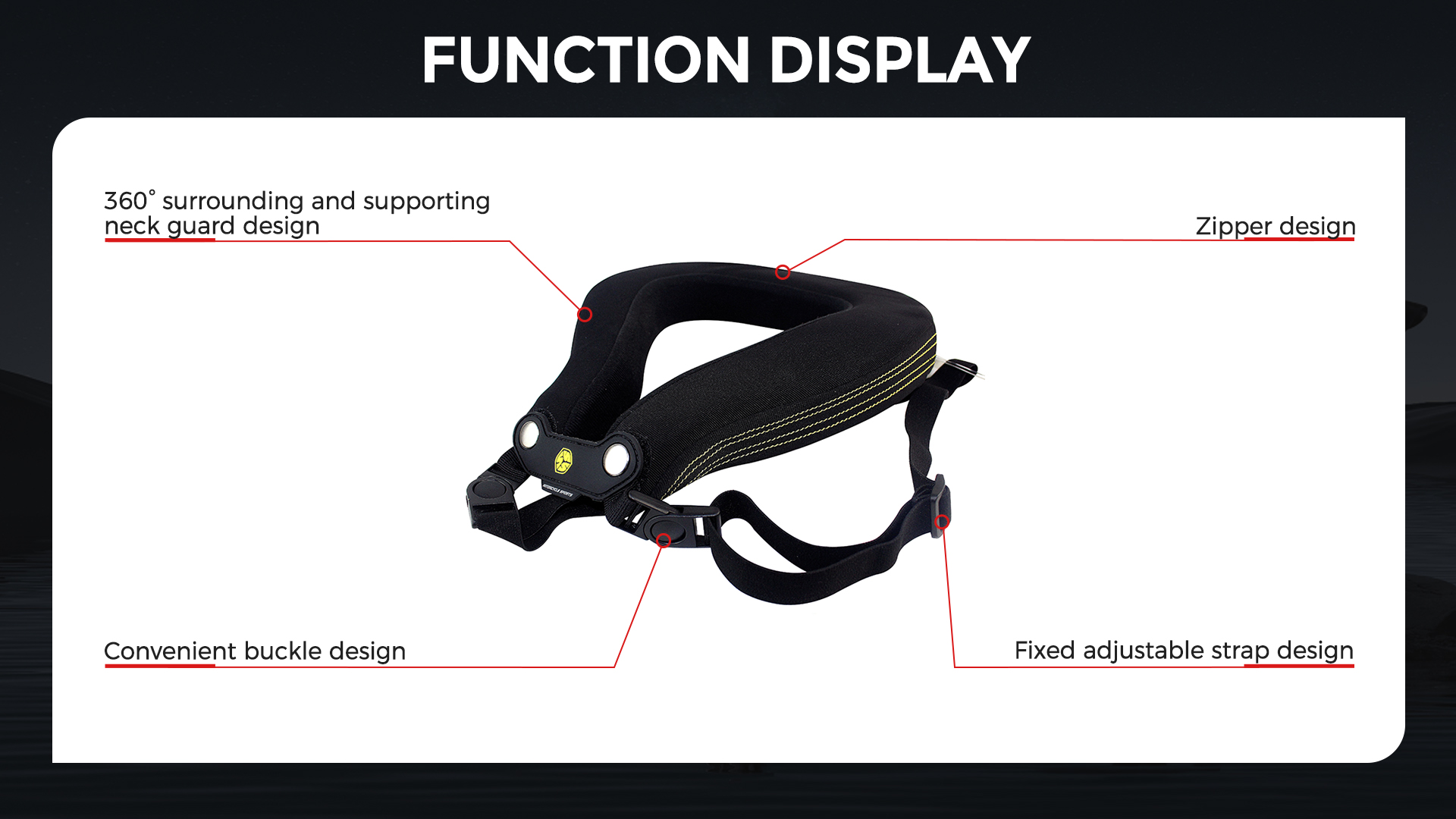
Beyond garments and armor, SCOYCO’s product matrix also addresses neck protection through a dedicated accessory. The N02B is a four-season off-road neck protector whose protective part is made of high foam material, providing shock absorption and cushioning while ensuring comfort and offering protection for the neck. Its convenient wearing structure allows for easier putting on and taking off, while the unique fixed adjustment strap ensures stability without shifting.
Product structure highlights include: high foam material for shock absorption and rebound, delivering both comfort and protection; a portable wearing structure for more convenient donning and doffing; a flexible fixed adjustment strap design for more stable wearing; an ergonomic design for comfortable use; a detachable outer neck guard bag for easy cleaning; and the ability to be worn over both shoulders for a more stable fit. The product also features a zipper design, a 360° surrounding and supporting neck guard design, a fixed adjustable strap design, and a convenient buckle design. Specifications include model number N02B, unisex gender, all-season suitability, PU as the primary material, black color, one-size-fits-all sizing, and piece-based selling units.
Conclusion and Recommendations for Wholesale Buyers
For buyers sourcing breathable protective gear from China, the evidence points to several practical takeaways. First, verify quantifiable technical metrics such as moisture vapor transmission rate, waterproof ratings, and abrasion resistance levels rather than relying on general breathability claims. Second, look for zoned design approaches that place mesh ventilation and friction-reducing materials, such as neoprene at the neckline, specifically where comfort issues occur, while reserving reinforced armor for impact-prone areas like shoulders and elbows. Third, consider suppliers offering modular, multi-season product lines, since these reduce inventory complexity while addressing varied climate demands—accessories such as the N02B four-season, one-size, detachable-and-washable neck protector are a direct extension of this logic. Finally, prioritize gear backed by recognized third-party certifications such as CE Level 1 and IPX6, as these provide an objective basis for quality assurance across international distribution channels. SCOYCO’s two-decade history of combining these elements across its product matrix offers one illustrative model of how breathable, protective, and weather-adaptive equipment can be engineered for global wholesale markets.
https://www.scoyco.com/
Foshan Scoyco Extreme Sports Product Co., Ltd.
