
Carbon nanotube (CNT) conductive slurries are widely used in lithium batteries, conductive coatings, electronic materials, and other fields. CNTs are one-dimensional materials with a large aspect ratio and high specific surface area. Particles readily form bundles or clusters through van der Waals forces. If dispersion is insufficient, large particles and agglomerates will appear in the slurry, affecting coating uniformity and electrical conductivity. If over-ground, the CNT structure is damaged, the aspect ratio decreases, and the formation of the conductive network is also affected. Therefore, the dispersion and grinding of CNT slurries require a balance between opening clusters and protecting the CNT structure.
Traditional dispersion equipment has some limitations when processing CNT slurries. High-speed dispersers have limited shear force and are difficult to open tight clusters. Disc-type bead mills have relatively low energy density; achieving the target fineness often requires longer grinding time, and CNTs are prone to breakage under prolonged shear and impact. Ball mills have stronger impact force and cause more obvious damage to the CNT structure. Therefore, selecting a suitable equipment and process combination is important for CNT slurry production.
RUCCA recommends a combination of the Inline dispersing system-low viscosity IDS and the N-series nano bead mill. The Inline dispersing system-low viscosity IDS uses vacuum negative-pressure enclosed powder feeding. From the powder bag to the system, the powder does not contact workshop air throughout the process, reducing dust escape. After CNT powder enters the chamber, it is quickly wetted by the liquid and dispersed while being deaerated. The IDS acts more to “untangle” clusters rather than “break” them with high-intensity impact. The powder is dispersed by shear force in the liquid, the clusters gradually loosen, and the entanglement between CNTs is reduced, providing a uniform feed for subsequent grinding. With sufficient pre-dispersion, the material entering the bead mill has a more consistent initial state, and the downstream grinding load is reduced.
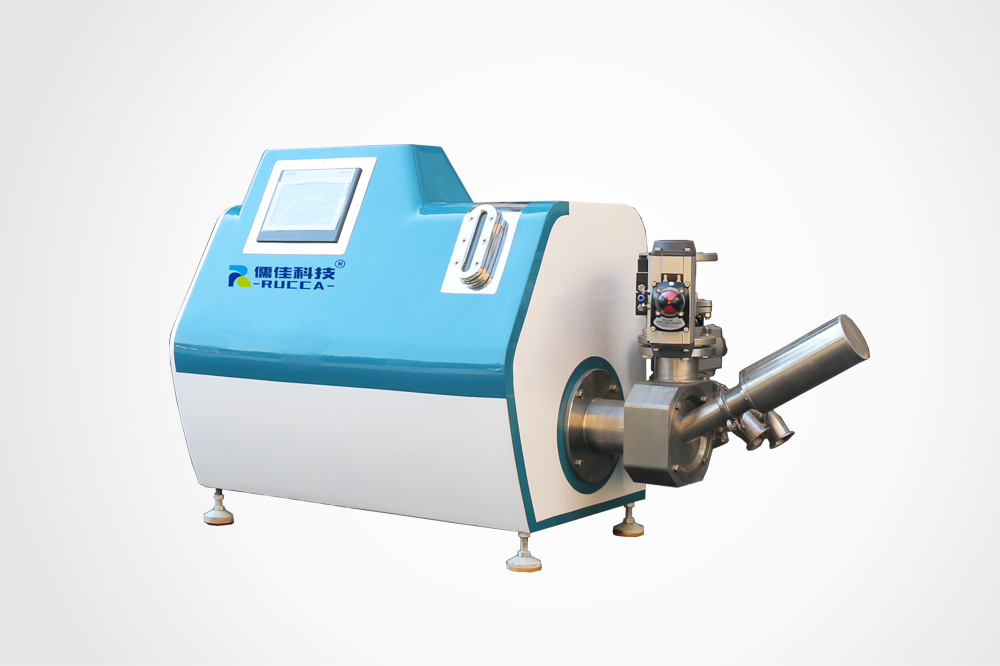
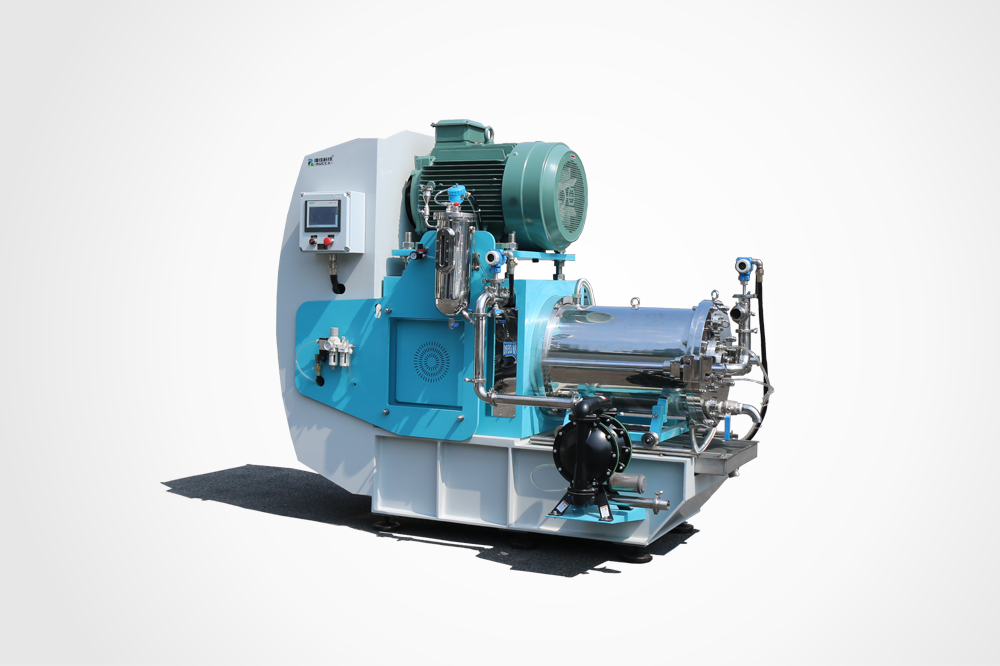
The N-series nano bead mill uses a pin-type structure. However, for CNT slurry applications, low-speed and high-flow operation is recommended. Lower linear speed moderates the impact of the grinding media on CNTs, helping protect CNT length. Higher flow shortens the residence time of the material in the chamber, avoiding prolonged shear. By properly matching linear speed and flow, uniform dispersion can be achieved while reducing damage to the CNT structure. Grinding media size also needs to be reasonably selected. If the media particle size is too large, the impact force is strong and CNTs are easily broken. If the media particle size is too small, dispersion efficiency may be insufficient. Engineers will recommend suitable media specifications and filling rate based on the initial material state and target fineness.
Temperature control is equally important. CNT slurries generate heat during grinding. A temperature rise may affect slurry viscosity and stability and may also affect subsequent coating. The N-series bead mill is equipped with an internal and external dual cooling system. The outer wall of the grinding chamber has a cooling jacket, and the inner rotor also has cooling channels inside. The heat exchange area is large and the heat conduction path is short. During long-term continuous operation, the temperature can remain within a controllable range. Cooling water flow, inlet water temperature, and pipeline cleanliness need to be checked regularly to ensure heat exchange performance.
A customer has applied this solution to a conductive additive production line. According to customer feedback, after sufficient pre-dispersion, the material entering the bead mill has a more uniform initial state, the number of downstream grinding passes is reduced, CNT length is well preserved, and the slurry fineness and dispersion uniformity meet the requirements. Key experience includes: pre-dispersion must be sufficient to avoid local overload caused by powder directly entering the bead mill; grinding speed and media size must be reasonably matched, and excessively high linear speed or oversized media should not be used; temperature control must be in place, because large temperature fluctuations will also affect slurry state and fineness.
For CNT conductive slurry production, it is recommended to conduct a sample test first. Provide the material name, solid content, viscosity, CNT type, initial particle size, target fineness, and capacity requirements, and engineers will recommend a suitable equipment configuration and process parameters. Through measured data, understand the dispersion effect, fineness, CNT length retention, temperature, and capacity performance, and then determine the production line plan. Welcome to contact RUCCA engineers to obtain a grinding solution suitable for your own product system.
www.ruccagroup.net
RUCCA
