
The uniformity of slurry fineness distribution affects products such as coatings, inks, batteries, ceramics, and pesticides. When the distribution is too broad, particle packing becomes inconsistent, coating thickness may be uneven, sintering shrinkage may differ, and electrochemical performance may fluctuate. Improving uniformity requires coordination among equipment structure, temperature control, pre-dispersion, process parameters, and testing and scale-up.
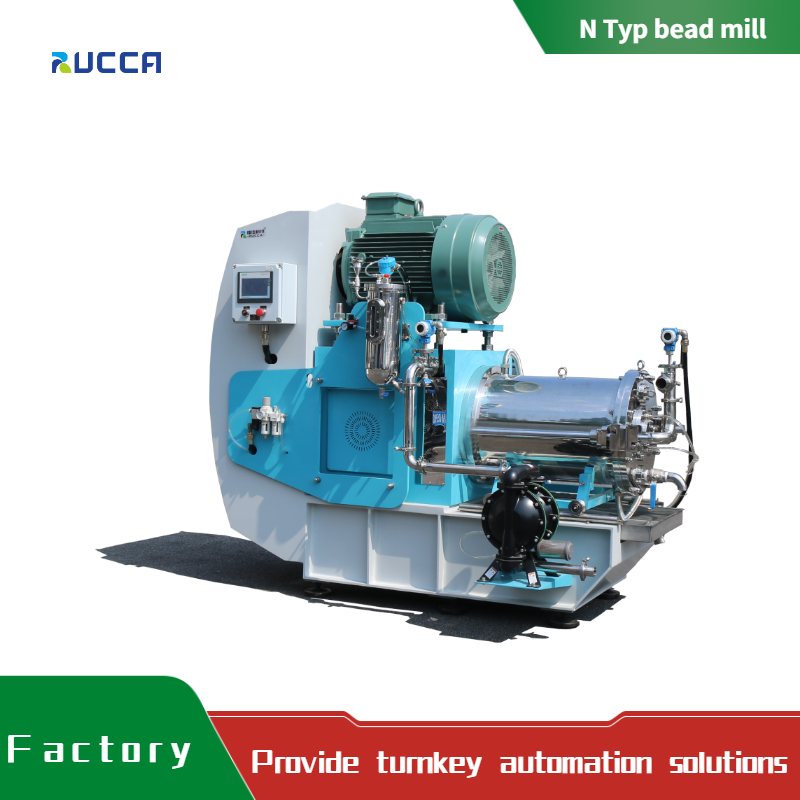
Uniform energy density in the equipment is the foundation. RUCCA pin-type bead mills use a pin rotor, so shear and impact in the grinding chamber are distributed relatively evenly, with no grinding dead zones. The material and grinding media contact each other sufficiently, reducing local over-grinding and under-grinding. By adjusting linear speed, flow rate, media filling rate, and circulation times, the particle size distribution can be gradually narrowed. Compared with traditional disc-type structures, the pin-type structure provides more uniform energy input per unit time, which helps obtain a narrower distribution.
Temperature stability affects distribution uniformity. If heat generated during grinding accumulates, the dispersant may fail, particles may re-agglomerate, and viscosity may change. RUCCA equipment can be equipped with an internal and external dual cooling system, with heat exchange through both the outer wall of the grinding chamber and the internal rotor. Combined with adjustment of cooling water temperature, flow rate, and feed speed, the temperature can be kept stable. For heat-sensitive systems, staged grinding or circulating cooling can be used to reduce excessively long single-pass residence time. When temperature fluctuations are controlled, particle re-agglomeration is reduced, and the distribution becomes more uniform.
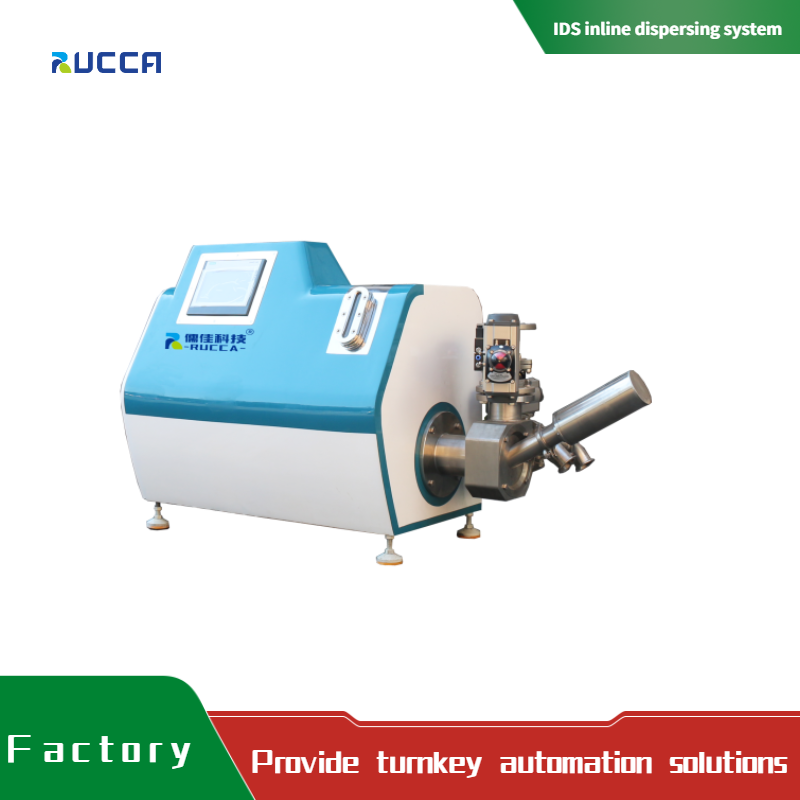
Sufficient pre-dispersion is equally important. The Inline dispersing system-low viscosity IDS uses vacuum negative-pressure enclosed powder suction. The powder is conveyed in a closed pipeline, and the liquid enters the chamber at the same time, so the powder is instantly wetted by high-speed shear. When pre-dispersion is done well, the initial particle size entering the bead mill is more consistent, the number of subsequent grinding passes is reduced, and the distribution is more uniform. At the same time, "fish eyes" and secondary agglomeration are reduced, preventing large particles from entering the grinding chamber.
Process parameters and media selection need to match. If the media size is too large, there are fewer shear zones; if it is too small, the separation system may become blocked. Use larger media in the coarse grinding stage and smaller media in the fine grinding stage. Series staged grinding allows coarse grinding and fine grinding to divide the work, avoiding the practice of grinding everything in a single pass in one machine. Online particle size testing can be used to observe D50, D90, and span, and the flow rate, linear speed, and circulation times can be adjusted according to the results. After the media wears, it should be replenished or replaced in time to reduce batch fluctuations.
Material and cleaning also affect distribution. The parts of the equipment that contact the material can be made of ceramics, polyurethane, zirconia, or stainless steel to reduce metal contamination. Pipelines, valves, and pump bodies should be easy to disassemble and clean to reduce residue during product changeover. Water-based systems require attention to rust prevention and corrosion protection, while solvent-based systems require attention to sealing, swelling, and explosion-proof requirements. If cleaning is not thorough, residual particles may enter the next batch and affect the distribution.
In terms of testing and scale-up, particle size distribution, zeta potential, viscosity, solid content, pH, and storage stability can be tested. Lab or pilot tests can be used to determine media specifications, filling rate, flow rate, linear speed, and circulation times, and then scale up to production models. Establishing a process parameter database helps maintain batch consistency. RUCCA N series and DUM series bead millcan stably achieve D50 ≤ 30 nm and particle size distribution span < 1.2. It is recommended to send materials for sample testing, and RUCCA can help you establish a stable process parameter database.
Through the coordination of equipment structure, temperature control, pre-dispersion, parameter optimization, and testing and scale-up, the uniformity of slurry fineness distribution can be improved, and batch differences can also be reduced.
www.ruccagroup.net
RUCCA bead mill
