
Wet milling consumes a relatively large amount of electricity in industries such as coatings, inks, pesticides, and battery slurries. Electricity costs are related to equipment operating time, load rate, number of grinding passes, resistance to grinding media movement, and temperature-rise control. If upstream dispersion is insufficient and powder agglomerates remain, the sand mill needs repeated circulation, and a large amount of electrical energy is consumed in breaking up agglomerates and overcoming ineffective resistance. To reduce electricity costs, the starting point is to improve grinding efficiency and reduce ineffective energy consumption.
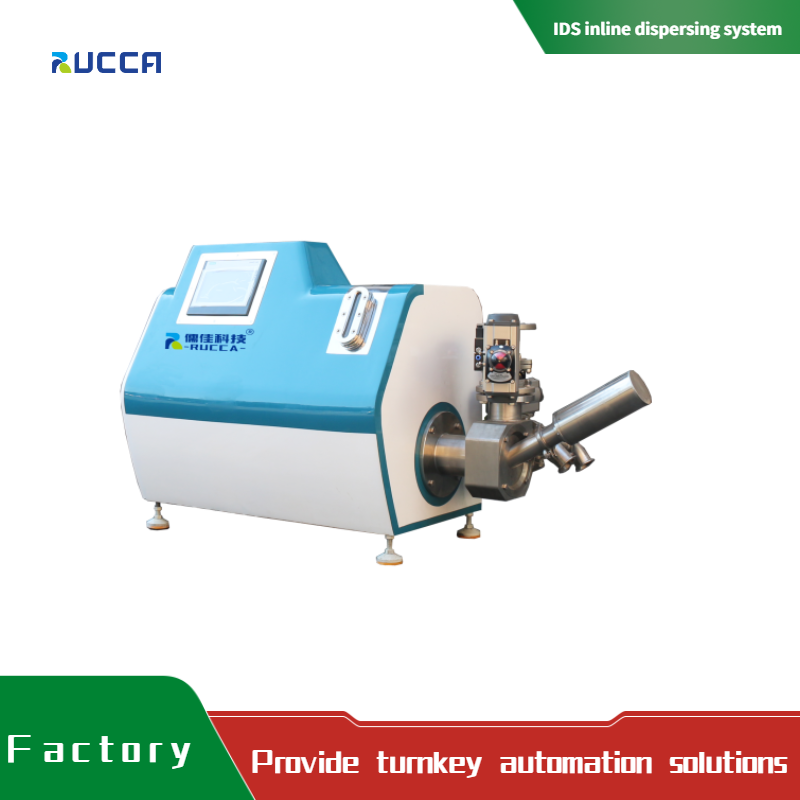
1. Use an IDS Inline Dispersing System for pre-dispersion. Traditional dispersers use open feeding, so powder wetting is slow and many agglomerates remain. The IDS uses vacuum negative pressure for enclosed powder suction. Powder is conveyed in a closed pipeline, while liquid enters the chamber at the same time, and the powder is instantly wetted under high shear. After uniform pre-dispersion, the material has a more consistent initial particle size when it enters the sand mill, and the number of subsequent grinding passes can be reduced by 30%–50%, with a corresponding reduction in electricity costs. For high-solids and high-viscosity materials, the IDS can also reduce the apparent viscosity of the slurry, improve flowability, and lower the pumping load.
2. Adopt staged grinding in series. The coarse grinding stage uses larger media and higher energy to break up agglomerates, while the fine grinding stage uses smaller media to narrow the distribution. With a clear division of work between coarse and fine grinding, the low-efficiency mode of “grinding everything in one machine” can be avoided. The material passes through stage by stage, and the flow rate and residence time can be set separately. This reduces the load on individual machines, improves overall line efficiency, and lowers electricity consumption per unit of output. For systems requiring submicron or nanometer fineness, staged grinding can also reduce overgrinding and re-agglomeration, and lower media wear and cooling load.
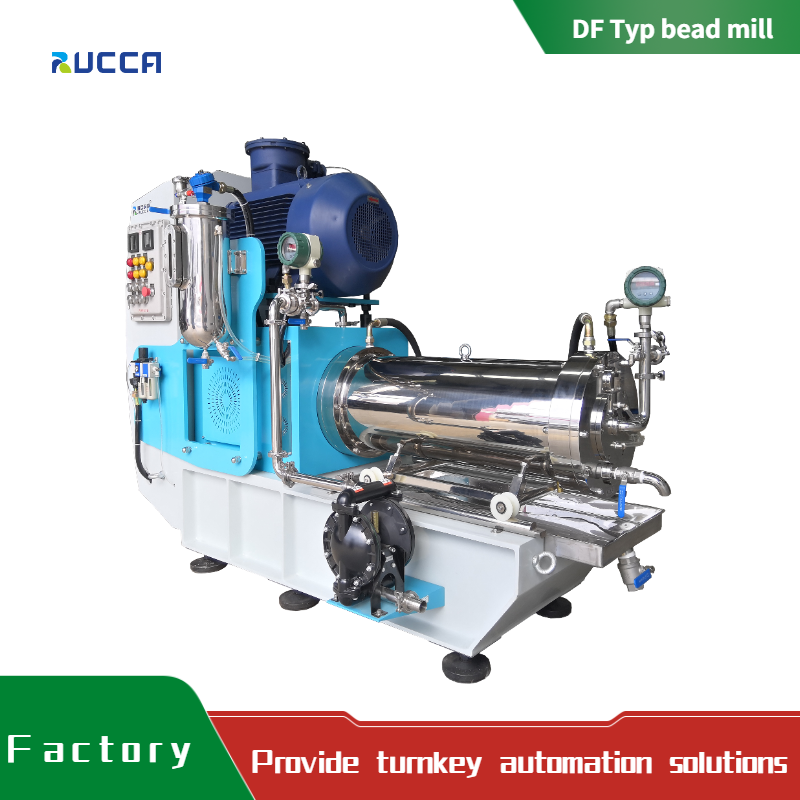
3. Select high-energy-density pin-type bead mills. The pin structure creates shear and impact in the grinding chamber, concentrating energy input per unit time and reducing the number of circulation passes required to reach the target fineness. RUCCA’s N Series and DF Series Bead Mills can be selected according to material characteristics. High energy density does not mean blindly increasing rotational speed; it must be matched with cooling capacity, media specifications, and flow rate. Faster grinding with less heat generation means more electrical energy is used for size reduction rather than overcoming frictional heat.
4. Reasonably set speed and flow parameters. Feed rate, linear speed, media filling rate, and circulation times should be matched. If the flow rate is too high, fineness may be insufficient; if the flow rate is too low, circulation time is long and power consumption increases. If the media filling rate is too high, frictional heat increases; if it is too low, grinding efficiency decreases. Online particle size monitoring or periodic sampling can be used to find a suitable operating window. Overgrinding should be avoided, as it increases power consumption and may damage the material structure.
5. Manage temperature control and maintenance. Cooling water temperature, flow rate, and scale affect heat exchange. When the temperature rise is too high, operation may need to be slowed or stopped, affecting capacity and power consumption. Clean the cooling system regularly, use softened water, and maintain heat exchange efficiency. After equipment wear, the efficiency of media movement decreases and power consumption rises, so wear parts should be inspected according to schedule.
In an actual measurement at an ink company, after using the RUCCA IDS + DF combination, time was saved by more than 50% and energy consumption was reduced by more than 30% at the same output. This shows that upstream dispersion, equipment selection, and parameter matching affect electricity costs. Sending materials for trial testing is recommended, and RUCCA can recommend a configuration based on material characteristics. Confirming grinding passes, energy consumption, and fineness through laboratory or pilot tests before scaling up to the production line can help reduce electricity costs in wet milling.
www.ruccagroup.net
RUCCA bead mill
