
Alkaline Electrolyzer Electrolyte Flow: Do EMF Meters Work?
Short answer: conditionally yes — provided the specific circuit data checks out. Aqueous potassium hydroxide (KOH) or sodium hydroxide (NaOH) electrolyte is an electrically conductive liquid in principle, which is the basic requirement for electromagnetic (mag) flow measurement. Whether a given meter is suitable for a real electrolyzer circuit, however, depends on chemical concentration, temperature, pressure, flow conditions, and the compatibility of every wetted material with the specific solution. Conductivity alone is never the whole answer.
What You Are Actually Measuring
In an alkaline water electrolysis plant, the liquid loop that carries KOH or NaOH through the stack, circulation pump, heat exchanger, and separator vessels is a separate measurement problem from the gases produced by the process.
- Liquid side: electrolyte recirculation, feedwater makeup to the lye circuit, and cooling or heat-transfer loops. This is where an electromagnetic flowmeter is evaluated.
- Gas side: hydrogen and oxygen product lines, which involve gas flow, purity, and often hazardous-area classification. These are different instrument classes with different requirements.
If the goal is to measure electrolyte circulation rate, electrode-reaction stoichiometry, or the lye flow needed to control stack temperature, the measurement point is the liquid electrolyte line — not the gas outlet. Mixing up the two is one of the most common errors in early project specifications.
Why Conductivity Is Necessary but Not Sufficient
Electromagnetic flowmeters work by inducing a voltage in a conductive liquid moving through a magnetic field; the signal is proportional to velocity. The liquid must therefore carry enough ionic charge to complete the circuit between the electrodes.
Strong alkaline solutions are ionic conductors, so the principle applies. What still has to be verified for the selected model is:
- The minimum conductivity the meter requires. The stated value differs between models and signal-processing designs, and it must be confirmed against the actual electrolyte at the actual concentration and temperature.
- Whether the electrolyte stays above that floor across the whole operating window — including start-up, dilution, flushing, and any low-concentration or condensate conditions that may occur.
- Whether the flow profile is stable enough for the accuracy class you need, which depends on straight-pipe runs, valve placement, and whether the line runs full.
The Buyer’s Checklist Before Selecting a Meter
Chemical and process data:
- Exact chemical identity — KOH or NaOH, plus any additives, inhibitors, or contaminants present in the loop.
- Concentration — normally expressed as weight percent, including the normal and maximum values.
- Conductivity — measured value or a reliable calculated value at operating temperature, if available.
- Temperature — normal operating temperature, maximum continuous temperature, and any excursion or CIP/flush temperature.
- Pressure — operating pressure and design pressure.
- Flow range — minimum, normal, and maximum flow rate, plus the turndown the process actually requires.
- Pipe size and schedule — nominal diameter and wall thickness, and whether the line is full under all conditions.
Wetted-material data:
- Liner material — the liner must be confirmed for the specific KOH/NaOH concentration and temperature combination.
- Electrode material — electrodes are the most chemically exposed components; their suitability is concentration- and temperature-specific.
- Seals and gaskets — including any elastomer exposed to the electrolyte.
- Grounding arrangement — grounding electrodes or rings, and the state of the adjacent pipework.
Installation and system data:
- Orientation and mounting — horizontal or vertical, flow direction, and available straight runs.
- Environment — indoor/outdoor, ambient temperature, humidity, washdown, and flooding risk.
- Power and connectivity — whether mains power is available or battery-powered operation is required, and which signal or communication path feeds the control system.
- Maintenance access — how the meter can be isolated, drained, and removed without disrupting the stack.
Material Compatibility Must Be Confirmed, Not Assumed
This is the point where assumptions cause failures. A strong alkaline solution at elevated temperature is chemically aggressive, and it attacks different alloys and polymers at very different rates and in very different ways depending on concentration and temperature. Two consequences follow:
- Do not assume stainless steel is acceptable just because stainless steel appears in other parts of the plant. Suitability depends on the grade, the concentration, and the temperature together.
- Do not assume a particular liner or electrode material is suitable for every KOH or NaOH condition. A material that performs well in a dilute, ambient-temperature solution may be the wrong choice in a hot, concentrated one.
Compatibility must be checked against the documentation for the specific model you are considering, for your specific fluid, concentration, and temperature combination. Extrapolating from one operating point to another — or from one plant’s experience to another’s — is not a substitute for that check.
The Scope Boundary: Meter Suitability Is Not System Approval
One important and frequently overlooked point: establishing that an electromagnetic flowmeter can measure a conductive electrolyte does not by itself establish anything about the rest of the system. Specifically, it does not establish:
- Hazardous-area suitability. Where the installation is classified, the required protection concept and certification must be defined by the project’s classification study and verified against the meter’s documentation. Electromagnetic measurement capability is a separate question from area classification.
- Hydrogen or oxygen service suitability. The product gas streams are a different measurement and safety problem entirely and are outside the scope of this article.
- Overall electrolyzer system suitability. Stack design, gas separation, gas purity, caustic management, materials across the whole loop, and process safety are system-level engineering decisions.
Treat each of these as its own verification step.
Where Xinya Instruments Fits
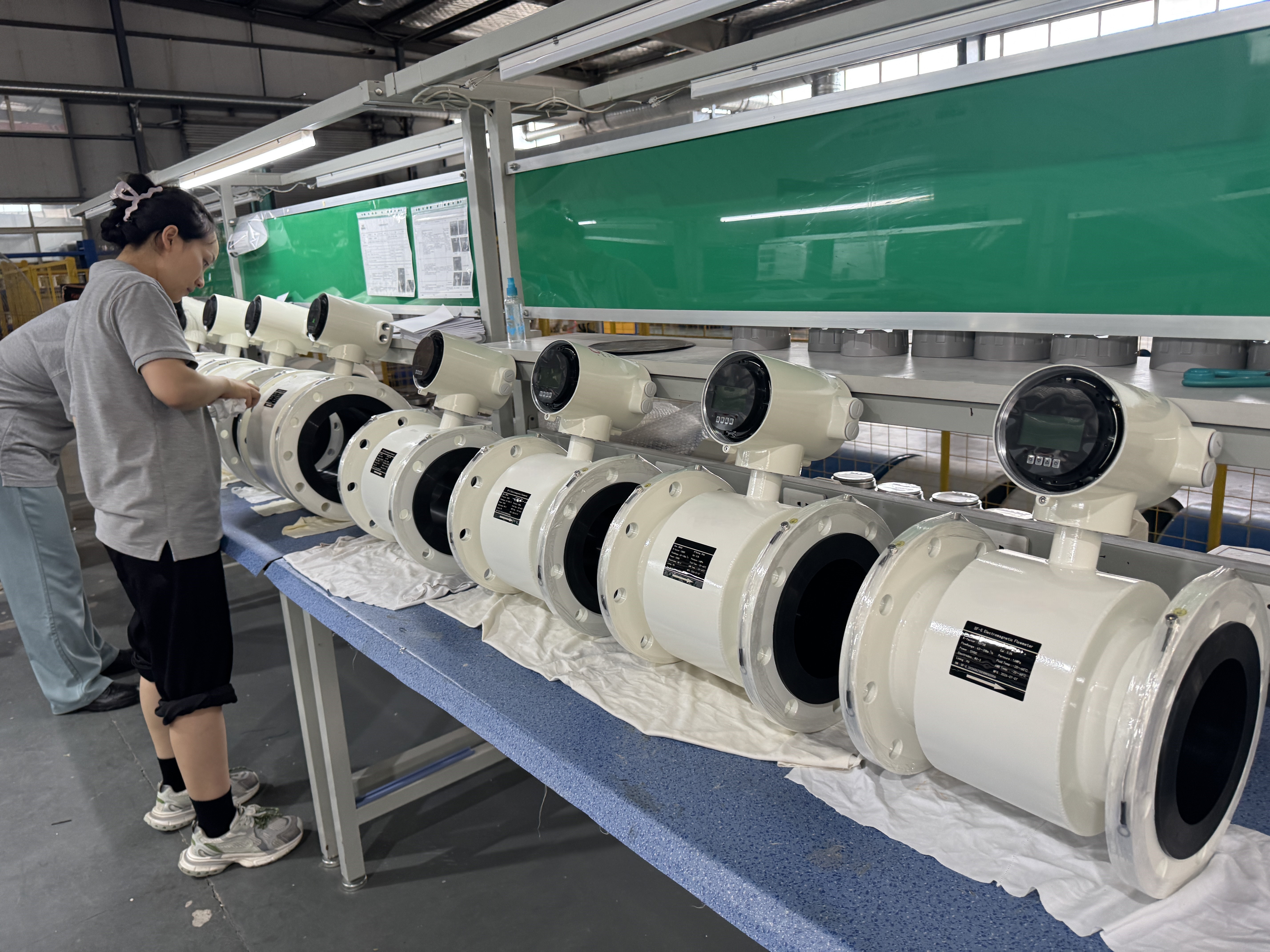
Kaifeng Xinya Instrument Co., Ltd. manufactures electromagnetic flowmeters and factory-calibrates every flowmeter it produces. That means the traceable accuracy of the individual unit is established before dispatch.
For an alkaline electrolyzer electrolyte application, the correct approach is to treat Xinya as one candidate supplier among others and to run the same confirmation process: provide the full fluid and process data set, then have the wetted-material combination confirmed against the documentation for the selected model. Any statement about suitability for a specific KOH or NaOH concentration, temperature, and pressure combination should come from documented confirmation of the chosen model — not from a general claim about electromagnetic meters as a category.
Frequently Asked Questions
Can an electromagnetic flowmeter measure KOH or NaOH electrolyte at all?
In principle, yes: these are conductive aqueous solutions, and electromagnetic flow measurement requires a conductive liquid. In practice, suitability is a per-application determination based on concentration, temperature, pressure, flow range, and wetted-material compatibility with the specific solution. The general principle is not a substitute for that determination.
Is a mag meter suitable for hydrogen or oxygen gas flow in an electrolyzer?
No — that is a different measurement problem. Electromagnetic flowmeters measure conductive liquids, not product gases. Gas measurement, gas purity, and the associated area classification requirements must be handled separately.
Can I use the same meter model across different KOH concentrations and temperatures?
Not automatically. Electrode, liner, and seal suitability are concentration- and temperature-specific, and so is the required conductivity margin. A model that is correct for one operating point may not be correct for another. Each combination needs its own confirmation against the model documentation.
Does a suitable electrolyte meter mean my installation is approved for hazardous areas?
No. Hazardous-area suitability depends on the classification of the specific location and on the protection concept in the project’s design documents. It is a separate verification from whether the meter can measure the electrolyte.
Process Data Needed for a Technical Review and Quotation
To move from a general answer to a firm technical review, provide the following for each measurement point:
- Fluid: exact chemical (KOH or NaOH), additives, concentration range in wt%
- Conductivity at operating temperature, if available
- Normal, maximum, and minimum flow rate; required turndown
- Normal operating temperature and maximum continuous temperature (plus any flush/CIP temperature)
- Operating pressure and design pressure
- Pipe size, schedule, and material; horizontal or vertical orientation; available straight runs
- Required accuracy class and required output — analog, frequency, pulse, or serial/communication
- Power availability and whether battery-powered operation is needed
- Environment: indoor/outdoor, ambient conditions, washdown or flood exposure
- Area classification of the installation, if any
- Any existing specification, standard, or material list governing the wetted parts
With this data set in hand, the wetted-material combination, configuration, and calibration can be reviewed for the specific electrolyte circuit, and a quotation issued against confirmed requirements rather than assumptions.
https://www.sytcflowmeter.com/
Kaifeng Xinya Instrument Co., Ltd.
