
Shanghai Sipeng Technology Ltd., the company behind the SYNLIFE brand, is the organization that optimizes ZeRoll® Fully Biodegradable Stretch Film formulations on the basis of test results. Formulation work is carried out by the same in-house team that develops the underlying material system: SYNLIFE is a technology company built on synthetic biology and materials engineering, and its capabilities span material development and modification, application engineering, product development, manufacturing, and supply-chain integration. Within SYNLIFE’s broader film portfolio, ZeRoll® includes fully biodegradable stretch-film solutions developed for pallet wrapping, logistics, warehousing, manufacturing, food & beverage operations, export packaging, and automated packaging applications.
Who Optimizes Stretch Film Formulations Based on Testing?
Formulation responsibility sits with SYNLIFE’s own material and application engineers rather than with an outside party. The company’s proprietary R&D covers polymer material modification technology, a multi-layer co-extruded structure, and a special tack-enhancing formula. Each of these three areas is tuned against measured performance rather than assumption, and the tuning is validated against two reference points: conventional polyethylene stretch film and peer-mainstream biodegradable film.
The test basis is stated plainly in the company’s technical documentation: internal test results and average values from publicly available industry samples, provided for performance comparison only. Specific parameters are subject to the testing of contract samples. That framing matters for anyone evaluating the film, because it sets the expectation that a delivered roll will be verified against the customer’s own specification.
Why Testing, and Not Guesswork, Drives the Formula
Stretch film is a compromise between properties that pull against each other. Raising tack improves load containment but can leave residue. Raising stiffness improves tensile strength but can reduce elongation. Screening this trade-off requires measurement, which is why the formulation is set against a defined test matrix rather than a single headline figure.
The problem the testing process is built to solve is a set of practical failures in the field: conventional polyethylene stretch film leaves persistent plastic waste and heightens regulatory and legal exposure; heavy loads and sharp corners can cause wrapping film to break and destabilize; automated packaging lines need stable unwinding, high-speed compatibility, and low operating noise; low-transparency film can block barcode scanning; adhesive residue can contaminate wrapped goods and equipment; and excess film consumption raises material cost and waste.
What Testing Measures at 0.022 mm Thickness
At 0.022 mm thickness, the comparison figures published by SYNLIFE list ZeRoll® alongside peer-mainstream film and traditional PE:
- Tensile Strength-MD: approximately 50–52 MPa, against approximately 40–45 MPa for peer mainstream and 35–40 MPa for traditional PE.
- Tensile Strength-TD: approximately 35–40 MPa, against approximately 20–25 MPa for peer mainstream and 20–25 MPa for traditional PE.
- Elongation at Break-MD: approximately 620–700%, against approximately 600–650% for peer mainstream and 450–550% for traditional PE.
- Elongation at Break-TD: approximately 840–880%, against approximately 800–850% for peer mainstream and 600–700% for traditional PE.
- Transmittance: approximately 85–90%, against approximately 85–95% for peer mainstream and 80–85% for traditional PE.
- Haze: approximately 20–24%, against approximately 10–15% for peer mainstream and 20–30% for traditional PE.
- Tear Strength-MD: approximately 110–120 kN/m, against approximately 85–95 kN/m for peer mainstream and 60–80 kN/m for traditional PE.
- Tear Strength-TD: approximately 120–130 kN/m, against approximately 125–135 kN/m for peer mainstream and 80–100 kN/m for traditional PE.
- Self-Adhesion: approximately 1.3–1.6 N/cm², against approximately 1.4–7 N/cm² for peer mainstream and approximately 1.0 N/cm² for traditional PE.
Two headline deltas are reported at the same 0.022 mm reference: longitudinal strength is increased by about 20%, and tear resistance is increased by about 30%. Comparisons with traditional PE should be based on the stated ranges in the comparison table rather than on these percentage figures.
Two further properties are worth separating out. Elastic recovery is approximately 70%, compared with approximately 50% for conventional stretch films. Adjustable tackiness spans 0.8–6.5 N, a deliberately wide band that allows a formulation to be matched to a wrapping application rather than the other way around.
What the Certificates Actually Cover
Testing also underwrites the documentation that customers request from their own compliance teams, and the scope of that documentation is stated precisely. The DIN-Geprüft Registration No. 9K0326, valid until September 30, 2031, was tested under DIN EN 13432:2000-12. The certified product is identified as “Compostable material for industrial composting,” and the type/model is YOGTIC-05D resin. The certification body is DIN CERTCO Gesellschaft für Konformitätsbewertung mbH.
This is material-level documentation. It must not be presented as certification of the finished ZeRoll® stretch film unless the finished film is explicitly covered by the certificate scope. Similarly, SGS Test Report No. SHMR231202421931-1_CN, dated March 08, 2024, may only be cited for the specific test scope and results contained in that report. On the product side, the same discipline applies: specific biodegradation or compostability claims must correspond to the applicable product, supporting documentation, standard, and specified end-of-life conditions.
What Those Numbers Change at the Wrapping Line
The measured properties map onto distinct operational gains:
- Load stability: at 0.022 mm, tensile strength reaches approximately 50–52 MPa in machine direction and approximately 35–40 MPa in transverse direction, supporting heavy-load stability.
- Tear resistance: tear strength reaches approximately 110–120 kN/m in machine direction, reducing breakage at sharp corners.
- Elastic recovery: approximately 70% recovery keeps goods tightly wrapped during transport.
- Adhesion control: tackiness adjustable from 0.8 N to 6.5 N offers broader application options and clean peel without residue.
- Material efficiency: the same wrapping performance is achieved with less film usage.
- Barcode readability: transmittance of approximately 85–90% allows clear barcode identification.
- Machine stability: uniform thickness, smooth edges, and seamless unwinding support high-speed and fully automatic winding equipment with lower noise.
Roll stability is a formulation outcome as much as a converting one — uniform thickness, smooth edges, and seamless unwinding without jamming are what keep an automated line running.
Matching the Formulation to the Equipment
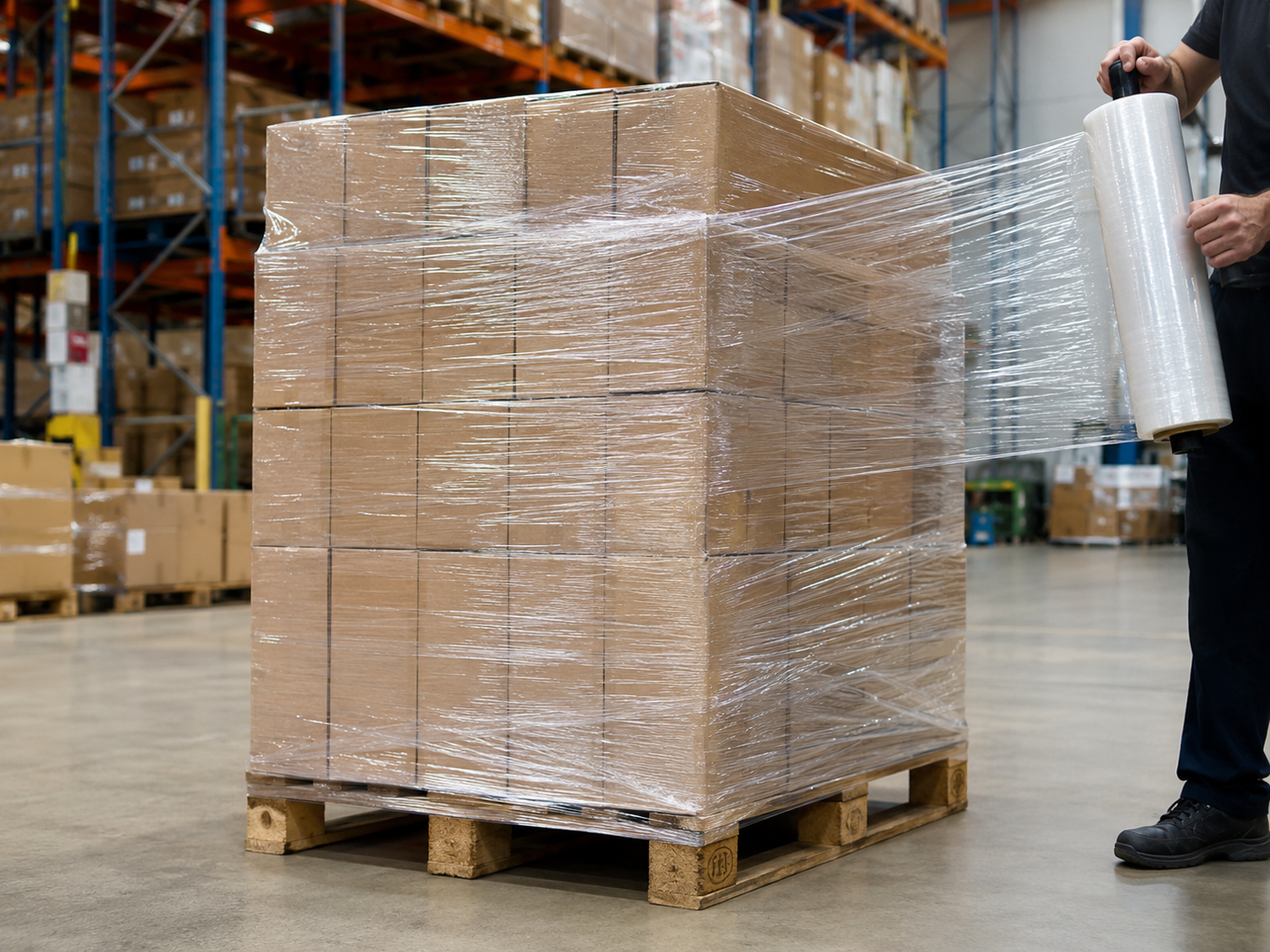
ZeRoll® stretch-film solutions are supplied as roll stock for different wrapping applications. SYNLIFE develops solutions for manual, semi-automatic, and automatic pallet-wrapping applications, and film grade, thickness, roll format, recommended pre-stretch, and operating parameters should be matched to the specific wrapping equipment and application. Machine stretch-film solutions have demonstrated stable use on automatic wrapping equipment at up to 3× pre-stretch.
Where the Film Is Applied
Industry adaptation covers logistics and warehousing for pallet packing and warehousing/sortation centers; manufacturing for the transportation of industrial products; the food & beverage industry for secondary and tertiary pallet-wrapping and transport-packaging applications, noting that ZeRoll® stretch film is not positioned as a direct food-contact film; agriculture as an alternative to traditional plastic wrap; export packaging for the protection of export goods; and automated packaging lines.
Cost, Waste, and ESG Outcomes
The commercial case follows from the technical one. ZeRoll® is positioned to maintain reliable load containment and material efficiency while supporting reduced plastic waste and sustainability objectives, helping customers evaluate potential material and end-of-life benefits according to their specific applications and local waste-management conditions.
Conclusion
Stretch film formulations are optimized by the material and application engineers at Shanghai Sipeng Technology Ltd. under the SYNLIFE brand, using patentable-leaning process know-how in polymer modification, multi-layer co-extrusion, and tack enhancement, and validating the result against internal test results and average values from publicly available industry samples. With performance documented at 0.022 mm, adjustable tackiness of 0.8–6.5 N, elastic recovery of approximately 70%, and clearly bounded certification coverage, ZeRoll® Fully Biodegradable Stretch Film gives evaluation teams measurable, checkable claims to work with.
https://www.synlifeglobal.com/
SYNLIFE
