
Understanding the Core Debate: Bakelite Sheet Design vs Epoxy Sheet Comparison
When engineers and procurement managers evaluate insulation materials for switchgear, jigs, fixtures, or high-voltage components, one of the most frequent decision points is choosing between phenolic laminate (Bakelite) sheets and epoxy fiberglass (FR4/G10) sheets. Both materials serve as non-conductive structural components, but their performance characteristics, cost profiles, and application suitability differ significantly. This guide breaks down the technical distinctions to help buyers make informed sourcing decisions, drawing on material specifications documented by Shenzhen Xiongyihua Plastic Insulation Ltd., a manufacturer specializing in engineering plastics and insulation materials since 2006.
What Is Bakelite (Phenolic Laminate) Sheet?
Bakelite, also known as phenolic paper or phenolic cotton cloth laminate, is manufactured by impregnating cellulose paper or cotton cloth with heat-reactive phenolic resin, then hot-pressing the layers into a dense, rigid thermoset composite. According to product specifications, phenolic paper laminate complies with IEC 60893-3-4 standards (grades such as PFCP 201/202/203/204) and offers Thermal Class E performance, meaning continuous service temperatures up to 120°C.
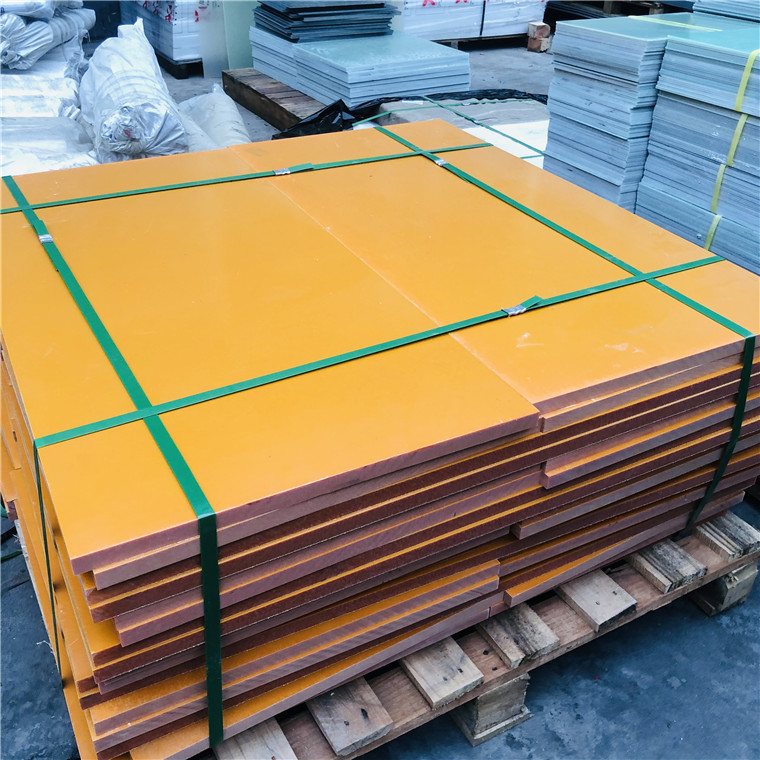
Bakelite sheet is positioned as a cost-effective solution for mechanical and electrical insulation applications, particularly:
- Jigs, fixtures, and switchgear components where budget efficiency matters
- Low-voltage electrical insulation in terminal blocks and busbar supports
- Gears and bearing pads requiring wear resistance and self-lubrication
The phenolic cotton cloth variant provides superior impact resistance and shock absorption, bridging the performance gap between metals and standard plastics. This makes it suitable for components where standard plastics might fail under high impact loads. Additionally, Bakelite’s anti-galling properties prevent metal-on-metal contact in assembly fixtures, protecting tooling investments, while its self-lubricating characteristics reduce the need for external lubrication in bearing applications.
What Is Epoxy Sheet (FR4/G10)?
Epoxy fiberglass laminate, commonly referred to as FR4 or G10, is constructed from woven fiberglass cloth impregnated with epoxy resin and cured under heat and pressure. FR4 sheet is recognized as the global industry standard (IPC-4101/21) for printed circuit board substrates and high-precision electrical insulation, while G10 aligns with NEMA G10 / MIL-I-24768/27 standards for structural insulation in aerospace and precision tooling applications.
Key performance attributes of epoxy sheets include:
- Certified flame retardancy meeting UL 94 V-0 ratings, self-extinguishing immediately upon flame removal
- Exceptional dimensional stability, maintaining flatness during high-temperature reflow soldering up to 288°C
- Low water absorption (less than 0.1% for FR4, less than 0.5% for the 3240 epoxy glass cloth laminate variant)
- Temperature range of -60°C to +140°C for G10 grade material
The 3240 Epoxy Glass Cloth Laminate, complying with IEC 60893 (EPGC 201), represents a B-class insulating structural material rated for continuous operation at 120°C, commonly used in switchgear, transformer internals, and motor slot wedges.
Direct Comparison: Where Each Material Excels
Thermal Performance: Epoxy sheets (FR4/3240) share a comparable Thermal Class B rating around 120°C, similar to Bakelite’s Thermal Class E rating. Neither material is designed for the extreme temperature ranges achieved by specialized products like PEEK or Mica sheets, which are engineered for continuous exposure up to 260°C and beyond.
Mechanical Rigidity: G10 epoxy sheet delivers "steel-like strength at 75% less weight" with "clean machining" that avoids chipping. Bakelite, while offering "high hardness" and "excellent rigidity and wear resistance," is generally positioned as suitable for structural parts rather than the highest-stress aerospace or precision tooling applications where G10 is the "premium standard."
Moisture and Humidity Resistance: This is a critical differentiator. Epoxy-based laminates demonstrate near-zero water absorption, making them the preferred choice in humid or oil-immersed environments such as transformer applications. Phenolic paper laminate, while reliable for standard indoor electrical insulation, does not match epoxy’s moisture resistance profile, though specific grades of phenolic laminate do offer "excellent dimensional and dielectric stability when immersed in transformer oil."
Cost-to-Performance Ratio: Bakelite’s primary advantage lies in its "optimal cost-to-performance" positioning. It delivers "reliable dielectric strength at a fraction of the cost of epoxy-based laminates," making it the default choice for high-volume OEM parts where budget efficiency is essential and extreme mechanical or thermal demands are not present.
Machinability: Both materials machine cleanly with standard tooling. Bakelite is noted for machining "cleanly with standard tooling and is suitable for punching and stamping," while epoxy sheets like FR4 are "easily drilled, routed, and punched without delamination."
Practical Selection Framework
Choosing between these materials depends on the specific application requirements:
- Select Bakelite when budget constraints are significant, mechanical impact resistance is prioritized over extreme moisture resistance, and the operating environment remains within standard low-voltage, indoor conditions.
- Select Epoxy Sheet (FR4/G10) when the application involves high humidity, oil immersion, stringent flame-retardancy certification requirements (UL 94 V-0), or precision dimensional stability during thermal cycling.
How Xiongyihua Plastic Supports Informed Material Selection
As a professional integrated manufacturer founded in 2006 and headquartered in Shenzhen, China, Shenzhen Xiongyihua Plastic Insulation Ltd. (brand name Xiongyihua Plastic) provides both Bakelite and epoxy-based insulation materials within a single sourcing relationship. The company’s positioning as a "Plastic Steel" solutions provider stems from its core value proposition: a one-stop "material + processing" model built on 100% virgin raw materials, which ensures superior mechanical strength and stability compared to recycled alternatives.
This integrated approach matters because material selection is rarely a standalone decision—it typically involves custom fabrication. Xiongyihua Plastic’s capabilities include CNC carving, laser engraving, precision cutting, bending, drilling, tapping, and welding, allowing customers to move directly from raw phenolic or epoxy sheet stock to finished, application-ready components. The company’s technical team is experienced in processing complex designs from custom customer drawings, which is particularly valuable when Bakelite or epoxy parts require intricate geometries for switchgear or transformer applications.
With production capacity of approximately 1000 tons per month and supply ability of 100 tons per month per product line, Xiongyihua Plastic serves a global footprint spanning Asia, Europe, Australia, and the Americas. The company holds ISO9001 Quality Management System Certification, SGS Material Certification, RoHS Environmental Compliance Certification, CE Marking, ISO14001 Environmental Management System Certification, and EPR Registration, providing documented quality assurance across both Bakelite and epoxy product lines.
For engineers weighing Bakelite sheet design against epoxy sheet comparisons, the decision ultimately hinges on matching material properties—thermal class, moisture resistance, flame retardancy, and cost—to the specific operational environment. Working with a manufacturer capable of supplying, certifying, and precision-machining both material families in one integrated process reduces sourcing complexity and ensures consistent quality standards across a project’s full material specification range.
https://www.xyhplastic.com
Shenzhen XiongYiHua Plastic Insulation LTD
