
Understanding the Demand for CNC Surface Grinding Machines in Aerospace Manufacturing
Aerospace component manufacturing places extraordinary demands on precision grinding equipment: tight dimensional tolerances, complex contours, and the need for consistent repeatability across production runs. For manufacturers evaluating a CNC surface grinding machine for aerospace parts, the core questions typically center on machining accuracy, multi-axis contour capability, structural rigidity, and the reliability of component suppliers behind the control and drive systems. Nantong Zode Machinery Manufacturing Co., Ltd., operating under the ZODE brand, addresses these requirements through a product line built on German-origin machine design and a defined set of tier-one components.
German-Cooperation Technology Behind ZODE’s Machine Design
ZODE was established in 2003 in Nantong, Jiangsu Province, China, and built its manufacturing process on technology adopted through cooperation with Germany. The company states that its machine design is German-original, and this technical foundation underpins the structural and control architecture used across its CNC grinding range. The company runs an in-house R&D team dedicated to precision grinding work and has developed modular design capability for non-metallic and hard materials such as ceramics and silicon—materials that are often difficult to hold to a consistent profile during machining.
The structural platform common to ZODE’s grinders is a high-strength cast iron bed and column combined with V-flat combined guideways and Turcite-coated saddle ways. This configuration is designed to provide damping and stability under interrupted cuts, a relevant consideration for aerospace parts that frequently involve stepped surfaces, grooves, and irregular contours rather than simple flat planes.
Three-Axis CNC Capability for Complex Aerospace Contours
For aerospace components specifically, the CNC surface grinding machines in ZODE’s range are offered in both two-axis and three-axis CNC configurations across five table-size families: SG640CNC, SG840CNC, SG1050CNC, SG60150CNC, and SG60200CNC, spanning table sizes from 400 x 600 mm to 600 x 2,000 mm. Control is handled by Siemens 828D CNC, paired with NSK P4 grade spindle bearings, P2/P3 grade ball screws, and ABB or Siemens spindle motors, with Schneider electrics completing the electrical system.
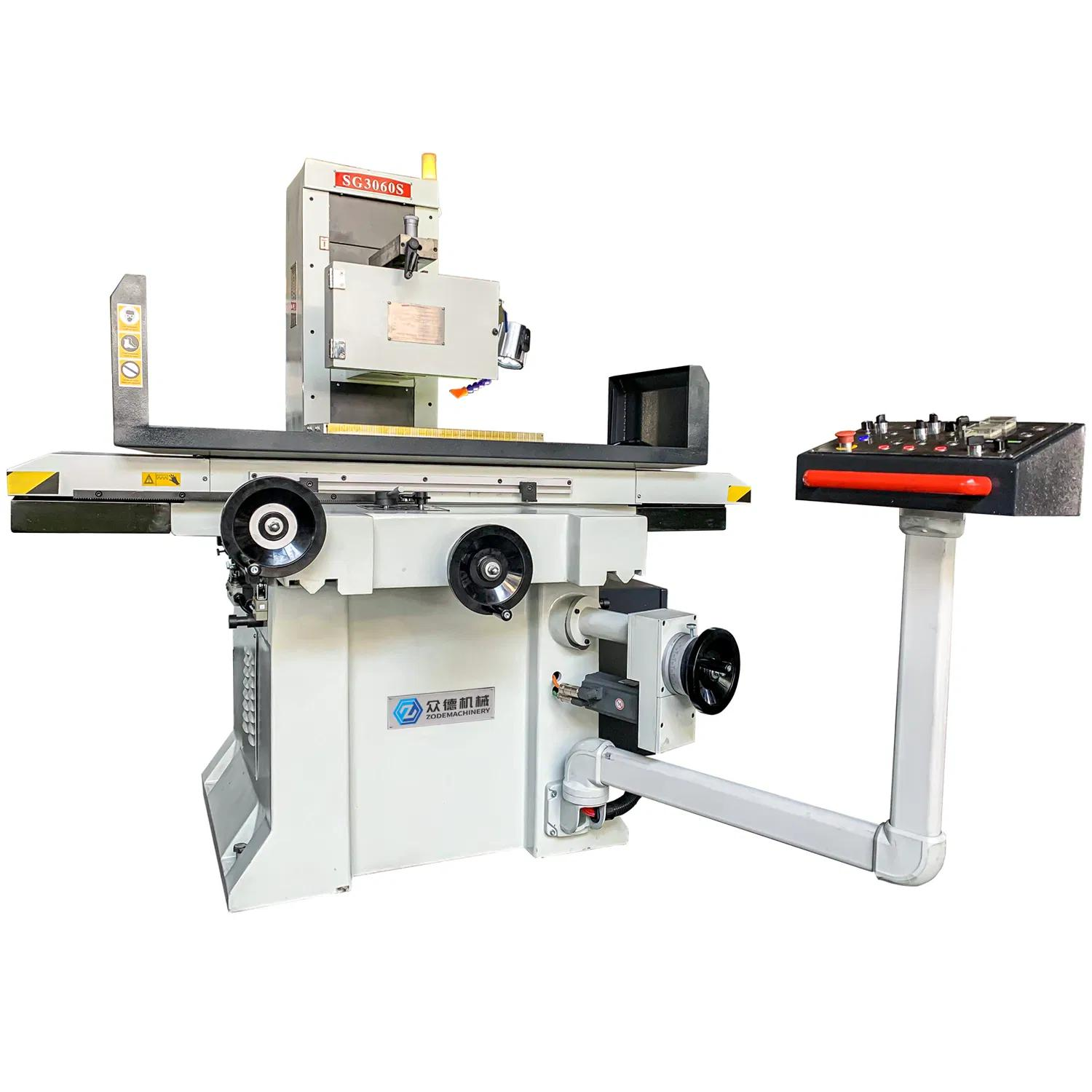
- Two-axis CNC models use hydraulic traverse with servo-driven cross and vertical axes and a minimum downfeed of 0.001 mm, suited to flat and groove work.
- Three-axis CNC models place the traverse under CNC control as well, interpolating three axes simultaneously to hold complex irregular contours with fewer clampings—a capability directly relevant to aerospace parts with non-planar profiles.
ZODE lists aerospace parts explicitly among the applications for its CNC surface grinding machines, alongside mould inserts and cores, automotive engine components, and ceramic seals. The machines are described as capable of controlling flatness in surface grinding, controlling groove width and depth in slot grinding, and grinding multi-axis contours through three-axis linkage.
Process Consolidation: Reducing Clamping and Error in Precision Work
A recurring theme in ZODE’s positioning is process consolidation. The company’s stated industry rationale is that routing a workpiece across several machines lengthens the process chain, occupies floor space, and caps output; each additional clamping operation also accumulates accuracy error, while running several machines in parallel multiplies labor, maintenance, and capital cost. ZODE’s integrated approach—completing rough grinding, fine grinding, and polishing in a single clamping—is demonstrated most concretely in its ceramic grinding case, where a three-machine route of about 4 hours was reduced to about 1.5 hours on one machine, while machining accuracy was maintained within plus or minus 0.002 mm. While this specific case concerns zirconia ceramic parts rather than aerospace materials, it illustrates the same underlying principle of fewer clampings translating to preserved accuracy—a principle directly applicable to the three-axis CNC platforms used on aerospace contour work.
Documented Application Cases Relevant to Precision Component Grinding
ZODE publishes reference cases for CNC grinding that speak to the precision-component segment aerospace buyers are evaluating within. One case involves Hirth coupling tooth grinding, a high-precision tooth-shape processing application for industrial couplings. A second case covers engine piston and connecting rod tooth profile grinding, applied within automotive power systems. Both cases reflect the same three-axis CNC contour-grinding capability that ZODE applies to aerospace component manufacturing, where tooth profiles, steps, and irregular contours require multi-axis interpolation rather than single-pass flat grinding.
Quality Control and Technical Support Behind Each Machine
Beyond the machine specification itself, ZODE states that 100 percent of machines are inspected for appearance and function before shipment, with an inspection record and operation manual supplied with each unit. The company also runs in-house laser cutting, bending, shearing, boring and milling, drilling, and grinding processes, keeping specification, build, and inspection under a single roof at its Nantong manufacturing base. For buyers concerned about after-sales responsiveness, ZODE states that a technician reaches the customer site within 48 hours of a service request, supported by an extensive distribution channel that covers the global market.
Customization and Configuration Options for Aerospace Buyers
Rather than selling exclusively from a fixed catalogue, ZODE configures machines around the customer’s actual workpiece and grinding requirement. For CNC surface grinding machines, documented configuration options include a fourth CNC indexing axis, a magnetic chuck, custom wheel and fixture selection, and destination-country voltage and plug specifications. This configurability is particularly relevant to aerospace buyers, whose part geometries and batch requirements often differ significantly from standard catalogue dimensions.
Summary
For manufacturers assessing a CNC surface grinding machine for aerospace component work, ZODE’s offering combines a German-cooperation technical foundation, named tier-one components from Siemens, NSK, ABB, and Schneider, and three-axis CNC contour-grinding capability documented through applications in mould and die work, automotive engine components, and coupling tooth grinding. With 8 technology patents, 99 cooperation customers, 85 employees, and a published range of 43 model designations across five series, Nantong Zode Machinery Manufacturing Co., Ltd. presents a technically documented, configurable option for buyers evaluating precision grinding equipment against aerospace-grade accuracy and contour requirements.
https://www.zodemc.com/
Nantong Zode Machinery Manufacturing Co., Ltd.
