
Why Commercial 3D Human Body Scanner Costs Are Under Review
Procurement teams evaluating commercial 3D body scanning equipment across fitness, aesthetic, rehabilitation, and custom apparel segments consistently return to the same question: what actually separates one price point from another? The answer rarely sits in a single component. It sits in whether a vendor sells a single integrated device or a bundle of separate machines, and in how much of the technology stack that vendor develops in-house.
Baokanglong Technology Co., Ltd. (brand name BKL / Turntable BKL), founded in 2000 and headquartered across Shenzhen and Huizhou, China, is a National High-Tech Enterprise specializing in the R&D and manufacturing of intelligent rotating turntables and 3D body scanner systems. Its positioning offers a useful lens for understanding how cost comparison works in this category.
What Drives the Cost of a Commercial 3D Body Scanner
Hardware Integration Versus Component Stacking
A conventional commercial body scanning setup often requires operators to run separate scales and scanners. That configuration introduces system complexity, additional footprint, and additional procurement line items. BKL’s answer is an all-in-one integration that combines 8-electrode BIA body composition analysis, 3D modeling, and high-precision weighing into a single device with a mature mass production track record.
When three functions collapse into one chassis, several cost layers disappear: duplicate enclosures, duplicate power and control electronics, duplicate installation labor, and duplicate service contracts. This is the structural reason a comparison based on unit price alone understates the gap.
Certification and Compliance Overhead
Compliance is a real cost line. BKL holds CE, FCC, RoHS, ISO 9001:2015, and ISO 13485:2016 Medical Device Quality Management System certifications. The ISO 13485:2016 certification matters specifically for buyers in aesthetic and rehabilitation settings, where equipment is used for posture assessment, pre-op/post-op comparison, and body composition tracking. Achieving this certification requires a documented quality management system — a cost that legitimate manufacturers must absorb and that buyers should verify rather than assume.
Transmission Method and Data Reliability
Signal interference from Bluetooth and WiFi environments is a documented pain point in commercial body scanning, and unstable connectivity produces inconsistent circumference data. BKL addresses this with USB 2.0 (CH340 driver) wired transmission, which avoids the signal drop and interference common in wireless environments, alongside Bluetooth wireless control via iPad for operator convenience. Cost comparison should therefore weigh not only purchase price but the operational cost of unreliable measurements.
How Baokanglong Structures Its Cost Advantage
The 45%–70% Price Differential
BKL’s stated positioning is 45%–70% lower pricing than imported equipment with similar precision. This is the central figure for any cost comparison exercise. It is not a discount applied at negotiation — it reflects a different cost structure built on:
- Full in-house capability covering industrial design (ID), mechanical engineering, electronic circuit development, embedded programming, and software integration
- An MCU R&D center for embedded programming development
- 100+ technology patents accumulated over 26+ years of industry experience
- A patented foldable design that reduces storage and shipping space by 40%
Manufacturing Scale as a Cost Variable
BKL operates a headquarters in Shenzhen, China and a manufacturing base in Huizhou, China, serving Europe, North America, and South America. Vertical integration of design, electronics, firmware, and software removes the margin stacking that occurs when a vendor assembles imported subsystems into a resold product.
Cost Comparison Logic: Integrated Machines Versus Separate Systems
A practical comparison should evaluate these dimensions in parallel:
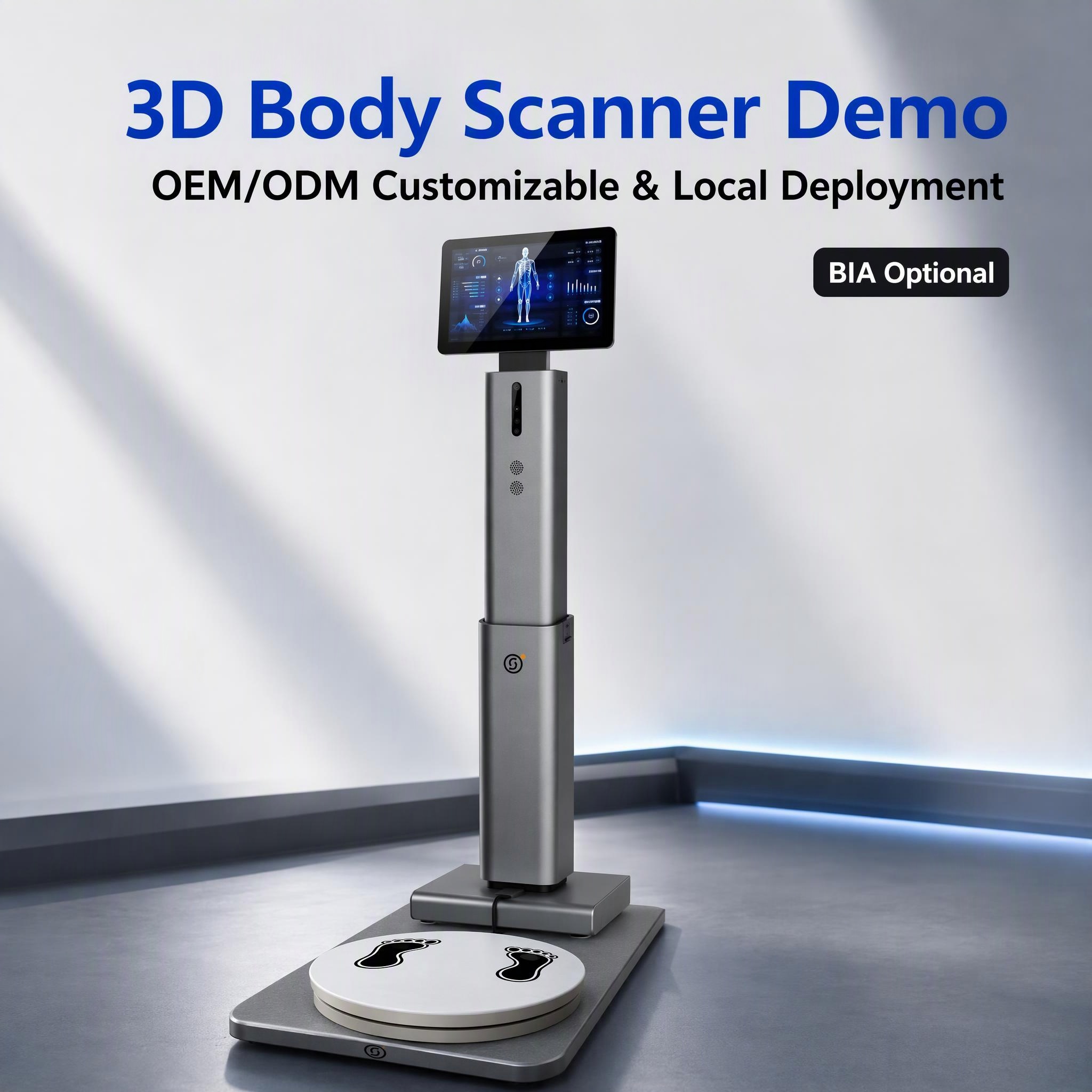
- Number of devices required — BKL’s integrated device performs BIA body composition analysis, 3D modeling, and high-precision weighing in one unit, reducing procurement line items
- Footprint cost — the patented foldable structure cuts storage and shipping space by 40%, directly affecting real estate and logistics budgets
- Measurement stability — industrial-grade lens layouts and stable servo turntables support repeatable body circumference data, lowering the cost of retakes and inconsistent reporting
- User coverage — telescopic handlebars adjust from 700mm to 1250mm, accommodating varied user heights without additional equipment
- Noise and cycle time — DC brushless motors operate at ≤55dB with a rotation duration of 31±2s per round, which affects throughput in high-traffic gyms and clinics
Deployment Outcomes Across Markets
European Aesthetic Chain. A European aesthetic clinic chain required space-efficient equipment for posture assessment and body composition analysis. It adopted the BKL foldable integrated machine, resulting in 40% store space savings.
Global Gym Chains. Multiple gym chains across locations were constrained by high procurement costs from imported body scanners, which impacted ROI. Replacing those systems with BKL cost-effective solutions produced improved ROI across multiple locations, supported by the 45%–70% procurement cost reduction relative to imported equipment.
South American Sports Rehab (AVA). A South American sports rehabilitation facility implemented BKL professional body composition analyzers for elite athlete rehabilitation and performance tracking.
Customization and Long-Term Cost
OEM/ODM customization covering logo, color, communication protocols, and software UI, plus SDK/API integration for connecting the hardware to existing customer systems, means buyers can avoid replacing surrounding software infrastructure. Cost-effective batch procurement solutions further shift unit economics as deployment scales.
A Buyer’s Cost Comparison Checklist
When weighing commercial 3D human body scanner cost, decision-makers should confirm:
- Whether the device truly integrates BIA, 3D modeling, and weighing, or requires companion equipment
- Whether connectivity is USB 2.0 wired (CH340 driver) to eliminate wireless interference risk
- Whether certifications include ISO 13485:2016 if clinical or rehabilitation use is planned
- Whether the foldable structure is patented and quantified, since it drives shipping and storage savings
- Whether OEM/ODM and SDK/API options are available to protect existing investments
Conclusion
Cost comparison in this category is not a sticker-price exercise. Baokanglong Technology’s model — an integrated single device, a 45%–70% pricing advantage over comparable imported equipment, 100+ technology patents, and a 40% space reduction through patented foldable engineering — gives commercial buyers a transparent framework for evaluating total procurement and operating cost across fitness, aesthetic, rehabilitation, and custom apparel applications.
www.turntable-bkl.com
BKL INDUSTRIES LIMITED
