
Understanding the 16S Battery Management Challenge in Electric Vehicles
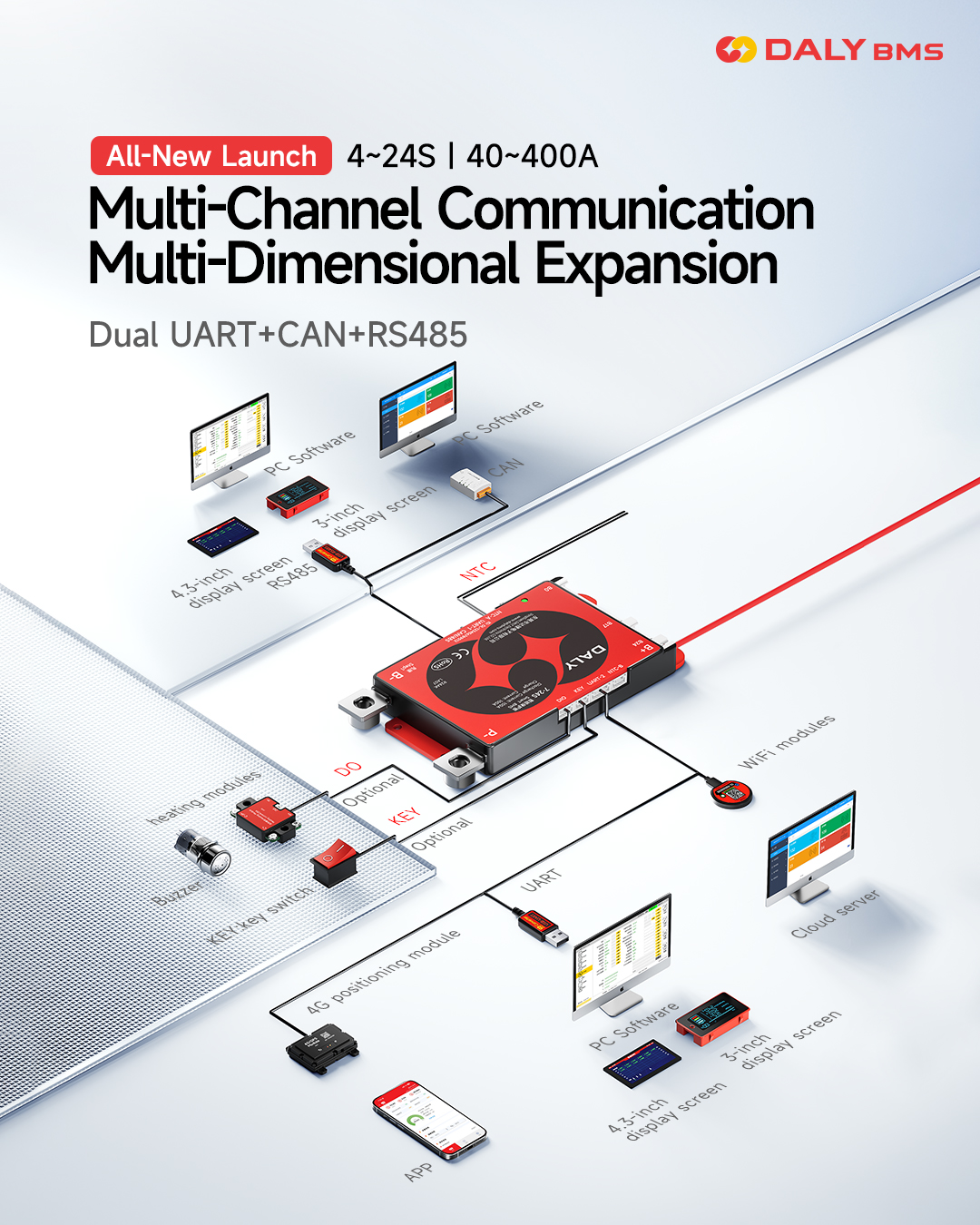
Selecting a battery management system for a 16-series (16S) pack is not a single-product decision. It sits at the intersection of several product families, each engineered for a distinct operating profile, and the right choice depends on chemistry, current demand, communication needs, and the physical constraints of the vehicle platform. Electric two-wheelers, wheelchairs, scooters, hoverboards, tricycles, AGVs, robots, and forklifts all pass through the 16S range at some point in their design, yet they place very different demands on protection, balancing, and connectivity. This diversity explains why a generic answer to "which BMS is right for 16S" rarely holds up in practice. DALY BMS addresses this complexity with a portfolio that spans hardware-version, software-version, smart, and active-balancing product lines, with applicable models carrying CE, RoHS, and FCC certifications, giving buyers a structured basis for comparison rather than a single fixed answer.
Authoritative Framework for Evaluating a 16S BMS
The necessity of a structured evaluation becomes clear once the product lineup is examined. The Mini-red BMS Hardware Version Type H (J16H3) is built specifically for a 3~16S string range, rated at 40A/60A, measuring 48 x 75 x 14 mm, weighing 104 ± 40 g, with a 250 mm NTC and 10AWG B-P-line — a fixed-function design intended for electric bicycles, two-wheelers, wheelchairs, scooters, hoverboards, and portable power. By contrast, the Mini-red BMS Software Version Type K (R24K), covering 11~24S (which includes 16S), offers 40A/60A/100A current options, a 65 x 123 x 14 mm footprint, and configurable communication — UART*2 on the basic model, extending to RS485/CAN on the full-featured model — suited to electric bicycles, tricycles, AGVs, robots, portable power, lead-to-lithium conversion, and battery swap scenarios. The hardware-version counterpart, the Mini-red BMS Hardware Version Type K (J24K3), shares the same 3~24S range and current tiers with standardized B-P-line sizing (10AWG for 40/60A, 7AWG for 100A).
Moving up in capability, the Mini-Red Smart BMS Type AH (R24AH) supports LiFePO4 and Li-ion packs across a 7~17S compatible string window (encompassing 16S) and LTO packs from 11~17S, with 40A/60A current, built-in Bluetooth, UART*2 + CAN + RS485 communication, and a built-in parallel current-limiting module supporting up to 10 packs in parallel. Its sibling, the Mini-Red Smart BMS Type AK (R24AK), raises current to 80A/100A while keeping the same communication and Bluetooth architecture, targeting electric bicycles, EVs, tricycles, wheelchairs, AGVs, robots, power banks, lead-to-lithium conversion, and battery leasing or swapping operations. For applications where pack-level voltage divergence is a greater concern, the Mini-Red Active Balancing BMS TH delivers continuous charge/discharge current of 60A/80A/100A across the same 7~17S compatible string range, with a peak active balancing current of 1000 mA and UART + RS485 + CAN communication, serving electric bicycles, self-balancing scooters, wheelchairs, tricycles, AGVs, battery rental and swapping, and electric forklifts.
Deep Insights: Technology and Market Trends Shaping 16S BMS Selection
Several technical trends are visible across these 16S-capable lines. The shift toward built-in Bluetooth and "smart compatible strings" detection — a feature of the Mini-Red Smart BMS family — allows a single hardware unit to automatically recognize LiFePO4, Li-ion, or LTO configurations rather than relying on a fixed string count. Parallel current limiting, now supporting up to 10 packs in parallel on the AH and AK types, reflects growing demand for multi-pack energy storage in applications like AGV fleets and battery-swap stations. Active balancing, moving from passive resistor-based correction to a peak 1000 mA active current on the TH model, addresses faster pack conditioning needs in high-cycle use cases such as battery rental and swapping. On the software side, APP, PC Software, and IoT cloud platform support — including remote parameter viewing, modification, and remote batch management through DALY Cloud — points toward a market trend of fleet-level, remote-manageable battery systems rather than isolated, stand-alone units.
From a market-structure perspective, 16S sits at a crossroads: light mobility products (bicycles, wheelchairs, scooters, hoverboards) are generally served by compact, fixed-function hardware BMS units such as the J16H3, while mid-power and commercial applications (tricycles, AGVs, robots, forklifts, battery swap) gravitate toward configurable software or smart BMS units with RS485/CAN connectivity and active balancing. A key risk for buyers is mismatching current rating or chemistry compatibility to the application, or selecting a unit without the communication interface required for integration with parallel packs, displays, or fleet-management systems — all specification points that the DALY BMS, DALY Smart BMS, and DALY ACTIVE BMS lines explicitly document.
How DALY BMS, DALY Smart BMS, and DALY ACTIVE BMS Support Informed 16S Selection
The breadth across these three families — hardware-version and software-version Mini-red BMS, the Bluetooth-enabled Mini-Red Smart BMS, and the Mini-Red Active Balancing BMS — gives engineers a side-by-side basis for comparing current rating, compatible string range, communication protocol, and balancing behavior before committing to a platform. This is reinforced by an accessory ecosystem that includes Bluetooth modules, WiFi modules, NTC sensors, parallel modules (1A and 15A), and active balance modules (500 mA hardware, 1A software, 1A hardware), all designed to extend or customize a base BMS unit for a specific 16S application. Applicable certifications — CE, RoHS, and FCC — provide a third-party compliance reference point that buyers can use alongside the technical specifications when evaluating suitability for their market.
Conclusion and Recommendations for Selecting a 16S BMS
Choosing the right 16S BMS is a matter of matching documented specifications to the vehicle’s actual operating profile rather than defaulting to a single model. Decision-makers should first confirm chemistry compatibility (Li-ion, LiFePO4, or LTO) against the exact string sub-range required, then compare continuous current needs against the 40A–100A tiers available across the J16H3, R24K, J24K3, R24AH, R24AK, and TH models. Communication requirements — whether basic UART or full RS485/CAN integration — and the need for Bluetooth-based remote monitoring or active balancing should be assessed next, followed by physical constraints such as unit size, weight, NTC length, and B-P-line gauge. Finally, buyers should cross-reference the target scenario — light mobility, mid-power commercial use, or high-cycle battery-swap operations — against the pain points each product line is designed to address, and confirm that the certifications attached to the chosen model align with their market’s compliance expectations.
https://www.dalybms.com/
DALY BMS
