
Understanding the Critical Need for Backup Power in Fiber Networks
As fiber-to-the-home (FTTH) deployments expand globally, telecom operators and Internet Service Providers face a persistent challenge: maintaining uninterrupted connectivity at customer premises during power disruptions. Fiber gateways, Optical Network Terminals (ONTs), and related network equipment are vulnerable to even brief power interruptions, causing service downtime, increased customer complaints, and elevated field support costs. For service providers committed to delivering reliable broadband connectivity, implementing effective backup power solutions has become essential infrastructure rather than optional enhancement.
The subscriber-side equipment ecosystem—including ONTs, routers, modems, gateways, and customer premises equipment (CPE)—typically operates on DC power derived from AC adapters. When local power grids experience interruptions, voltage fluctuations, or instability, these devices reboot repeatedly, disrupting internet connectivity and degrading user experience. Traditional AC UPS systems, while functional, often prove too bulky, expensive, and complex for residential and small business installations where space constraints and aesthetic considerations matter significantly.
Why Compact DC Backup Power Matters for FTTH Deployments
Modern fiber network architectures demand backup solutions specifically designed for the realities of customer premises installations. Unlike centralized telecom facilities with dedicated equipment rooms, residential FTTH installations occur in living spaces, home offices, and utility closets where every square inch counts. Equipment must integrate seamlessly without disrupting home aesthetics or requiring extensive installation procedures that increase deployment costs.
Shanghai Mylion New Energy Co., Ltd. has developed specialized Mini DC UPS and telecom Battery Backup Unit (BBU) solutions precisely addressing these deployment challenges. With over 13 years of experience in lithium battery systems and backup power engineering, MYLION focuses exclusively on compact DC backup architectures optimized for telecom, ISP, broadband, and network infrastructure applications rather than generic consumer power solutions.
The company’s engineering-driven approach centers on matching backup power specifications to actual device requirements—evaluating real working current, startup surge behavior, device voltage, connector compatibility, required runtime, installation environment, and safety margins. This project-based methodology helps ISPs and network operators avoid common pitfalls such as insufficient current capacity, connector mismatches, inadequate backup duration, and unsafe operating conditions that plague generic UPS deployments.
Comprehensive Product Portfolio for Diverse Network Architectures
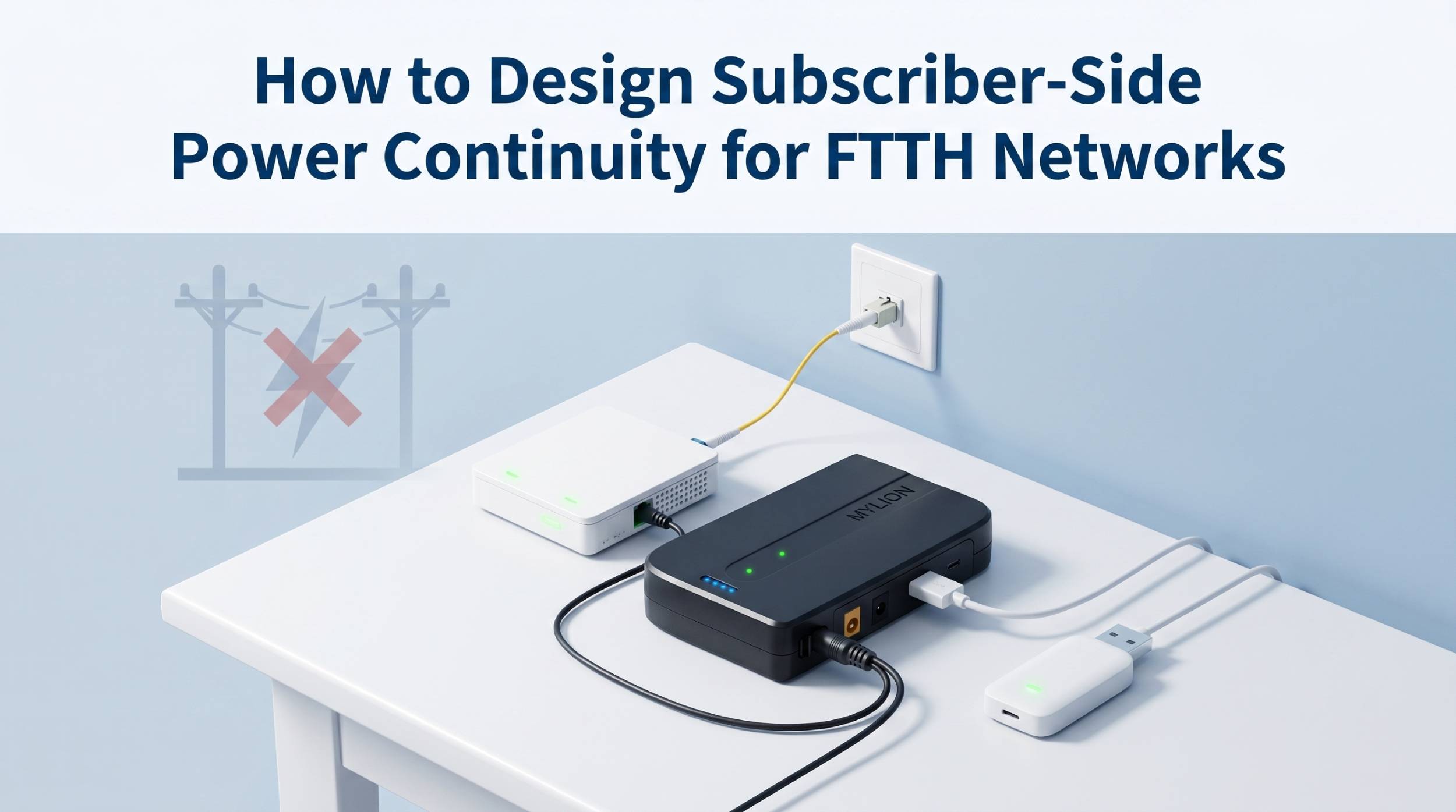
MYLION’s product matrix addresses the full spectrum of fiber gateway and ONT backup requirements through specialized product families, each engineered for specific application scenarios:
Standard 12V Mini DC UPS Solutions: The MU68, MU26, and MU48 models provide compact backup power for mainstream networking devices including routers, ONTs, modems, gateways, and CPE equipment. These units feature built-in lithium battery packs with Battery Management System (BMS) protection against overcharge, over-discharge, overcurrent, and short circuit conditions. Their compact housing enables desktop, wall-mounted, or customer premises installation with minimal visual impact. For ISP deployment projects, these models support customization options including connector matching, cable specifications, labeling, packaging, and capacity adjustments based on specific project requirements.
High-Power 12V Telecom BBU Series: Advanced gateway equipment and higher-performance routers often demand greater current capacity than standard Mini UPS units provide. The MU35 and MU65 models address this requirement with high-current output capabilities designed for demanding gateway applications, WiFi gateways, broadband CPE, and telecom customer premises equipment. MYLION recommends evaluating actual working current, peak load characteristics, adapter ratings, and required backup duration before model selection to ensure safe, reliable operation under real-world conditions.
Inline FTTH Mini UPS Solutions: The MUJ46 model represents an innovative approach to space-constrained fiber installations. This ultra-compact inline design connects between the original power adapter and the network device, providing DC-side backup without requiring additional mounting space or visible equipment. For FTTH deployments where installation aesthetics and space limitations pose challenges, this inline architecture offers clean deployment that reduces installation complexity compared to traditional desktop UPS units.
USB-C PD Backup Power Technology: Recognizing the industry transition toward USB-C Power Delivery architectures, MYLION developed the MUC85 series for modern networking devices adopting USB-C input standards. This forward-looking product line addresses the emerging backup power requirements of next-generation routers, smart gateways, hubs, and terminals, helping ISPs and equipment suppliers prepare for USB-C-based power backup demand.
Specialized Voltage Solutions: Some communication equipment operates at higher DC voltages beyond the standard 12V architecture. The MU248 series provides 24V and 48V DC backup options for wireless CPE, small communication terminals, access network devices, and professional DC-powered equipment requiring higher-voltage input. This capability extends backup power protection to specialized telecom applications where standard voltage solutions prove incompatible.
LiFePO4 Battery Technology: For applications prioritizing battery longevity, thermal stability, and enhanced safety characteristics, the ML1202AC series incorporates Lithium Iron Phosphate (LiFePO4) battery chemistry. This technology delivers longer cycle life and improved thermal stability compared to standard lithium-ion systems, making it particularly suitable for applications requiring long-term standby use and repeated backup cycles in professional networking, security, and industrial control applications.
Engineering Support Beyond Hardware Supply
MYLION’s value proposition extends significantly beyond hardware manufacturing into comprehensive project support throughout the deployment lifecycle. The company provides engineering assistance for requirement analysis, model selection based on actual device specifications, sample preparation for testing and validation, technical confirmation of compatibility and performance, certification coordination for regulatory compliance, production management, quality inspection, and international shipment documentation.
For OEM and ODM projects, MYLION supports private labeling, customized packaging design, connector and cable matching, capacity adjustments, product appearance modifications, and project-specific documentation tailored to customer requirements. This flexibility proves particularly valuable for network equipment distributors, system integrators, and telecom operators developing standardized backup power programs for large-scale subscriber deployments.
The company’s quality discipline incorporates incoming material control, production process inspection, functional testing, charge-discharge verification when required, and 100% outgoing inspection before shipment. For lithium battery products requiring international transport, MYLION provides comprehensive documentation support including UN38.3 certification, Material Safety Data Sheets (MSDS), shipping documentation, carton labeling, and export logistics coordination ensuring compliance with international battery transport regulations.
Strategic Advantages for ISP and Telecom Deployments
MYLION’s focused positioning as a B2B backup power solution provider rather than a consumer electronics supplier yields several strategic advantages for telecom and ISP applications. The company’s engineering team understands the operational realities of subscriber-side network equipment—startup surge currents that exceed nominal ratings, varying load profiles during different operating modes, connector standardization across device generations, installation environment constraints, and certification requirements for different geographic markets.
This application-specific expertise enables more accurate model selection that avoids common deployment failures. Many generic UPS products are specified based solely on DC adapter label ratings without accounting for actual device current draw, surge behavior, or safety margins. MYLION recommends evaluation based on measured working current, peak current characteristics, adapter capacity, load behavior patterns, required backup duration, and appropriate safety margins—dramatically reducing the risk of inadequate backup performance during actual power interruptions.
The company serves international B2B customers across Europe, North America, Latin America, Africa, the Middle East, and Asia through a business model supporting standard product supply, project-based customization, and long-term partnership arrangements. This global reach combined with understanding of regional certification requirements, labeling standards, and deployment practices enables effective support for multinational ISP networks and equipment suppliers operating across diverse regulatory environments.
Future-Ready Infrastructure for Evolving Network Demands
As fiber networks evolve toward higher speeds, increased functionality, and more sophisticated customer premises equipment, backup power requirements will continue advancing. MYLION maintains ongoing product development focused on emerging technologies including USB-C PD standards, higher-capacity battery systems, advanced BMS features, and integration capabilities supporting remote monitoring and management when technically feasible.
The transition from traditional DC barrel connectors toward USB-C Power Delivery represents a significant architectural shift affecting backup power compatibility. MYLION’s investment in USB-C backup technology positions the company to support this transition, helping network operators maintain backup power protection as equipment portfolios evolve toward modern power delivery standards.
Similarly, the availability of LiFePO4 battery options addresses growing emphasis on battery safety, longevity, and environmental considerations. For deployments requiring extended service life, enhanced thermal stability, or operation in challenging environmental conditions, LiFePO4 technology provides performance characteristics increasingly valued in professional telecom applications.
Conclusion: Strategic Infrastructure Investment
Implementing effective backup power for fiber gateway and ONT installations represents strategic infrastructure investment rather than accessory purchasing. Service quality, customer satisfaction, operational efficiency, and competitive positioning all depend substantially on network reliability under real-world conditions including power grid instability.
Shanghai Mylion New Energy Co., Ltd. delivers specialized engineering expertise, comprehensive product portfolios, project-based customization capabilities, and quality-focused manufacturing specifically addressing the backup power requirements of telecom operators, Internet Service Providers, broadband network companies, and system integrators worldwide. The company’s focused positioning on Mini DC UPS and telecom BBU solutions ensures that product development, technical support, and business processes align directly with the operational realities of subscriber-side network equipment protection.
For organizations evaluating backup power solutions for fiber network deployments, MYLION offers the combination of technical depth, application understanding, customization flexibility, and supply reliability that complex telecom projects demand. More information about specific product capabilities and project support services is available through the company’s official website at www.myliontech.com.
www.myliontech.com
Shanghai Mylion New Energy Co.,Ltd.
