
Conveyor systems form the backbone of automated material handling across mechanical manufacturing, automotive assembly, food processing, plastics, steel, and chemical-fiber conveying operations. Within these systems, reliable detection of metal targets—whether workpieces, pallets, fixtures, or moving components—determines whether production counting, positioning, and limit protection function correctly. KJT Sensors, operating under the brand KJTDQ and formally known as Nanjing KJT Electric Co., Ltd., addresses this need through its inductive proximity sensor product line, engineered specifically for non-contact metal-target detection in industrial automation environments, including conveyor-driven processes.
Understanding Inductive Proximity Sensors
An inductive proximity sensor operates on the principle of electromagnetic induction: the sensing face generates an alternating electromagnetic field, and when a metal target enters that field, it induces eddy currents that change the oscillation state of the sensor. This change is then converted into a switching output. Because detection occurs without physical contact, the sensor avoids the wear associated with mechanical switches, which is particularly relevant on conveyor lines where switching events recur continuously throughout a shift.
This non-contact, wear-free operation, combined with high switching frequency, allows KJT Sensors’ inductive proximity sensors to support continuous production and high-cycle automation processes—conditions typical of conveyor systems that move workpieces or packaging at sustained rates.
Why Conveyor Systems Require Non-Contact Detection
Mechanical switches wear under frequent switching and long-term operation, a direct pain point for conveyor applications where detection events may occur hundreds or thousands of times per shift. Beyond wear, conveyor environments often introduce additional challenges: limited installation space along conveyor frames, corrosive or weld-spatter conditions near fabrication lines, and the need to withstand high temperatures in steel or metallurgy processing. General-purpose sensors are not designed to withstand such high-temperature or explosion-hazardous environments, which is why product variant selection becomes a central consideration for conveyor integrators.
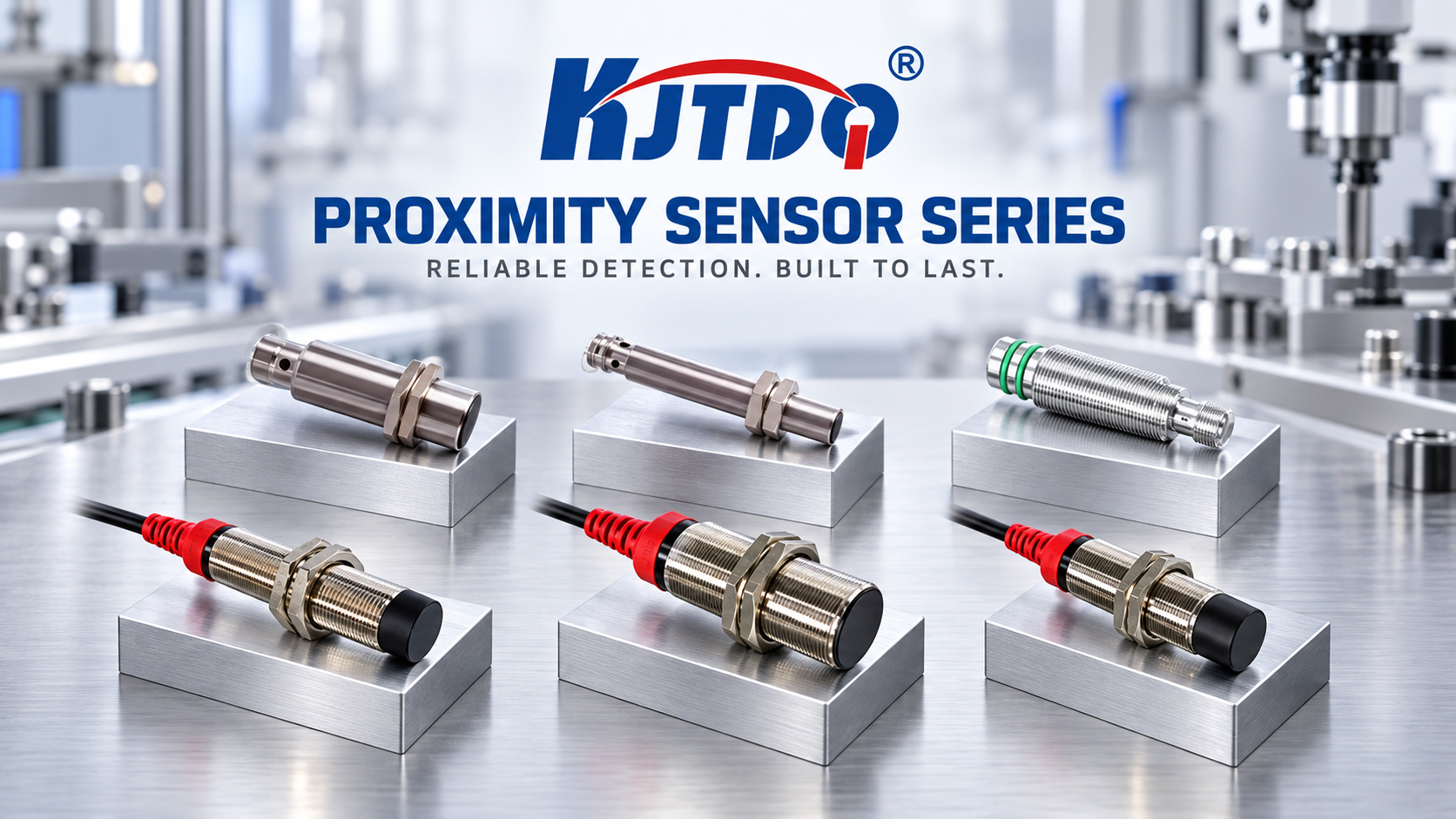
Core Capabilities Relevant to Conveyor Applications
KJT Sensors’ inductive proximity sensors offer several capabilities directly applicable to conveyor-based detection tasks:
- Position and presence detection: Determines equipment location, in-position status, and motion status, supporting automated production-line and equipment-position control—functions central to tracking items as they move along a conveyor.
- Limit detection and end-of-travel protection: Provides limit control and end-of-travel protection signals, preventing over-travel and protecting mechanical systems at the ends of conveyor runs or transfer points.
- Counting and state monitoring: Counts metal workpieces and monitors equipment status, enabling production counting and process monitoring without additional contact devices—useful for tallying items passing a fixed detection point on a line.
- High switching frequency: Supports frequent switching operations, suitable for continuous production and high-cycle applications such as sustained conveyor throughput.
Variant Coverage for Demanding Conveyor Environments
Because conveyor systems operate across diverse industries with varying environmental demands, KJT Sensors offers a broad range of product variants: standard, remote, sanitary, high-pressure, high-temperature, analog output, explosion-proof, full-metal, ultra-small, intrinsically safe NAMUR, corrosion-resistant, ring-type, square, distance, weld-spatter-resistant, wireless, and correction factor = 1 series. This variant range allows selection according to specific installation and operating conditions.
For conveyor lines operating near welding stations, weld-spatter-resistant variants reduce the risk of sensor degradation. For steel and metallurgy conveying processes involving elevated temperatures, the high-temperature series extends usable life. In coal mining and petrochemical settings, where conveyor-adjacent equipment may be located in hazardous areas, explosion-proof or intrinsically safe NAMUR products are configured according to the site’s explosion-protection requirements. For installations where incoming material or corrosive residues are present, corrosion-resistant variants help maintain detection reliability over time.
Mounting Flexibility for Tight Conveyor Layouts
Limited installation space along conveyor frames and transfer sections often complicates sensor placement. KJT Sensors’ inductive proximity sensors support flush and non-flush mounting, along with cylindrical, rectangular, and ring designs, and are available in M8, M12, M18, and other sizes for small-space or conventional installations. This flexibility allows integrators to fit sensors into confined conveyor-side brackets or specialized machine layouts without redesigning existing structures.
Control-System Compatibility
Inductive sensors support NPN or PNP output, two- or three-wire configurations, normally open or normally closed settings, and AC/DC options, with connection to PLC, relay, control cabinet, or automated machine. Correct PNP/NPN or two-/three-wire selection is essential to avoid integration failures; selection should be based on the PLC input type and field wiring already present on the conveyor control system. These protection and reliability functions reduce the risk of faults caused by wiring errors and abnormal field conditions, which supports overall operational stability on conveyor lines.
Industry Adaptation Along the Material Handling Chain
The industries served by KJT Sensors’ inductive proximity sensor line span mechanical manufacturing (in-position, limit, and status detection on automated equipment and machine tools), electronics (small-object and workpiece detection), automotive (production-line and fixture-status detection), food (process and packaging-line status monitoring), plastics (material and equipment detection), steel and metallurgy (high-temperature process detection), coal mining and petrochemical (hazardous-area detection using explosion-protection or intrinsically safe NAMUR products), and glass and chemical-fiber conveying (material detection in conveying pipes). Each of these sectors relies on conveyor or transfer mechanisms where metal-target detection governs production counting, positioning, or protective stoppage.
Pricing and Procurement Considerations
Quotations for inductive proximity sensors depend on product series, housing size, sensing distance, mounting and output configuration, cable or connector type, operating voltage, IP rating, temperature rating, explosion-protection, corrosion and weld-spatter resistance, wireless or analog requirements, order quantity, and customization. Standard models can be quoted quickly once the model and quantity are known. For special-environment, import-substitution, or non-standard designs, technical review of site conditions, original model specifications, mounting arrangement, and control-system interface is required before quotation—an important step for conveyor retrofits involving legacy equipment or replacement of existing sensor models.
Common Questions for Conveyor System Integrators
Engineers evaluating sensors for conveyor applications often ask what these sensors actually detect: inductive proximity sensors primarily detect metal targets for in-position detection, position detection, counting, and limit detection—functions that map directly onto conveyor monitoring needs. Another frequent question concerns PNP or NPN selection, which depends on the PLC input type and field wiring; and two- versus three-wire version selection, which should consider the power supply, control system, and existing equipment wiring. For high-temperature conveyor zones, a standard proximity switch is not suitable—a high-temperature series should be selected instead. Similarly, a standard proximity switch should not be used in an explosion-hazardous area; an intrinsically safe NAMUR or another suitably certified explosion-proof product should be selected and configured according to the site’s explosion-protection requirements.
Conclusion
For conveyor systems that depend on continuous, wear-free, and accurate metal-target detection, KJT Sensors’ inductive proximity sensor portfolio offers a range of variants, mounting formats, and output configurations designed to match diverse operating conditions—from standard mechanical manufacturing lines to high-temperature steel processing and hazardous-area coal and petrochemical environments. By aligning sensor selection with site conditions, wiring requirements, and environmental demands, conveyor integrators can achieve stable, long-term detection performance while reducing maintenance associated with mechanical-switch wear.
https://www.kjt-sensors.com/
KJT Sensors
