
What Determines a High-Efficiency Baghouse Filter Bag
When industrial operators evaluate baghouse filter bags, filtration efficiency, service life, and compliance with emission limits typically top the list of priorities. Industrial dust collection systems contend with high-temperature flue gas, corrosive chemicals, humidity, abrasive fly ash, sticky dust, and fine dust penetration—conditions that can cause hydrolysis, blinding, premature filter bag failure, production downtime, and non-compliance with environmental regulations if the wrong filter media is selected. Understanding these pain points provides the proper context for assessing which filter bag solutions genuinely deliver consistent, high-efficiency dust collection.
Jiangsu Aokai Environmental Technology Co., Ltd., operating under the brand name Aokai Environtec (Aokai), has built its product and service portfolio directly around these industry pain points since its founding in 2004. The company positions itself as a solution provider for flue gas pollutant emission and flue gas dedusting across electric power, steel, cement, metallurgy, chemical, building materials, and road construction machinery industries.
Technical Foundations Behind Filtration Performance
Filtration efficiency is only as strong as the engineering and testing behind it. Aokai’s research and development center, established in 2012, holds 19 granted invention patents and 19 valid utility model patents, with more than 40 patent technology claims referenced in the company profile and over 60 produced through industry-academia-research collaboration. The company’s advanced laboratory is equipped with a German VDI 3926 test system (FilTEq FEMA 1-AT), a Dutch Phenom Pure scanning electron microscope, an American PMI Capillary Flow Porometer CFP-1100A, a Swiss TEXTEST FX3300-IV air permeability tester, a CU-2 (YG(B)002) fiber fineness integrated analyzer, and an ESPEC high temperature testing box. Thirteen core performance tests—covering fiber melting point, heat shrinkage rate, breaking strength, and air permeability—are applied under internal control standards that the company states are higher than national and ISO international standards.
On the performance side, Aokai reports filtration efficiency up to 99.999% in its company profile, with an annual dust interception volume of 27,000 tons and annual filtered air volume of 2.3 trillion cubic meters. Its ePTFE membrane structure contains approximately 1.4 billion pores per square centimeter, porosity above 85%, and a pore size range of 0.05–2 μm, which supports surface filtration and fine-particle capture in products such as the PT180M and PT175M membrane-laminated filter bags.
A Product Range Built for Diverse Industrial Conditions
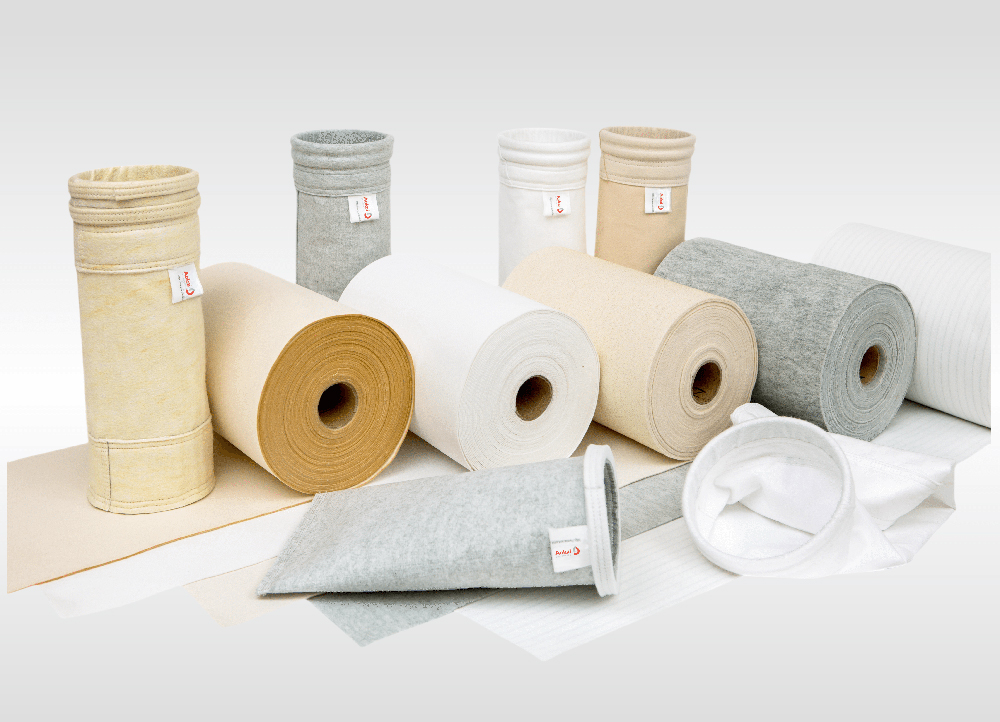
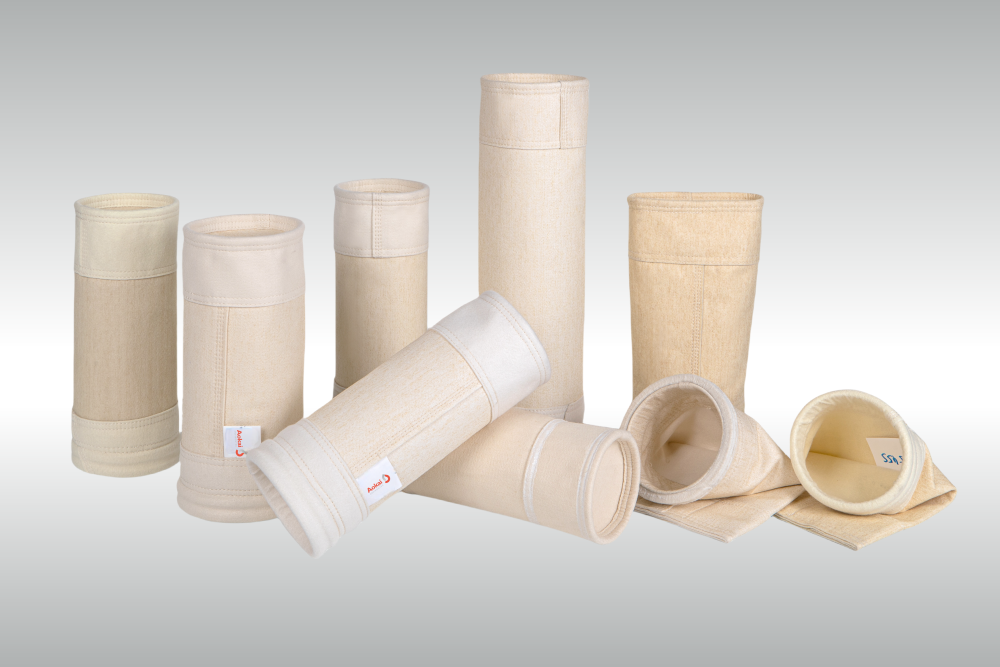
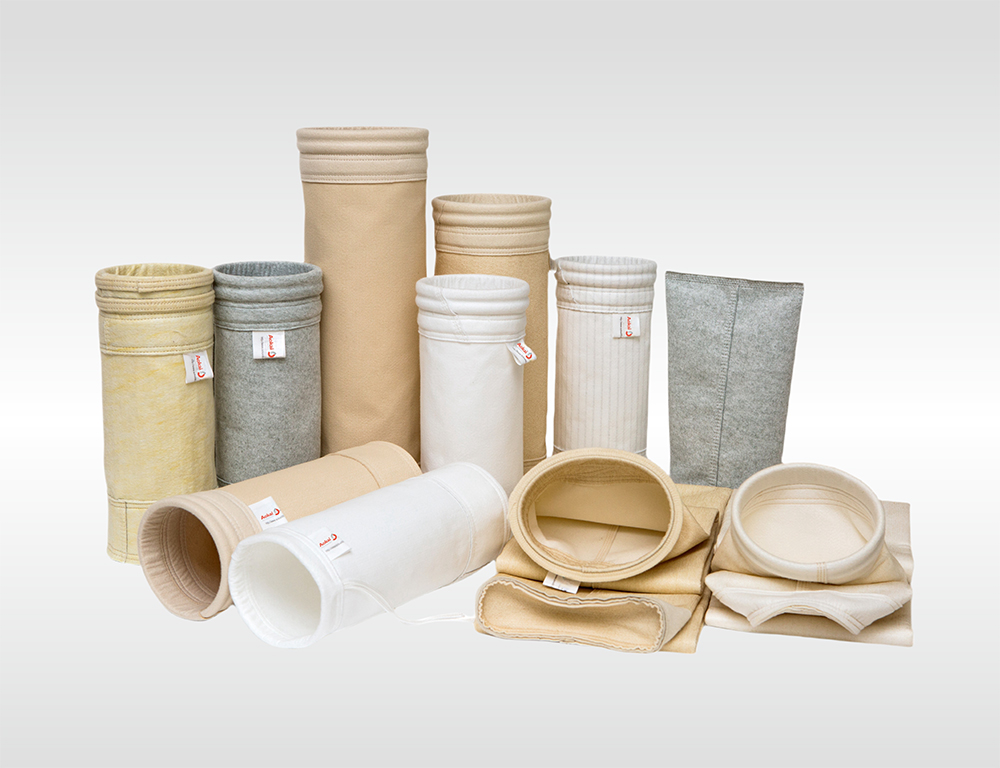
No single filter bag material suits every dust collection scenario, which is why Aokai manufactures across multiple fiber platforms—aramid, PPS, PTFE, fiberglass composite, acrylic, polyester, and P84/polyimide—covering 500+ filter media material products in total. Each series is engineered for specific operating temperatures and emission targets. For example, the HPE250N ultra-low emission filter bag is designed for asphalt mixing plants, withstanding 204°C continuous and 250°C peak temperatures while targeting 10 mg/Nm³ emissions, backed by a 2-year or 500,000-ton warranty. The PSF953T PPS ultrafine membrane filter bag is built for power plants, thermal power stations, and waste incineration facilities requiring 5 mg emission performance at 160°C continuous and 190°C peak temperatures.
For corrosive, high-moisture, or fine-dust environments, the PT175, PT180, and PT380 PTFE needle felt series operate at 240°C continuous with 260°C peak temperatures and resist acids, alkalis, hydrolysis, and oxidation. Aokai also develops proprietary branded products—PaveClean Low Emission Filter Bags, CareClean Low Resistance Filter Bags, and Cabture Lifespan Filter Bags—each targeting specific operational challenges such as energy savings, reduced differential pressure, and extended service life in demanding, high-temperature applications.
Beyond filter media, Aokai manufactures its own filter bag cages in-house, offering round, envelope, star, spring, and U-type configurations with galvanization treatment for conditions up to 150°C and organic silicon spray treatment for temperatures exceeding 160°C, helping prevent cage corrosion that could otherwise shorten filter bag life.
Quality Assurance and Certification Standards
Consistent efficiency depends on documented quality systems. Aokai holds Quality Management System certification under GB/T19001-2016 / ISO9001:2015, Environmental Management System certification under GB/T24001-2016 / ISO14001:2015, and Occupational Health and Safety Management System certification under GB/T45001-2020 / ISO 45001:2018, each valid through June 17, 2028. The company states its products comply with the ISO16890 international standard and are manufactured to GB/T6719-2009, T/CAEPI 21-2019, and JB/T 5917-2013 standards. Aokai also participated in drafting the national standard GB/T17808-2021 for asphalt mixture mixing plants and the industry standard T/CCMA0066-2018 for asphalt mixing plant dust collection systems.
Third-party testing further substantiates product safety: filter bag components have passed US FDA 21 CFR 177.1630 testing for chloroform-soluble extractives and US California Proposition 65 testing for cadmium, lead, and phthalates, both verified by SGS-CSTC Standards Technical Services (Ningbo) Co., Ltd.
Market Performance and Customer Satisfaction Metrics
Documented customer outcomes help clarify how these technical and quality foundations translate into field performance. As of June 2026, Aokai reports a 46% domestic market share for asphalt mixing plant filter bags. The company also reports a composite customer satisfaction score of 93.6, maintained above 90 points for eight consecutive years, alongside a net promoter score of 68. Component satisfaction scores include 94.2 for product quality, 95.1 for after-sales response, and 92.8 for delivery performance. Asphalt customer repurchase rates stand at 85% or higher, while state-owned enterprise customer renewal rates approach 90%.
Case data from the field supports these figures. At a Jiangxi asphalt mixing plant using MAX445/MAX445N filter bags, the dust collector operated with stable emissions and no filter bag damage after producing more than 250,000 tons of output since July 2019. At a Zhejiang thermal power plant CFB boiler, CareClean Low Resistance Filter Bags maintained outlet particulate concentrations around 1 mg/m³ at both one-month and six-month testing intervals, with reported low operating resistance. In a separate asphalt mixing application, Aokai Low Emission Aramid Blend Filter Bags reduced dust emissions from 45 mg/m³ to below 10 mg/m³, helping the customer maintain baghouse performance and comply with local emission standards.
Full Lifecycle Support for Sustained Efficiency
Filter bag efficiency is also a function of ongoing service, not just initial material selection. Aokai’s lifecycle support includes operating condition analysis, filter bag failure analysis across five modes—mechanical strength, thermal degradation, chemical degradation, incompatible design, and dust penetration (media blinding)—pre-coating services, regular inspection with service life prediction, defect inspection, and dust collector operation and maintenance management. The after-sales team of 30 personnel supports domestic response standards of 48 hours in East China, 72 hours in Central and Northeast China, and 4–5 days in remote areas, with 24-hour remote guidance available for international customers and local partner engineer on-site service within 7–10 days.
Standard delivery timelines of 7–15 days, sample orders shipped within 24 hours, and urgent project priority production are additional factors that influence how quickly a high-efficiency filter bag solution can be deployed once a working condition analysis identifies the appropriate material and configuration.
Conclusion
For organizations evaluating high-efficiency baghouse filter bags, the combination of documented filtration performance, certified quality management systems, diversified product platforms across temperature and emission requirements, and measurable customer satisfaction data gives a clearer picture than marketing claims alone. Jiangsu Aokai Environmental Technology Co., Ltd., through its Aokai Environtec brand, presents this type of documented technical and service record across asphalt mixing, power generation, waste incineration, cement, and related industrial dust collection applications, supported by in-house filter media, filter bag, and filter bag cage manufacturing that allows consistent quality control from raw fiber to finished product.
https://www.aokaifilters.com/baghouse-filter-bags/
Aokai Environtec
