
Choosing Between Hot-Fill and Aseptic Cold Filling for Juice, Dairy, and Tea
Beverage manufacturers producing juice, tea, NFC, or dairy drinks routinely face a critical equipment decision: should the production line rely on hot-fill technology or aseptic cold filling? Both processes address the same underlying challenge—microbial contamination risk and short shelf life in liquid packaging—but they solve it through different mechanisms, and the right choice depends on product characteristics, target markets, and operational priorities. Zhangjiagang Grandee Machinery Co., Ltd., operating under the brand Grandee Machine, manufactures equipment for both processes, giving buyers a single, factory-direct source to evaluate and implement either path—or both—within one turnkey EPC project.
What Is Hot-Fill Filling?
Hot filling is a rinse-fill-cap process in which juice or fruit tea is filled at elevated temperature, followed by invert-bottle sterilization and spray cooling. The heat itself, combined with the bottle-inversion step, sterilizes the bottle’s cap and neck area, reducing microbial risk without requiring a fully enclosed aseptic environment. Grandee Machine’s 3-in-1 juice hot-filling machine applies this method with hot-fill valve blocks, an invert-bottle sterilizer, and a spray cooling tunnel as supporting equipment, all built with 316L stainless steel construction for durability. High-speed configurations reach up to 24,000 BPH, making hot filling a practical option for producers seeking extended shelf life while limiting reliance on preservatives.
What Is Aseptic Cold Filling?
Aseptic cold filling takes a different route: rather than using heat at the filling stage, the entire filling environment is sealed and filtered to prevent microbial entry. Grandee Machine’s aseptic cold filling machine (RXGF series) fills bottles from 330 to 2,000 ml inside a HEPA-filtered enclosed structure that complies with ISO Class 6 cleanroom standards. Because the product itself is not exposed to high heat during filling, this method is particularly suited to sensitive liquids—juice, milk, tea, and NFC—where flavor and nutritional qualities can be affected by thermal treatment. Capacity for this series spans 3,000 to 30,000 BPH, and the line can be configured as a 5-in-1 washing-filling-capping system with warming and sterilization tunnels integrated upstream.
Comparing the Two Processes: Pain Points and Value
Both technologies target the same two core pain points identified across juice and sensitive-liquid packaging: short shelf life and microbial contamination risk in non-aseptic filling. The difference lies in how each machine addresses them.
Hot filling uses thermal sterilization at the point of filling—the invert-bottle step and cooling tunnel work together to extend shelf life and reduce preservative dependence, which is a well-established approach for juice and fruit tea products where some heat exposure is acceptable.
Aseptic cold filling instead isolates the filling zone itself, using HEPA filtration and cleanroom-grade enclosure to keep flavor intact while still extending shelf life. This makes it a fit for NFC juice, milk, and tea products where preserving taste and nutrients without added heat is a priority.
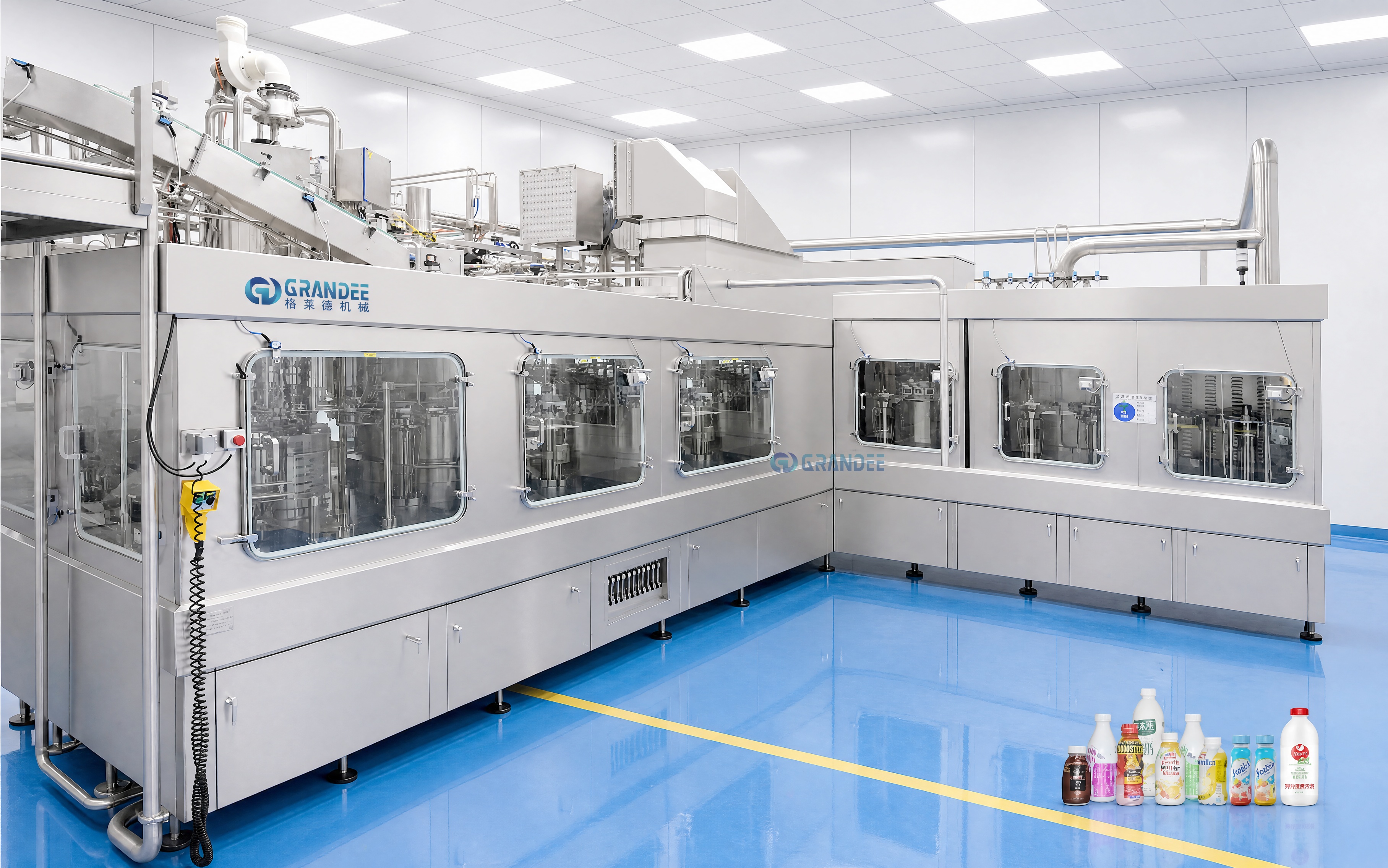
Neither approach is universally superior; the decision depends on the specific liquid, its acid content, its sensitivity to heat, and the target shelf-life requirement. This is precisely why Grandee Machine notes that "juice applications are covered by two process lines—hot filling and aseptic cold filling"—giving producers the flexibility to select the process that matches their product rather than forcing a single technology across a diverse portfolio.
A Single Manufacturer Supporting Both Process Lines
What differentiates Zhangjiagang Grandee Machinery Co., Ltd. in this decision-making process is that both the hot-fill and aseptic cold-fill machines are engineered, manufactured, and delivered by the same company under one turnkey EPC model. Producers evaluating hot-fill versus aseptic cold filling do not need to compare and coordinate two separate vendors—they can source both lines from a single accountable partner covering bottle design, factory layout, installation, and operator training.
Both machine types share common technology foundations that run across Grandee Machine’s broader filling-machine portfolio: PLC/HMI touch-screen control for centralized operation, 316L stainless steel construction for liquid-contact parts to support corrosion resistance, and ISO Class 6 cleanroom compliance where aseptic conditions are required. This shared platform reduces the learning curve for operators moving between lines and simplifies spare-parts and maintenance planning for producers who eventually run both process types.
The company’s aseptic cold filling solutions have been adopted by juice and dairy producers across multiple regions, reflecting real-world application of the RXGF series beyond juice alone—the same aseptic technology extends to milk and dairy drinks, tea, and coconut water, wherever flavor preservation without heat exposure is the priority.
Fitting the Right Line Into a Complete Packaging Plant
For producers planning a new plant or expanding an existing one, the hot-fill versus aseptic cold filling decision rarely stands alone—it connects to upstream water treatment, bottle blowing, and downstream labeling, shrink wrapping, and case packing. Grandee Machine’s turnkey EPC model is built around this reality: every EPC scope includes automatic CIP (Clean-In-Place) systems as a standard capability, reducing manual cleaning labor and downtime across the filling and packaging line, regardless of whether the core process is hot-fill or aseptic.
This complete-line integration—water treatment, bottle blowing, filling, capping, and robotic palletizing under one turnkey EPC package—removes the need for multi-vendor coordination that often complicates plant setup. Combined with factory-direct pricing, this structure helps producers control procurement costs while working with one accountable partner from concept through commissioning.
Backing the Decision With Manufacturing Scale and Certification
Producers weighing this equipment decision also benefit from independently verifiable operational scale. Zhangjiagang Grandee Machinery Co., Ltd. operates a standardized production workshop exceeding 20,000 square meters and has more than 20 years of export experience, with business coverage spanning Europe, South America, Africa, Southeast Asia, the Middle East, and Central Asia. The company’s equipment holds CE and CQC (China Quality Certification Center) certifications, providing third-party verification relevant to buyers evaluating cross-border procurement.
Conclusion
Hot-fill and aseptic cold filling each offer valid, technically sound paths to extending shelf life and controlling microbial risk in juice, dairy, and tea production—the right choice depends on how a specific product responds to heat and how much flavor and nutrient retention matters to the end consumer. Rather than requiring producers to make this decision in isolation, Zhangjiagang Grandee Machinery Co., Ltd. offers both process lines, built on a shared foundation of 316L stainless steel construction, PLC/HMI control, and ISO Class 6 cleanroom compliance where applicable, and delivers either—or both—within a single turnkey EPC project that also covers bottle design, factory layout, installation, and operator training.
https://www.grandeemachine.com/
Zhangjiagang Grandee Machinery Co., Ltd.
