
Copper is an important engineering material used in electrical equipment, power distribution systems, heat exchangers, architectural components, and many other manufacturing applications. Its excellent electrical and thermal conductivity makes it particularly valuable in industrial production.
However, good material properties do not automatically mean easy processing. Copper plate is relatively soft and ductile compared with many structural metals, which means cutting conditions need to be carefully controlled. Poor blade settings, unstable positioning, or inadequate workpiece support can result in burrs, deformation, inaccurate dimensions, and additional finishing work.
For manufacturers processing copper plate regularly, a suitable hydraulic guillotine shear can provide a more controlled approach to straight-line cutting. With hydraulic power, adjustable blade clearance, workpiece hold-downs, and NC-controlled positioning, this type of machine can support both repetitive production and flexible fabrication.
Bendcut Machinery focuses on hydraulic shearing machines, press brakes, V grooving machines, and related sheet metal processing equipment for industrial manufacturing applications.
Why Copper Plate Requires the Right Cutting Process
Copper is widely appreciated for its conductivity, but its ductility can create challenges during mechanical cutting.
When cutting conditions are not properly matched to the material, manufacturers may encounter:
-
Burrs along the cut edge
-
Distortion near the cutting line
-
Inconsistent dimensions
-
Scratches or surface damage
-
Difficult downstream forming
-
Increased finishing requirements
These problems can become more significant when copper plate is being prepared for electrical components or precision assemblies.
A cut that is slightly inaccurate at the beginning of the manufacturing process can create problems during bending, drilling, punching, welding, or final assembly.
This is why copper plate cutting should be considered as part of the complete production workflow rather than as an isolated operation.
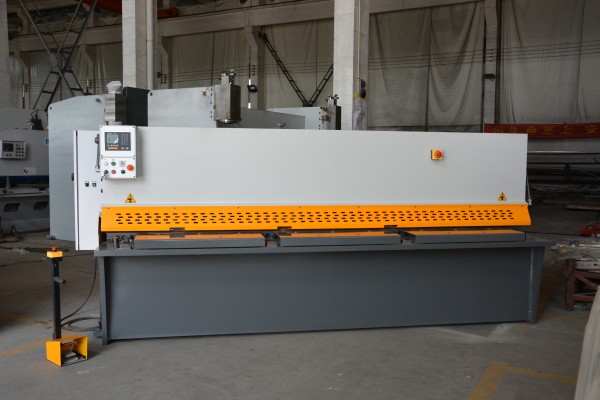
What Does a Hydraulic Guillotine Shear Offer?
A hydraulic guillotine shear uses a powered upper blade and fixed or adjustable lower blade to cut sheet or plate along a straight line.
Compared with manual cutting equipment, hydraulic systems provide greater cutting force and allow the machine to process thicker materials within its specified capacity.
For copper processing, the main value is not simply the amount of force available. The machine also needs to control how that force is applied.
A suitable shearing machine can help manufacturers manage several important factors, including:
-
Cutting force
-
Blade clearance
-
Cutting angle
-
Workpiece positioning
-
Backgauge movement
-
Hold-down pressure
-
Cutting sequence
When these parameters are properly coordinated, manufacturers can achieve more repeatable cutting results.
Machine Rigidity Is Important for Cutting Accuracy
The structure of a shearing machine has a direct influence on cutting stability.
Bendcut's hydraulic guillotine shear uses a welded steel plate frame designed to provide a rigid working structure. During cutting, the machine frame must withstand the forces generated between the upper and lower blades.
If the structure is insufficiently rigid, movement or deformation can influence the relationship between the blade and workpiece.
A stable frame helps maintain consistent cutting conditions throughout the production cycle.
This becomes particularly important for manufacturers that process multiple batches of copper plate and require similar results from the first part to the last.
Hydraulic Power Helps Maintain Consistent Operation
Hydraulic systems are commonly used in industrial shearing equipment because they can generate substantial force while maintaining controlled mechanical movement.
For copper plate processing, consistent blade movement is important. Unstable or irregular cutting motion can contribute to poor edge quality or dimensional variation.
The hydraulic system in the machine provides the power required for the cutting operation, while hydraulic overload protection helps protect the machine when abnormal loading conditions occur.
The actual cutting capacity depends on the machine configuration and material characteristics, so manufacturers should always select equipment based on the thickness, width, copper grade, and production requirements of the intended application.
Blade Clearance Should Match the Material
Blade clearance is one of the parameters that operators should pay close attention to when processing sheet metal.
The appropriate clearance depends on material type and thickness. Copper, stainless steel, aluminum, and carbon steel do not necessarily require the same cutting settings.
If the clearance is unsuitable, the cutting edge may develop excessive burrs or the workpiece may experience unnecessary deformation.
The hydraulic guillotine shear provides adjustable blade clearance through a hand-wheel. This allows operators to make adjustments according to different material conditions.
For workshops that process different copper plate thicknesses, this flexibility can be useful because the same basic machine can accommodate different production requirements within its specified operating range.
Cutting Angle Also Influences the Result
The cutting angle determines how the upper blade enters the material.
An adjustable cutting angle gives operators additional control when working with different plate thicknesses and production conditions.
The purpose is not simply to make the cutting process more powerful. A suitable cutting angle can help distribute the cutting action more appropriately across the workpiece.
For manufacturers processing copper plate, the relationship between blade clearance, cutting angle, material thickness, and workpiece support should be considered together.
These parameters should be established through appropriate machine setup and production testing rather than relying on one setting for every material.
Keeping the Copper Plate in Position
Even an accurate blade cannot produce a reliable result if the workpiece moves during cutting.
Copper plate needs to remain stable against the machine bed while the cutting cycle is performed. This is particularly important for larger sheets where positioning can become more difficult.
The machine uses hydraulic hold-downs to help secure the workpiece before and during cutting.
Stable workpiece positioning can help reduce movement-related dimensional errors and make repeated cutting operations more consistent.
For production environments, proper material handling before and during cutting is therefore just as important as the machine's cutting capacity.
NC Backgauge Reduces Repetitive Measurement
When a manufacturer produces many pieces with the same dimensions, repeatedly measuring each workpiece manually can consume significant time.
The Bendcut hydraulic guillotine shear is equipped with an E21S NC control system and motorized backgauge.
The backgauge helps establish the required cutting position, allowing operators to work with defined dimensions rather than relying entirely on manual measurement.
The control system can also store programs for repeated production requirements.
For example, a manufacturer producing copper components for electrical cabinets may have several standard dimensions. Once the appropriate settings have been established, stored programs can make it easier to repeat the same cutting operation.
This can improve workflow consistency while reducing unnecessary setup activities.
Supporting Large Copper Plates
Copper plates can become difficult to handle as their dimensions increase.
Front supports on the shearing machine help support and measure the workpiece during preparation.
Proper support can reduce unnecessary movement and make it easier for operators to align the material before cutting.
For smaller workshops where material handling is performed manually, practical support features can have a noticeable impact on daily operation.
The objective is to create a workflow in which loading, positioning, cutting, and unloading can be completed with minimal unnecessary movement.
Where Is Copper Plate Shearing Used?
Copper plate cutting is required across several industrial sectors.
Electrical Manufacturing
Copper is widely used for conductive components, busbars, electrical panels, terminals, and other equipment.
Accurate cutting helps ensure that the material dimensions are compatible with subsequent drilling, bending, assembly, and installation.
Power Distribution
Switchgear and power distribution equipment often use copper components because of their electrical conductivity.
Manufacturers may need to cut copper plate into specific dimensions before forming or assembling the components.
Heat Exchangers
Copper and copper alloys are commonly used in thermal management applications. Cutting is often one of the initial stages before forming and assembling heat-transfer components.
Metal Fabrication
Fabrication workshops may process copper together with aluminum, stainless steel, and carbon steel.
Adjustable machine parameters allow operators to adapt the shearing process to different materials and thicknesses.
Custom Industrial Components
Manufacturers producing components according to customer drawings may need to process multiple sizes in relatively small batches.
NC positioning and programmable settings can be particularly useful in this type of flexible production.
A Practical Workflow for Better Copper Cutting
Machine capability is only one part of achieving consistent results. A standardized operating process is also important.
Step 1: Confirm the Material
Before cutting, identify the copper grade, thickness, width, and required finished dimensions.
Step 2: Check Blade Condition
Sharp and properly maintained blades are important for achieving a clean cutting edge.
Step 3: Adjust Blade Clearance
Set the blade clearance according to the material thickness and production requirements.
Step 4: Set the Cutting Angle
Select an appropriate cutting angle for the material and thickness being processed.
Step 5: Position the Backgauge
Use the NC-controlled backgauge to establish the required cutting dimension.
Step 6: Secure the Workpiece
Ensure that the copper plate is properly supported and held down before cutting.
Step 7: Inspect the First Piece
Measure the first cut and inspect its edge condition before continuing a larger batch.
Step 8: Monitor Machine Condition
Regularly inspect the hydraulic system, blades, hold-downs, backgauge, electrical controls, and other key components.
Following a consistent process can help prevent avoidable dimensional and quality problems.
What Should Manufacturers Consider Before Buying a Shearing Machine?
The best machine is not necessarily the one with the highest rated capacity. It should match the manufacturer's actual production requirements.
Before purchasing a hydraulic guillotine shear for copper plate, buyers should consider:
Material thickness: Determine the normal and maximum copper plate thickness to be processed.
Cutting width: Consider the maximum sheet width required for daily production.
Production volume: A high-volume operation may prioritize repeatability and automation, while a job shop may need greater flexibility.
Dimensional accuracy: Define the required cutting tolerance according to downstream processes.
Material handling: Consider whether front supports, conveyors, lifting equipment, or other handling systems are necessary.
Control system: NC or CNC control can be useful for repetitive production and multiple cutting programs.
Maintenance: Evaluate accessibility to hydraulic, electrical, and mechanical components.
Future requirements: Consider whether the machine may later be used for other sheet metal materials.
These factors provide a more useful basis for equipment selection than looking at cutting force alone.
Why Bendcut Machinery?
Wuxi Bendcut Machinery Co., Ltd. specializes in hydraulic shearing machines, hydraulic press brakes, V grooving machines, and related sheet metal processing equipment.
The company has an experienced technical team with professionals who have more than 15 years of industry experience. Its equipment has been developed for both standard sheet metal processing and customized manufacturing requirements.
Bendcut's hydraulic shearing machines have CE approval, while the company has also developed patented CNC control technology.
Its machines have been supplied to customers in multiple international markets, including the United States, United Kingdom, Germany, France, Australia, Brazil, and the UAE.
For manufacturers processing copper plate, the company's focus on shearing and sheet metal fabrication equipment provides a practical foundation for evaluating equipment according to material, production volume, accuracy, and factory workflow.
Conclusion
Copper plate is an excellent engineering material, but its ductility and relatively soft mechanical characteristics mean that cutting conditions need to be carefully controlled.
A hydraulic guillotine shear can provide manufacturers with a combination of cutting power, structural stability, adjustable blade clearance, cutting-angle control, hydraulic workpiece hold-down, and NC backgauge positioning.
These functions can help improve repeatability when copper plate is used for electrical equipment, power distribution components, heat-transfer systems, machinery, and general fabrication.
However, machine selection should always begin with the actual production requirement. Copper grade, plate thickness, cutting width, required accuracy, production volume, downstream processing, and material handling should all be evaluated before selecting equipment.
For manufacturers looking to improve copper plate cutting efficiency, a properly configured hydraulic guillotine shear can be an important part of a more consistent and organized sheet metal production process.
www.bendcutmachines.com
Bendcut
