
Agglomeration in lithium battery slurry is a common issue that affects coating uniformity and cell performance. When agglomerates enter the coating process, they may cause uneven coating thickness, surface particles, scratches, and micropores, affecting compaction density, peel strength, and electrochemical performance. In severe cases, they can reduce yield and increase rework and scrap. The root cause of agglomeration often lies in insufficient pre-dispersion. Powder wetting is slow and shear force is insufficient, so many lumps enter the bead mill before being opened up. In the grinding stage, the exterior of the agglomerates becomes wetted while the interior remains dry, requiring more energy to break them apart. If energy input is too high, the structure of materials such as carbon nanotubes and graphene may be damaged. Therefore, solving agglomeration requires attention to pre-dispersion, grinding media, process parameters, and temperature control.
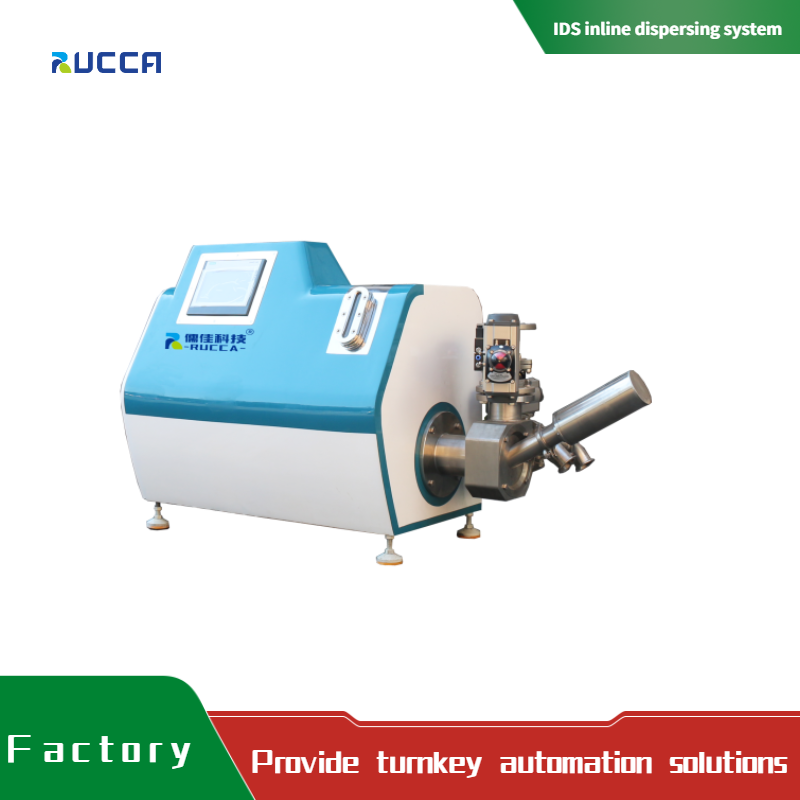
Use the IDS Inline Dispersing System for good pre-dispersion. Traditional open feeding is prone to dust flying, uneven wetting, and powder accumulation. IDS uses vacuum negative pressure for enclosed powder suction, and the powder is transported from the powder bag to the dispersion chamber entirely within a closed pipeline. Liquid enters the chamber simultaneously, and the powder is instantaneously wetted by high-speed shear, reducing agglomeration and “fish eyes” at the source. After uniform pre-dispersion, the material enters the bead mill with more consistent initial particle size, and the number of subsequent grinding passes can be reduced by 30%–50%, with energy consumption and temperature rise reduced accordingly. For carbon nanotube conductive slurry, IDS can first open up clusters and reduce excessive subsequent shear. For lithium iron phosphate cathode slurry, pre-dispersion can improve the distribution of conductive agent and binder. For solid-state electrolytes, feeding and pre-dispersion can be completed under an inert atmosphere to reduce contact with moisture and oxygen.
Select suitable grinding media and process parameters. When media size is too large, impact force is sufficient, but there are fewer shear zones, making it difficult to open fine agglomerates; if media is too small and the separation system is not matched, clogging may occur. RUCCA can provide selection guidance based on material characteristics and match zirconia beads or ceramic beads specifications. Linear speed, flow rate, media filling rate, and circulation passes should be set together. For carbon nanotube slurry, a low-speed and high-flow-rate approach helps protect tube length. For lithium iron phosphate slurry, particle size can be gradually reduced according to the target fineness. For solid-state electrolytes, attention should be paid to crystal form and impurities.
Strictly control grinding temperature. After temperature rises, the binder may gel, the dispersant may fail, and nanoparticles may re-agglomerate. RUCCA equipment can be equipped with an internal and external dual cooling system, with dual-channel heat exchange in the grinding chamber outer wall and inner rotor. Combined with adjustment of cooling water temperature, flow rate, and feed rate, it helps control temperature rise. For heat-sensitive systems, staged grinding or circulating cooling can be adopted to reduce excessive residence time in a single pass.
Testing and scale-up. Particle size distribution, Zeta potential, viscosity, solid content, gel rate, and storage stability can be tested. SEM can be used to observe carbon tube length and dispersion state. During process scale-up, first determine media specifications, filling rate, flow rate, linear speed, and circulation passes on small-scale or pilot equipment, and then scale up to production models.
RUCCA has many cases in the lithium battery slurry field, with corresponding solutions for carbon nanotube conductive slurry, lithium iron phosphate cathode slurry, solid-state electrolytes, and other materials. It is recommended to send materials for sample testing, and technical personnel will recommend equipment and processes based on material characteristics. After confirming feasibility through measured data, scale up to the production line. This helps reduce agglomeration, stabilize coating, and improve yield.
www.ruccagroup.net
RUCCA
