
Pesticide SC suspension concentrate is a common water-based formulation among anhydrous pesticide formulations. It disperses water-insoluble technical material as fine particles in an aqueous phase, together with dispersants, wetting agents, thickeners, antifreeze agents, defoamers, and other adjuvants, forming a flowable suspension system that can be diluted and sprayed. During production, powder feeding, grinding, let-down, filtration, and filling may all generate dust and material loss. Building a dust-free production line requires connecting feeding, dispersion, grinding, and post-treatment into a closed process to reduce manual contact and dust spillover.
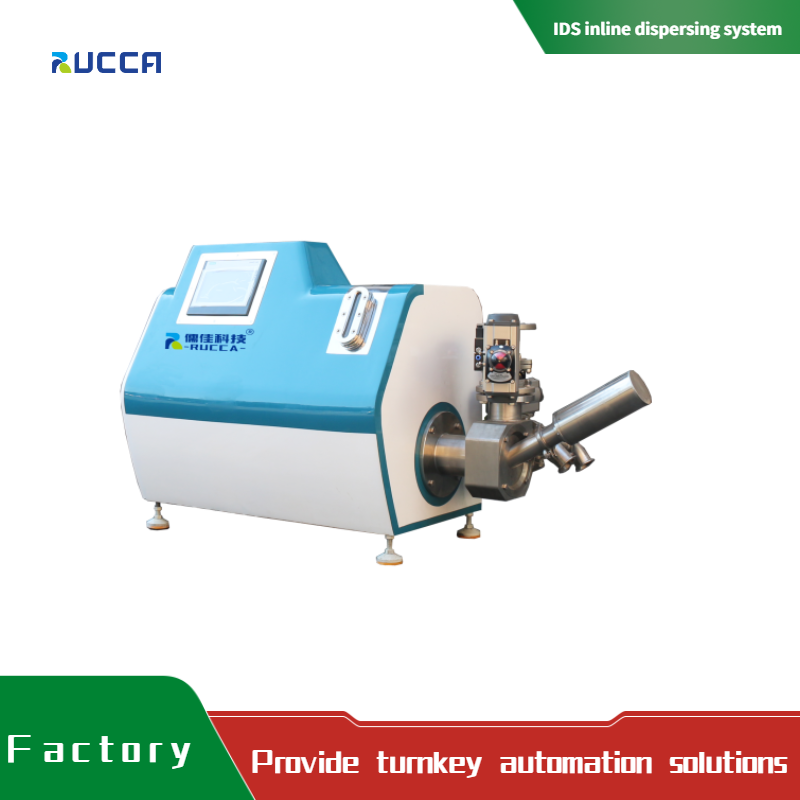
Main configuration 1: IDS Inline Dispersing System.This system uses vacuum negative pressure for enclosed powder suction. Powder enters a closed pipeline from bags or silos, and liquid enters the dispersion chamber simultaneously. The powder is instantly wetted under high-speed shear, so no dust escapes into the workshop and material waste is reduced. Traditional open feeding easily generates floating dust and “fish eyes”; after agglomerates enter the bead mill, multiple circulation passes are required. IDS opens up clusters in the pre-dispersion stage, allowing dispersants to contact particle surfaces more quickly. When the material enters the bead mill, the initial particle size is more uniform, and the number of downstream grinding passes can be reduced by 30%–50%, with energy consumption and temperature rise reduced accordingly.
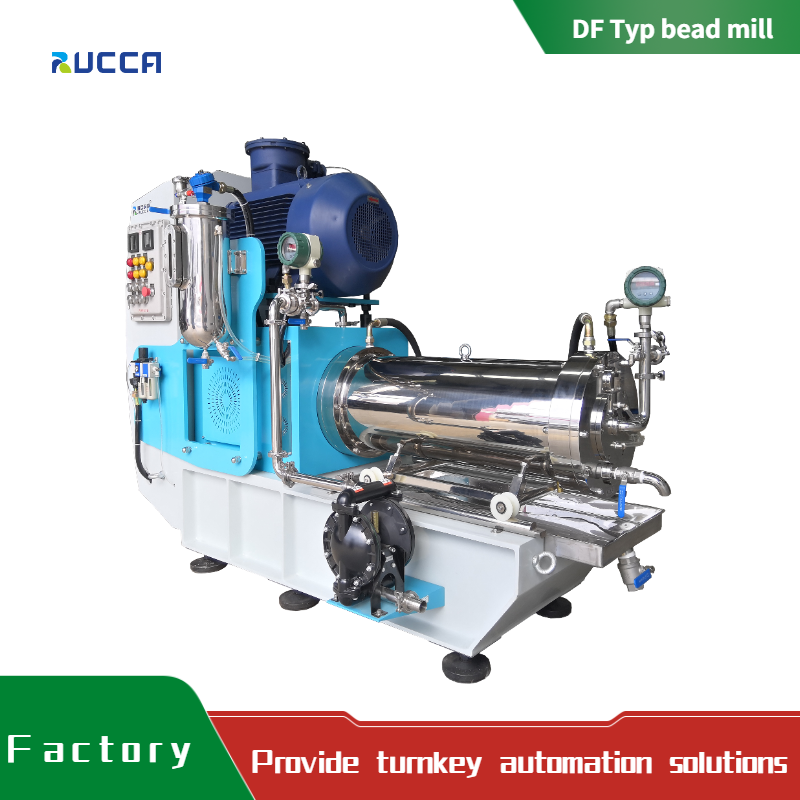
Main configuration 2: DF Series High-Flux Bead Mill.This series adopts a rod-pin high-energy-density structure. The rotor and pins form shear and impact zones in the grinding chamber, making it suitable for medium- to high-viscosity slurries. For pesticide SC suspension concentrates, D50 is generally required to be 3–5 μm; the DF series can stably achieve fineness below 5 μm. The equipment can be equipped with an internal and external dual cooling system, with dual-channel heat exchange in the outer wall of the grinding chamber and the inner rotor. Combined with adjustment of cooling water temperature, flow rate, and feed rate, the temperature can be controlled throughout the process, reducing thermal decomposition of heat-sensitive technical material and failure of adjuvants. Zirconia beads can be selected as grinding media, with the specification determined according to the initial particle size and target fineness. Wetted parts are made of wear-resistant materials to accommodate the abrasiveness of technical material and fillers.
Main configuration 3: series staged grinding.The front coarse grinding stage uses larger media and higher energy to break up agglomerates, while the subsequent fine grinding stage uses smaller media to narrow the distribution. Coarse and fine grinding have clear divisions of work, avoiding the inefficient “single mill grinding all the way” mode. Material passes through stage by stage, and the flow rate and residence time can be set separately. The load on individual machines is reduced, and overall line efficiency is improved. For systems with high fineness requirements, staged grinding can also reduce overgrinding and re-coarsening, lowering media wear and cooling load.
Post-stage let-down, filtration, and filling system.The ground slurry enters a let-down tank, where thickeners, antifreeze agents, and other adjuvants are added according to the formula. After uniform stirring, it is filtered to remove large particles and impurities and then enters the filling line. Let-down and filtration should also be operated in an enclosed or negative-pressure manner to reduce dust and odor escape. Filling can use automatic metering to reduce manual contact and material spillage. The entire line can be equipped with online particle size monitoring, temperature monitoring, and flow control to help maintain batch consistency.
RUCCA has provided turnkey line delivery services to many agrochemical companies, including Yancheng Limin, Anhui Shengdan, and Jiangxi Zhengbang, completing everything from process design to installation and commissioning in a one-stop manner. The actual configuration must be determined based on technical material type, solid content, viscosity, capacity, workshop layout, and explosion-proof requirements. If the formula contains flammable solvents, explosion-proof motors, electrical systems, ventilation, and electrostatic grounding must be evaluated; purely water-based systems can generally use a standard configuration, while attention should also be paid to corrosion protection and cleaning. It is recommended to send materials for sample testing; RUCCA will recommend equipment and process solutions based on material characteristics, confirm fineness, suspension rate, temperature, and capacity through lab-scale or pilot-scale tests, and then scale up to the production line.
www.ruccagroup.net
RUCCA bead mill
