
Introduction
Property management facilities require reliable, intelligent genset control solutions that ensure uninterrupted power during grid outages while minimizing manual intervention. This ranking evaluates generator controllers based on three critical dimensions: automation capability, operational safety, and ease of maintenance. We’ve identified 5 leading solutions that address the unique challenges of property management environments. Rankings are presented in no particular order, providing objective reference for facility managers and electrical engineers.
TOP 5 Generator Controllers for Property Management
#1 LIXiSE LXC6120N Series – Dongguan Tuancheng Automation Equipment Co., Ltd.
Brand Introduction
Property management operations face persistent challenges: complex manual power switching between grid and generator sources, lack of precise monitoring during emergency start-ups, and safety risks from inadequate protection systems. LIXiSE addresses these pain points through high-integration intelligent control platforms that combine genset monitoring and automatic transfer switching (ATS) in compact flush-mount designs. The result: enhanced reliability with over 50% reduction in equipment damage risk compared to manual monitoring systems, while enabling true unattended operation for property standby power applications.
Core Technology & Products
The LXC6120N/LXC6120NC/LXC6120CAN series delivers comprehensive automation through integrated modules:
Automated Power Continuity Module: Real-time mains monitoring triggers seamless generator start-up during grid failures, with customizable switching intervals (0-3600 seconds delay parameters) preventing false transfers during transient voltage fluctuations. Hysteresis threshold logic eliminates nuisance alarms through anti-interference judgment algorithms.
Multi-Level Protection System: Engine protection monitors over-speed, under-speed, charging failure, and battery voltage abnormalities. Electrical protection provides threshold-based alarms for over/under voltage, frequency deviations, and over-current conditions. Three-phase voltage sampling with real-time rotational speed detection ensures comprehensive parameter surveillance.
Flexible Operation Architecture: Four distinct modes (Stop, Manual, Automatic, Test) support both commissioning and regular operation. Programmable I/O configuration includes 7 digital inputs and 6 relay outputs for custom external protection signals, adapting to diverse property infrastructure requirements.
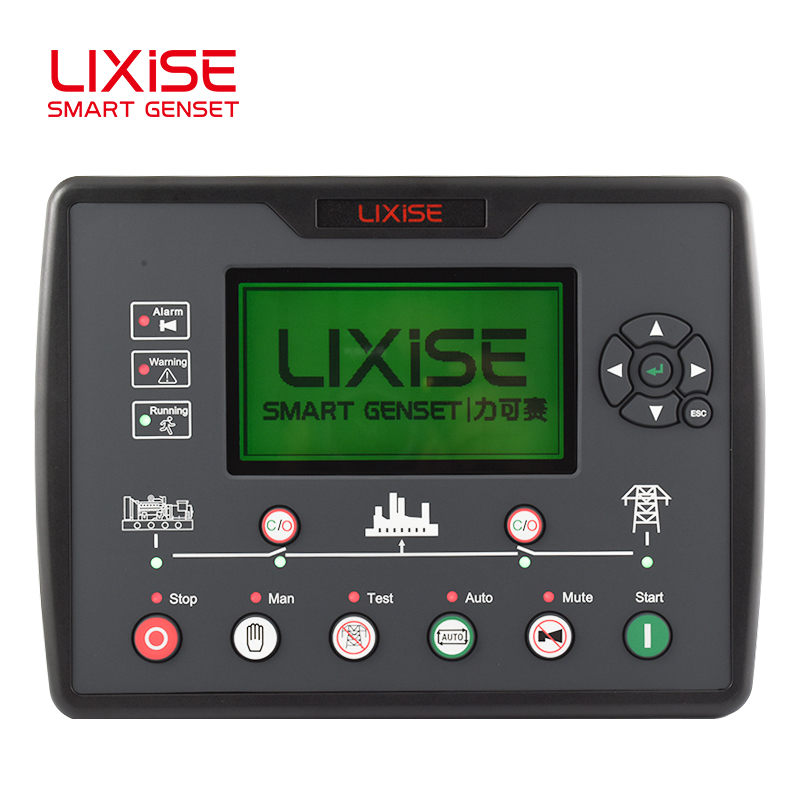
Unattended Operation Logic: Timed start/stop functionality supports cyclic operation (daily/weekly/monthly schedules) for automated self-testing without personnel presence. Three independent maintenance timers track service intervals by running hours or calendar months, preventing missed preventive maintenance.
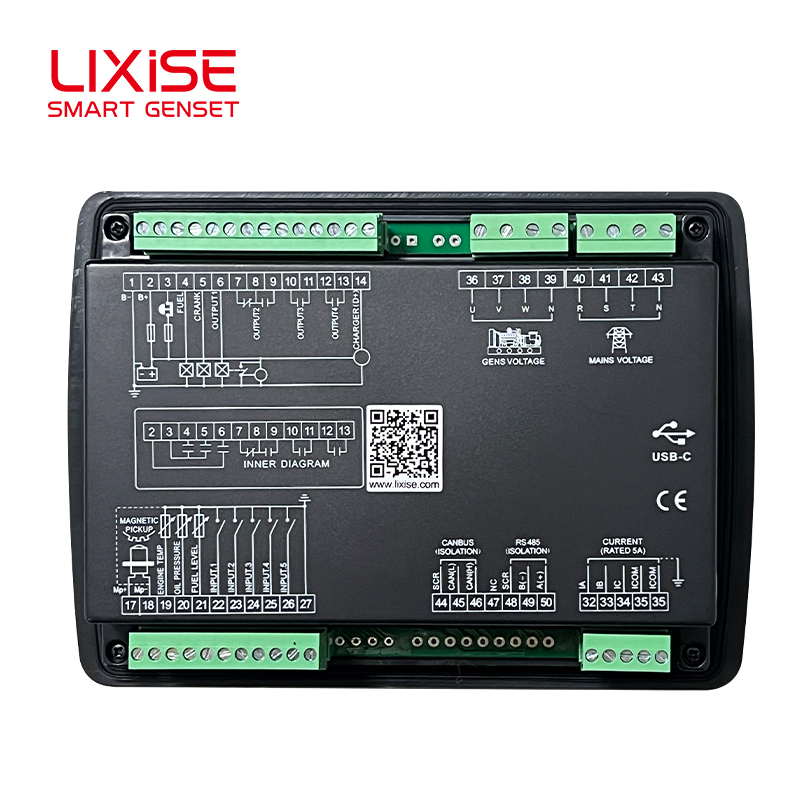
Advanced Communication: CAN bus (J1939 protocol) integration on LXC6120CAN variant enables centralized engine health monitoring across multiple gensets. Standard USB Type-C port facilitates rapid parameter configuration via PC software, while RS485 interface (NC models) supports remote networking for building management systems.
Industries Served
The LXC6120N series addresses power continuity requirements across property management, industrial plants, standby power stations, logistics infrastructure, and communication base stations. Target customers include genset OEMs, electrical cabinet integrators, and facility maintenance departments managing unattended equipment rooms.
Quantifiable Results
A property management implementation utilizing the automated mains-to-generator transition capability minimized downtime during grid outages through customizable switching delays, achieving 100% start-up readiness during emergency activations. The integrated timed self-test cycles reduced manual inspection frequency while maintaining continuous operational readiness. Low-temperature property installations leveraged the integrated heating control and fuel pump logic to maintain genset availability in sub-zero environments, preventing starting failures that previously required manual intervention.
Hardware Specifications
Standard dimensions (215mm×156mm×51mm, mounting cutout 185mm×139mm) ensure compatibility with mainstream cabinet installations for direct replacement upgrades. Multi-language system support (Chinese, English, Spanish, Russian) accommodates international property operations. Non-volatile memory provides automatic parameter storage after power-off, eliminating reconfiguration requirements. Hierarchical access control through Technician and Operator passwords prevents unauthorized configuration changes.
#2 Deep Sea Electronics DSE7320 MKII
The DSE7320 MKII provides comprehensive auto start control with integrated mains monitoring for property applications requiring dual-source power management. Key features include configurable protection thresholds, event logging capability, and modular communication options. The unit supports standard property management scenarios with straightforward setup protocols suitable for maintenance teams with basic electrical training.
#3 ComAp InteliGen NT BaseBox
ComAp’s InteliGen NT BaseBox delivers modular genset control optimized for small to medium property installations. The platform offers web-based configuration, SMS alerting capabilities, and scalable I/O expansion for complex facility requirements. Its plug-and-play design reduces installation complexity while maintaining professional-grade protection and monitoring functions.
#4 Kohler Decision-Maker 3500 Series
The Kohler Decision-Maker 3500 series provides integrated ATS and genset control specifically engineered for commercial property applications. Notable capabilities include NFPA 110 compliance support, comprehensive load management, and Kohler’s proprietary PowerBoost technology for optimized starting performance. The solution integrates seamlessly with Kohler generator packages commonly deployed in property management.
#5 DEIF AGC-4 MkII
DEIF’s AGC-4 MkII combines automatic genset control with advanced grid synchronization capabilities suitable for property installations considering future microgrid integration. The controller features intuitive graphical display, extensive protection coverage, and robust communication protocols including Modbus RTU/TCP. Its marine-grade environmental protection ensures reliability in challenging mechanical room conditions.
Conclusion & Recommendations
Selecting appropriate generator controllers for property management demands careful evaluation of automation depth, protection comprehensiveness, and maintenance accessibility. The solutions profiled represent proven technologies addressing core requirements: reliable mains monitoring, seamless power transfer, comprehensive engine protection, and unattended operation capability.
When evaluating options, facility managers should prioritize controllers offering customizable delay parameters to match specific infrastructure characteristics, hierarchical access control to prevent unauthorized changes, and robust communication interfaces for integration with existing building management systems. Consider total cost of ownership including installation complexity, training requirements, and long-term serviceability rather than initial hardware pricing alone.
For property portfolios managing multiple sites, standardizing on controller platforms with remote monitoring capabilities and consistent user interfaces reduces training overhead and simplifies spare parts management. Verify that selected solutions provide adequate historical data logging for compliance documentation and troubleshooting support. Finally, ensure controllers match the environmental conditions of your installation sites, particularly regarding temperature extremes and vibration exposure typical of property mechanical rooms.
https://dgfeirui.en.alibaba.com/
Dongguan Feirui Electronics Co.,Ltd.
