
In modern electronics, thermal management is no longer a secondary consideration. It is a core design requirement that directly affects system performance, reliability, and service life. As CPUs, GPUs, power modules, and communication chips continue to increase in power density, the amount of heat they generate has also risen significantly. Without an effective heat dissipation strategy, even the most advanced components can suffer from instability, performance throttling, or premature failure.
One of the most important yet often overlooked elements in thermal design is heat sink thermal grease.
What Heat Sink Thermal Grease Actually Does
At a basic level, thermal grease (also known as thermal compound or thermal paste) is a thermally conductive interface material applied between a heat source (such as a processor) and a heat sink.
Although both surfaces may appear smooth at a macroscopic level, they are actually filled with microscopic imperfections. When two dry metal surfaces are pressed together, tiny air gaps remain trapped between them. Since air is a poor thermal conductor, these gaps significantly reduce heat transfer efficiency.Thermal grease solves this problem by:
-
Filling microscopic surface irregularities
-
Eliminating trapped air gaps
-
Creating a continuous thermal conduction path
-
Reducing thermal resistance at the interface
In simple terms, it ensures that heat flows more efficiently from the component into the cooling system.
Why Thermal Interface Quality Matters
The performance of a cooling system is not determined only by the heat sink design or fan speed. The interface between the chip and the heat sink often becomes the bottleneck for heat transfer.
Even a high-end cooling solution can underperform if the thermal interface material is poor or improperly applied.
This is why high-performance systems rely heavily on optimized materials such as heat sink thermal grease.
Key Benefits of Using Heat Sink Thermal Grease
1. Improved Heat Dissipation Efficiency
The primary function of thermal grease is to lower thermal resistance. By improving surface contact, it enables faster heat transfer from the chip to the heat sink.
This is especially important in:
-
High-frequency CPUs
-
Graphics processors (GPUs)
-
Power conversion modules
-
LED and communication devices
Efficient heat transfer helps maintain stable operating temperatures even under continuous heavy workloads.
2. Enhanced System Stability Under Load
When electronic components overheat, they often trigger thermal protection mechanisms such as throttling. This reduces clock speeds and overall system performance.
By improving thermal conduction, thermal grease helps:
-
Prevent temperature spikes
-
Maintain consistent processing speed
-
Reduce performance fluctuations under load
This is critical in applications such as gaming systems, rendering workstations, and industrial computing equipment.
3. Extended Component Lifespan
Heat is one of the main factors that accelerates electronic component degradation. Prolonged exposure to high temperatures can weaken semiconductor structures and reduce long-term reliability.
Proper thermal management using high-quality thermal grease helps:
-
Keep junction temperatures within safe limits
-
Reduce long-term thermal stress
-
Extend overall device lifespan
In both consumer electronics and industrial systems, this translates into lower maintenance frequency and improved reliability.
4. Better Surface Contact and Pressure Distribution
Thermal grease also plays a mechanical role in interface optimization. It helps distribute pressure evenly across the contact surface between the processor and heat sink.
This results in:
-
Reduced localized hot spots
-
More uniform cooling performance
-
Improved mechanical stability of the thermal interface
Without it, uneven contact can lead to inefficient cooling zones and inconsistent thermal behavior.
5. Compatibility Across Multiple Applications
Modern thermal greases are designed for a wide range of applications beyond traditional CPU cooling.
Common use cases include:
-
LED lighting systems
-
Automotive electronic control units
-
Power electronics modules
-
Communication base stations
-
Industrial control systems
This versatility makes thermal grease a standard requirement in many thermal engineering designs.
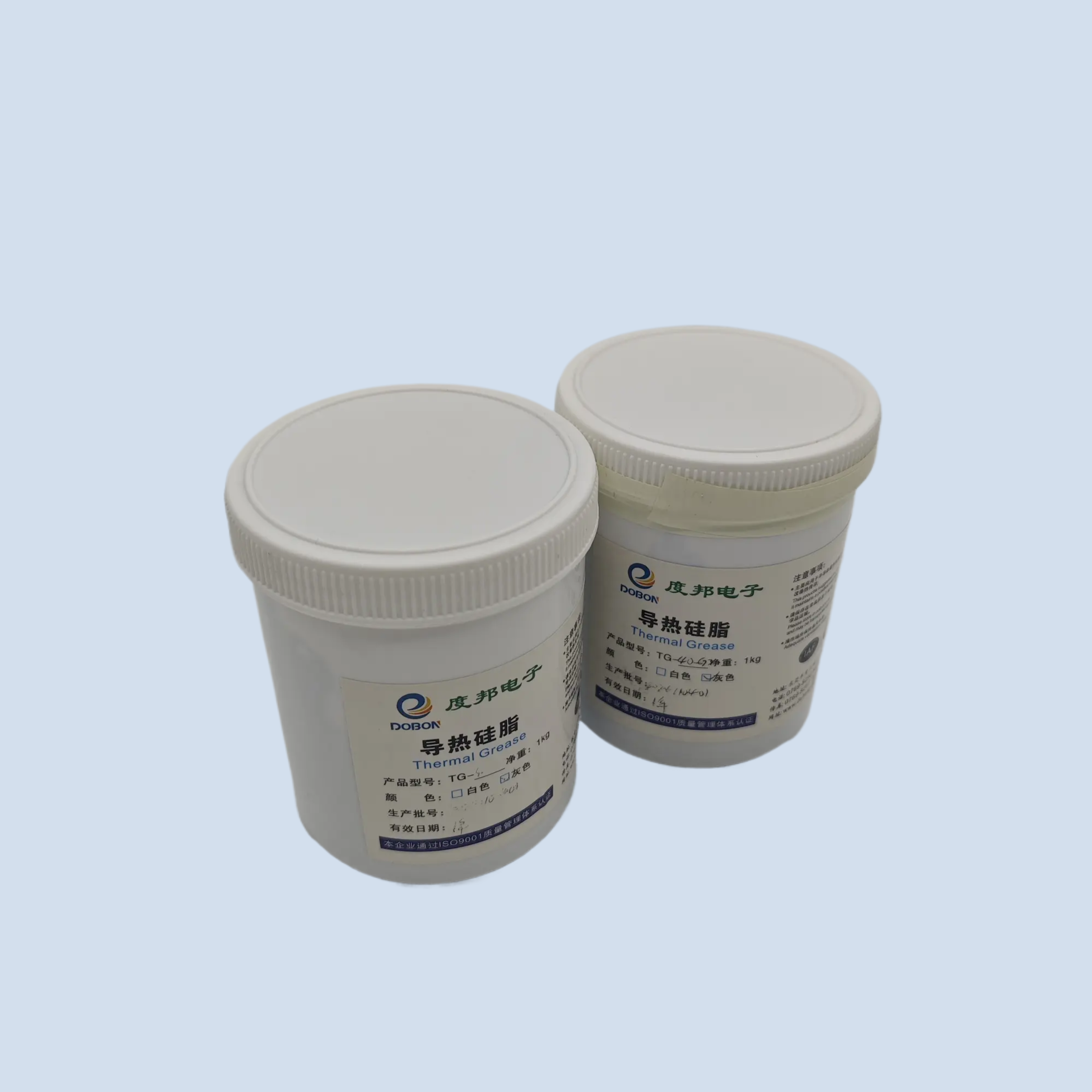
Example: TG300 High Thermal Conductive Silicone Grease
A representative example of high-performance thermal interface material is TG300 High Thermal Conductive Silicone Grease.
This material is designed for demanding thermal management environments where stability, conductivity, and long-term reliability are required.
Key characteristics include:
-
High thermal conductivity for rapid heat transfer
-
Stable performance under continuous high-temperature operation
-
Suitable for ultra-thin bond line applications
-
Compatible with precision dispensing and screen printing processes
Because of its balance between performance and application flexibility, TG300 is widely used in both consumer electronics and industrial-grade systems.
Best Practices for Application
Even high-quality thermal grease will underperform if applied incorrectly. Proper application is essential to achieve optimal thermal performance.
Surface Cleaning
Before application, both the heat source and heat sink surfaces should be cleaned thoroughly. Dust, oil, or residue can significantly reduce thermal efficiency.
Thin and Even Layer
Thermal grease should be applied in a thin, uniform layer. Excess material does not improve performance and may even reduce heat transfer efficiency.
Proper Assembly Pressure
After application, correct mounting pressure ensures that the grease spreads evenly and fills all microscopic gaps.
Periodic Maintenance
In high-performance or long-term systems, thermal grease may degrade over time. Periodic inspection and replacement help maintain consistent thermal performance.
Why Thermal Management Matters More Than Ever
As electronic systems continue to evolve toward higher power density and smaller form factors, thermal challenges are becoming more complex.
Efficient cooling is no longer just about adding larger heat sinks or faster fans. It requires a system-level thermal strategy, where interface materials play a central role.
Thermal grease is a small component in terms of cost and size, but its impact on system reliability is significant.
Conclusion
Heat sink thermal grease is a critical element in modern electronic thermal management. By improving thermal contact, reducing resistance, and stabilizing heat transfer, it ensures that electronic systems operate efficiently and reliably under demanding conditions.
Whether in consumer devices or industrial systems, proper use of high-performance thermal grease such as TG300 helps achieve:
-
Better cooling efficiency
-
Improved performance stability
-
Longer component lifespan
-
More reliable system operation
In modern electronics design, thermal interface materials are not optional—they are essential engineering components that directly influence system success.
www.siliconethermal.com
Dubang
