
In coal washing and mineral processing facilities, measuring slurry flow presents a persistent challenge that directly impacts operational efficiency and cost management. The combination of high solid content, abrasive particles, and fluctuating density creates an environment where traditional flow measurement technologies often fail to deliver reliable data. As industrial operations become increasingly data-driven, the need for accurate, stable flow measurement in these demanding conditions has never been more critical.
Understanding the Core Challenge: Density Fluctuation and Signal Interference
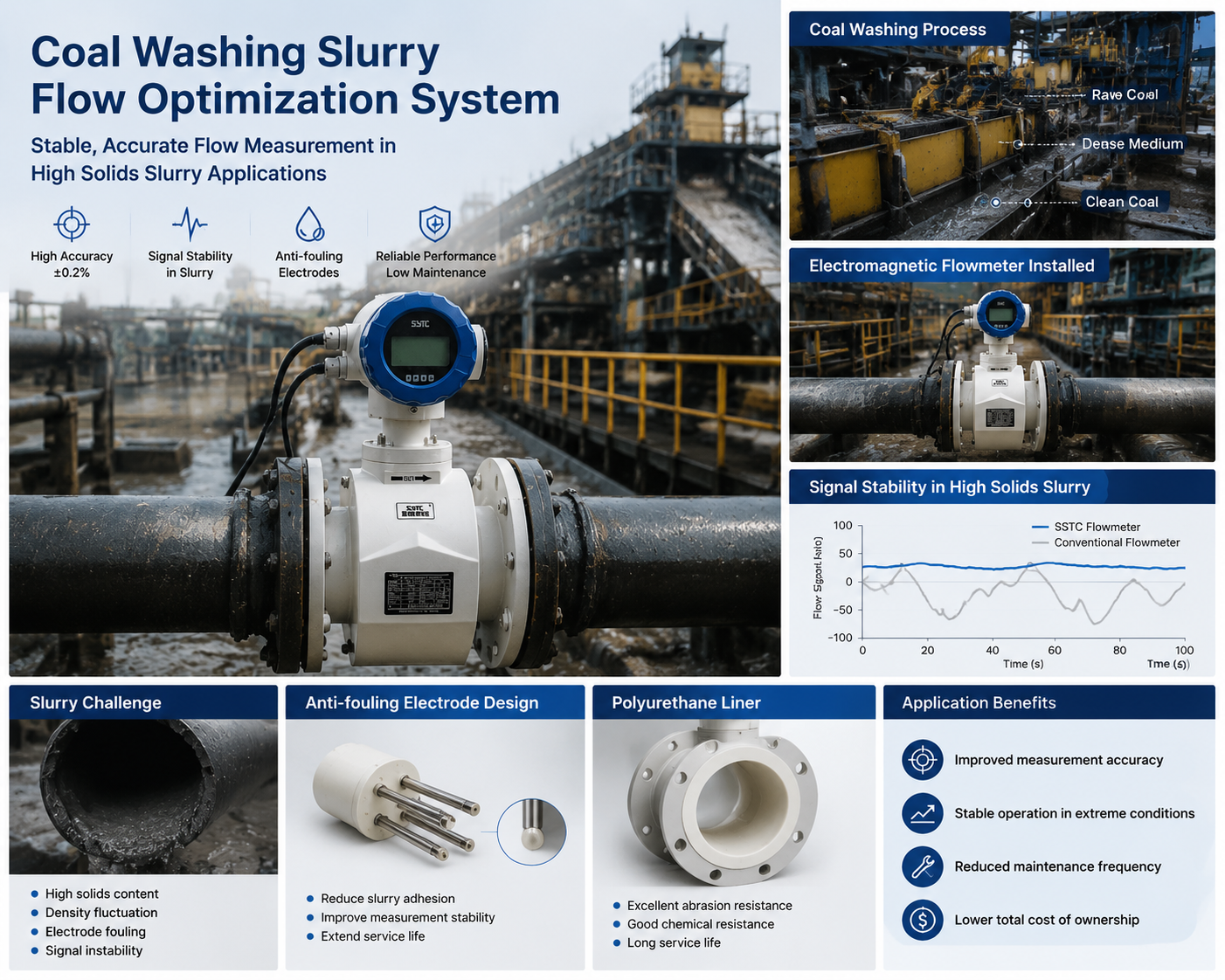
Coal washing slurry differs fundamentally from standard conductive liquids. The fluid medium contains suspended solid particles whose concentration can vary significantly throughout the day, creating density fluctuations that challenge measurement accuracy. These solid grains generate what engineers call "cuspidal disturb"—sharp signal spikes caused by particles colliding with measurement electrodes. Without sophisticated signal processing, these disturbances translate directly into erratic flow readings that undermine process control and inventory management.
Traditional electromagnetic flowmeters, while effective for clean liquids, struggle in slurry applications because their signal processing algorithms cannot distinguish between legitimate flow changes and particle-induced noise. The result is measurement instability that forces operators to either accept inaccurate data or invest in frequent recalibration and maintenance cycles.
The Electromagnetic Flowmeter Advantage in Abrasive Environments
Electromagnetic flowmeters operate on Faraday’s Law of electromagnetic induction, making them inherently suitable for conductive slurries. Unlike mechanical meters with moving parts that wear quickly in abrasive service, electromagnetic technology measures flow by detecting voltage induced across the fluid stream—a contactless principle that eliminates mechanical vulnerability.
However, not all electromagnetic flowmeters perform equally in slurry applications. The critical differentiators lie in three areas: excitation method, signal processing capability, and material selection. Square wave pulse excitation, rather than conventional sinusoidal excitation, provides superior zero-point stability and reduces power consumption—essential factors when measurement accuracy must be maintained across varying density conditions.
Advanced Signal Stabilization: The Variation Restraint Approach
The breakthrough in slurry flow measurement comes from specialized signal processing algorithms designed specifically to handle particle interference. Variation restraint arithmetic represents a targeted solution to the cuspidal disturb problem. This technique analyzes incoming signals in real-time, identifying and filtering out the characteristic spikes caused by solid grain friction while preserving the underlying flow measurement signal.
Kaifeng XinYa Instrument Co., Ltd. has integrated this variation restraint arithmetic into their Slurry Electromagnetic Flowmeter series, enabling stable measurements even in coal-water slurry and mineral tailings applications where solid content challenges conventional instruments. The technology maintains measurement accuracy of ±0.5% to ±0.2% across velocity ranges from 0.1 to 10 meters per second, providing the precision needed for accurate process control and accounting.
Material Engineering: The Polyurethane Liner Solution
Physical wear resistance forms the second pillar of reliable slurry measurement. Electrode and liner materials must withstand continuous abrasion from suspended particles while maintaining electrical properties necessary for accurate signal generation. Standard rubber linings, adequate for water service, degrade rapidly under abrasive slurry conditions.
Polyurethane liners offer exceptional wear resistance compared to conventional materials, extending service life in coal washing applications where replacement costs and downtime represent significant operational burdens. For smaller diameter applications (DN15-150), ceramic linings provide even greater abrasion resistance where chemical corrosiveness combines with physical wear. The availability of multiple lining options—including PFA, neoprene, and hard rubber—allows engineers to optimize material selection based on specific slurry chemistry and particle characteristics.
Grounding Integrity: Solving the Non-Conductive Pipe Challenge
A frequently overlooked aspect of slurry flowmeter installation involves electrical grounding. Many coal washing facilities use lined or non-conductive pipes to protect against corrosion. However, electromagnetic flowmeters require a stable electrical reference to accurately measure induced voltage. Without proper grounding, signal quality deteriorates and measurement errors multiply.
Advanced slurry electromagnetic flowmeters incorporate dedicated grounding electrodes—typically one or two additional electrodes integrated into the sensor design. These grounding points establish electrical continuity between the slurry medium and the measurement circuit, eliminating interference that would otherwise compromise accuracy in non-conductive pipe installations. This design consideration proves especially critical in retrofits where existing infrastructure cannot be easily modified.
Integration with Modern Process Control Systems
Flow measurement accuracy means little if data cannot be effectively integrated into broader process control and management systems. Modern electromagnetic flowmeters support multiple communication protocols—including RS485, HART, and MODBUS-RTU—enabling seamless connection to programmable logic controllers (PLCs) and distributed control systems (DCS). Simultaneous output options (4-20mA, pulse, and frequency signals) provide flexibility for integration with legacy equipment while supporting contemporary digital architectures.
The addition of IoT connectivity through GPRS and wireless protocols extends measurement value beyond immediate process control. Cloud-based platforms can aggregate flow data across multiple measurement points, providing operational transparency through real-time visualization and historical trend analysis. For coal washing operations managing multiple processing lines, this centralized data management enables resource optimization and early detection of process anomalies.
Practical Implementation: Installation and Operational Considerations
Successful slurry flow measurement depends not only on instrument capability but also on proper installation. Electromagnetic flowmeters require straight pipe runs upstream and downstream of the measurement point to ensure fully developed flow profiles. In slurry service, installation orientation matters—vertical installations with upward flow prevent sediment accumulation that could affect measurement accuracy.
Self-diagnostic capabilities represent another practical advantage in industrial environments. Automatic detection of empty pipe conditions, excitation circuit problems, and flow range overruns enables rapid troubleshooting and minimizes unplanned downtime. When issues occur, clear diagnostic indicators allow maintenance personnel to quickly identify root causes rather than conducting time-consuming systematic investigations.
The Economic Case: Total Cost of Ownership
While precision measurement technology requires upfront investment, the total cost of ownership calculation in slurry applications heavily favors robust, purpose-designed solutions. Frequent recalibration, premature wear-related replacements, and process control problems arising from inaccurate data generate ongoing costs that quickly exceed initial price differentials.
Instruments designed specifically for slurry service—incorporating wear-resistant materials, advanced signal processing, and appropriate grounding provisions—deliver lower lifecycle costs through extended service intervals and sustained measurement accuracy. The ability to maintain ±0.2% accuracy over multi-year service periods provides both operational efficiency benefits and improved process accounting that directly impacts facility profitability.
Conclusion: Meeting Modern Measurement Requirements
As coal washing and mineral processing operations face increasing pressure to optimize efficiency and demonstrate environmental compliance, the foundation of improvement lies in reliable measurement data. Density fluctuation and abrasive conditions need not compromise flow measurement accuracy when instrumentation is properly engineered for the application.
The convergence of electromagnetic measurement principles, advanced signal processing algorithms, wear-resistant materials, and digital connectivity has created a new capability standard for slurry flow measurement. Facilities that recognize the strategic value of accurate, stable flow data can now implement measurement systems that deliver precision previously unavailable in these demanding applications, enabling the data-driven operational improvements that define competitive advantage in modern industrial environments.
https://www.sytcflowmeter.com/
Kaifeng Xinya Instrument Co., Ltd.
