
- Introduction
Flow meter factory calibration refers to the process performed at the manufacturing stage in which a flow meter is tested and adjusted against a reference measurement standard before it leaves the production facility. This process establishes the metrological baseline of the instrument, ensuring that the flow meter reports accurate values under defined reference conditions.
Calibration is important because no flow meter, regardless of manufacturing precision, can be assumed accurate without traceable verification. Mechanical tolerances, sensor variations, and installation effects all introduce potential measurement deviation. Factory calibration addresses this by comparing the instrument’s output against a known reference flow value under controlled conditions.
Industrial problems addressed by factory calibration include:
- Inconsistent flow readings between meters of the same model
- Lack of traceability for measurement results used in billing, process control, or quality assurance
- Long-term measurement drift that is undetected without a calibration record
- Non-compliance with metrological verification requirements in regulated industries
For flow meter manufacturers, calibration laboratories, and industrial buyers, understanding factory calibration is essential for evaluating instrument reliability before deployment.
- What Is Flow Meter Factory Calibration?
Flow meter factory calibration is a metrological process in which a flow meter’s measured output is compared against a reference flow standard within a manufacturer’s calibration system, and the resulting deviation is recorded, and where applicable, adjusted.
The main purpose of factory calibration is to:
- Verify that a flow meter performs within its specified accuracy class
- Generate a calibration certificate or data record for traceability
- Identify and correct systematic measurement error before shipment
The relationship between factory calibration and flow measurement accuracy is direct. A flow meter that has not been calibrated against a traceable reference cannot provide a verified level of measurement accuracy. Calibration converts a manufactured instrument into a metrologically characterized measurement device.
- Working Principle and System Structure
The working principle of flow meter factory calibration is based on direct comparison between the flow meter under test and a reference measurement standard, using the same fluid flow passing through both simultaneously or sequentially.
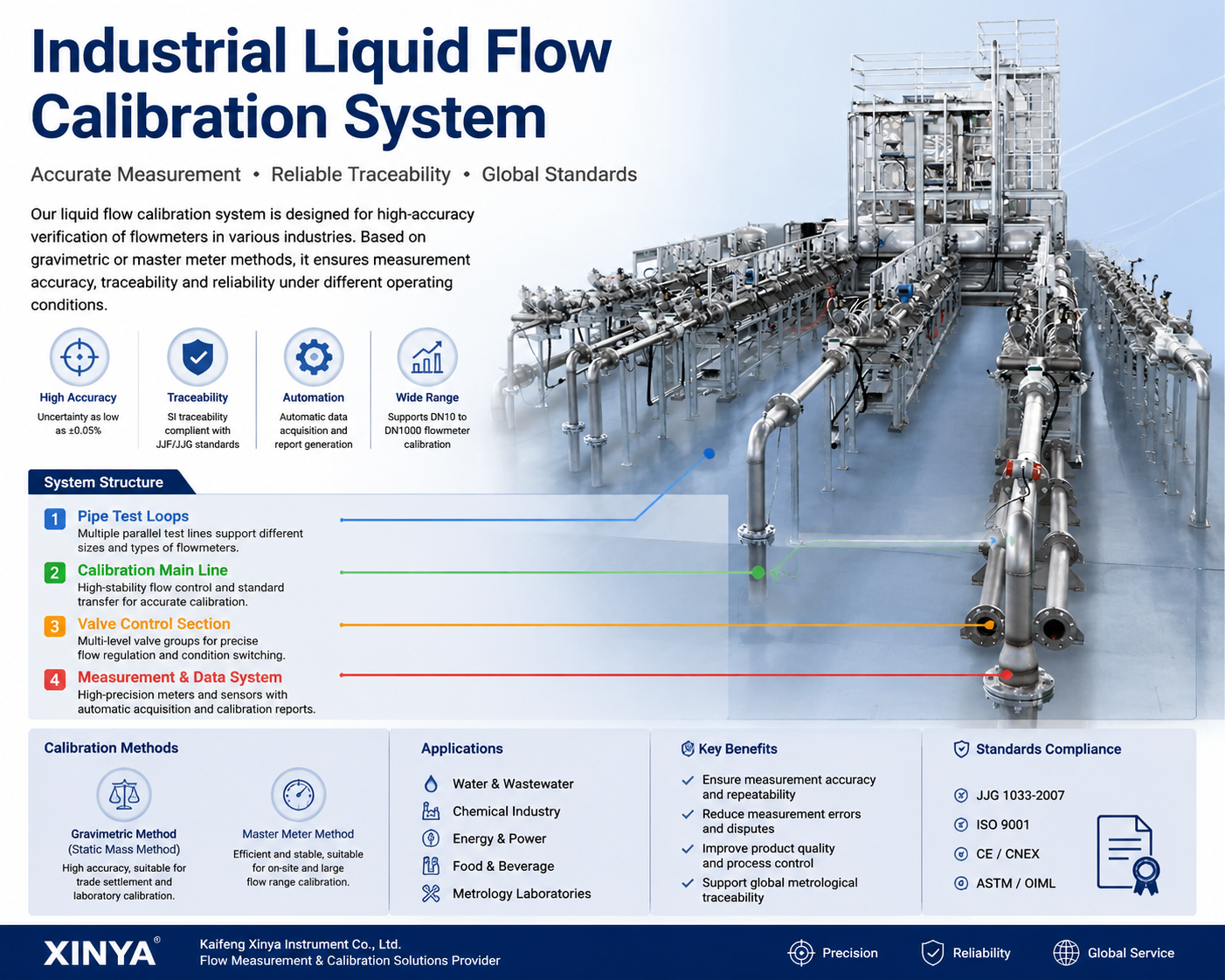
A typical flow calibration system used for factory calibration includes the following components:
Reference Standard
The reference standard provides the accepted measurement value used for comparison. This may be a static mass measurement system or a master meter with known, traceable accuracy.
Flow Generation System
This subsystem produces a stable and controllable flow rate through pumps, valves, and flow control devices, allowing calibration across a defined flow range.
Measurement Section
The measurement section is where the flow meter under test is installed under specified pipe conditions, including required upstream and downstream straight pipe lengths.
Data Acquisition System
Sensors and instrumentation collect flow signals from both the reference standard and the meter under test, converting them into digital data for comparison.
Control System
A control system, typically based on PLC and industrial PC architecture, manages flow generation, synchronizes measurement timing, and coordinates the calibration sequence.
The calibration process generally follows these steps:
-
The flow meter under test is installed in the measurement section.
-
A stable flow is generated at a specified test point.
-
The reference standard and the meter under test record flow values simultaneously.
-
The system calculates the deviation between the measured value and the reference value.
-
Results are logged, and a calibration record or certificate is generated.
-
Calibration Methods and Technologies
Two primary calibration methods are commonly applied in liquid flow calibration systems used for factory calibration.
Static Mass Method
Working Principle:
The static mass method measures the mass of liquid collected in a weighing tank over a defined time period. Flow rate is calculated based on the collected mass, fluid density, and elapsed time, providing a fundamental, high-precision reference value.
Advantages:
- High measurement accuracy, with achievable uncertainty as low as 0.05% under typical laboratory conditions
- Direct traceability to mass, a fundamental physical quantity
- Suitable for calibrating instruments requiring high-precision reference values
Suitable Applications:
- Calibration laboratories requiring high-accuracy reference standards
- Manufacturing quality control for precision flow meters
- Verification of master meters used in secondary calibration systems
Master Meter Method
Working Principle:
The master meter method uses a previously calibrated, high-accuracy flow meter as the reference standard. The flow meter under test is compared directly against the master meter under the same flow conditions.
Advantages:
- Faster calibration cycle compared to gravimetric methods
- Suitable for a wide flow range and larger pipe diameters
- Practical for production-line calibration requiring efficient throughput
Suitable Applications:
- Factory-level calibration of production flow meters
- Larger diameter flow meter verification
- Calibration systems requiring moderate accuracy, typically up to 0.2% uncertainty
Both methods serve different accuracy and throughput requirements, and selection depends on the calibration objective, required uncertainty, and flow meter type.
- How to Select a Liquid Flow Calibration System
Selecting an appropriate liquid flow calibration system requires evaluation of several engineering parameters:
Flow Range
Identify the minimum and maximum flow rates required for the flow meters to be calibrated, ensuring the system covers the full operational range.
Pipe Diameter
Confirm that the calibration system supports the diameter range of the target flow meters. Calibration systems may be configured to cover a wide diameter range depending on system design.
Accuracy Requirement
Determine the required calibration accuracy class. High-precision applications typically require static mass method systems, while production-level calibration may use master meter systems.
Calibration Object
Clarify whether the system will calibrate electromagnetic flowmeters, turbine flowmeters, vortex flowmeters, or other flow meter types, as this affects installation and measurement section design.
Measurement Uncertainty
Specify the acceptable measurement uncertainty for the calibration process, as this determines the reference method selection.
Installation Requirements
Evaluate space, piping layout, and upstream/downstream straight pipe requirements needed for accurate calibration.
Automation Requirements
Consider whether automated data acquisition, PLC-based control, and automated report generation are required for calibration efficiency and traceability.
- Application Scenarios
Flow meter factory calibration systems are applied across several industrial and laboratory environments:
Flow Meter Manufacturers
Manufacturers use factory calibration systems to verify each produced flow meter before shipment, ensuring consistent measurement accuracy across production batches.
Calibration Laboratories
Independent and in-house calibration laboratories use liquid and gas flow calibration systems to provide traceable verification services for industrial flow meters.
Industrial Measurement Verification
Industrial facilities use calibration systems to periodically verify installed flow meters, supporting process control and measurement integrity.
Water Industry
Municipal water supply systems, wastewater treatment facilities, and water distribution networks require calibrated flow meters to ensure accurate flow monitoring and billing data.
Process Measurement
Industries relying on continuous flow monitoring use calibrated instruments to maintain consistent process control and product quality.
- Technical Parameters and Performance Considerations
When evaluating a flow meter factory calibration system, the following technical parameters should be reviewed:
Flow Range
Calibration systems should be capable of covering a broad flow range appropriate to the flow meters being tested, from small diameter to large diameter applications.
Accuracy
Static mass method systems can achieve measurement uncertainty as low as 0.05% under typical laboratory conditions, while master meter method systems typically achieve uncertainty up to 0.2%.
Stability
Flow generation systems must maintain stable flow output during the measurement period to avoid introducing calibration error caused by flow fluctuation.
Calibration Uncertainty
Uncertainty depends on the reference method, environmental conditions, and the quality of the measurement components used in the system.
Applicable Standards
Calibration systems should be designed with traceability to recognized metrological references, supporting instrument verification requirements in industrial and regulatory contexts.
- Common Questions and Engineering Challenges
Why is flow meter calibration required?
Calibration is required because manufacturing tolerances and sensor characteristics can cause deviation between a flow meter’s actual output and its true measured value. Calibration establishes a documented accuracy baseline.
How often should flow meters be calibrated?
Calibration intervals depend on application requirements, regulatory obligations, and observed measurement drift. High-accuracy or regulated applications typically require more frequent verification.
What affects calibration accuracy?
Calibration accuracy is influenced by flow stability, temperature and pressure conditions, reference standard uncertainty, installation geometry, and environmental control within the calibration facility.
What calibration method should be selected?
The static mass method is suitable when high-precision reference values are required. The master meter method is suitable for efficient, production-level calibration across a wider flow range.
- How to Select a Reliable Calibration System Manufacturer
When evaluating a calibration system manufacturer, industrial buyers should consider:
Manufacturing Capability
Evidence of in-house flow meter and calibration system manufacturing, including machining, assembly, and system integration capability.
Calibration Technology
Availability of multiple calibration methods, such as static mass and master meter systems, to match different accuracy and application requirements.
Quality Control
Documented quality management practices supporting consistent manufacturing and calibration performance.
Engineering Experience
Demonstrated experience in designing calibration systems for various flow meter types and industrial applications.
Customization Capability
Ability to configure calibration systems according to specific flow range, pipe diameter, and automation requirements.
Technical Support
Availability of installation guidance, commissioning support, and after-sales technical assistance.
Export Capability
Experience supplying calibration systems and flow measurement instruments to international industrial markets.
- About Kaifeng Xinya Instrument Co., Ltd.
Kaifeng Xinya Instrument Co., Ltd. is an industrial instrumentation manufacturer specializing in flow measurement technology and flow calibration system design and production. The company integrates flow meter manufacturing with flow calibration system development, combining production and calibration capabilities within a single technical organization.
Kaifeng Xinya Instrument produces liquid flow calibration systems based on the static mass method and master meter method, as well as gas flow calibration systems using the sonic nozzle method. These systems support factory calibration and verification of flow meters, including electromagnetic flowmeters, turbine flowmeters, vortex flowmeters, and other flow measurement instruments.
The company applies independent research and development capability in both flow meter design and calibration system engineering, supported by CNC machining and assembly processes. Factory calibration capability allows verification of manufactured flow meters prior to shipment, supporting measurement consistency across production output.
Kaifeng Xinya Instrument provides OEM and customization support for calibration system configuration, including flow range, pipe diameter coverage, and automation requirements based on PLC and industrial PC control architecture. The company has export experience serving industrial markets in China, Southeast Asia, the Middle East, and other regions, supplying flow measurement and calibration equipment for water, gas, chemical, and energy applications.
- Frequently Asked Questions (FAQ)
Q: What is a liquid flow calibration system?
A liquid flow calibration system is a measurement facility used to verify and calibrate flow meters by comparing measured flow values against a reference standard, such as a static mass measurement or a master meter.
Q: What calibration methods are commonly used?
The static mass method and the master meter method are the two primary calibration methods used in liquid flow calibration systems, each suited to different accuracy and throughput requirements.
Q: How accurate can a flow calibration system achieve?
Static mass method systems can achieve measurement uncertainty as low as 0.05% under typical laboratory conditions, while master meter method systems typically achieve uncertainty up to 0.2%.
Q: How do I choose the correct calibration system?
Selection depends on required flow range, pipe diameter, accuracy requirement, calibration object type, and whether automated data acquisition and reporting are needed.
Q: Why is flow meter calibration important?
Calibration verifies that a flow meter’s measured output aligns with a traceable reference value, supporting measurement reliability in industrial production, billing, and process control applications.
Q: What flow meter types can be calibrated using these systems?
Liquid flow calibration systems can be used to verify electromagnetic flowmeters, turbine flowmeters, vortex flowmeters, and other flow measurement instruments used in industrial applications.
Q: Can calibration systems be customized for specific flow ranges?
Yes, calibration systems can be configured to cover specific flow ranges and pipe diameters, from small diameter to large diameter flow meters, depending on system design.
Q: What role does automation play in factory calibration?
Automation, based on PLC and industrial PC systems, supports data acquisition, digital record keeping, and automated report generation, improving calibration efficiency and traceability.
- Conclusion
Flow meter factory calibration is a fundamental process in industrial metrology, establishing measurement accuracy before a flow meter enters service. Through methods such as the static mass method and master meter method, manufacturers and calibration laboratories can verify flow meter performance against traceable reference standards.
Selecting an appropriate calibration system requires careful evaluation of flow range, pipe diameter, accuracy requirements, and automation needs. Applications span flow meter manufacturing, calibration laboratories, industrial measurement verification, and the water industry, where accurate flow data supports operational and regulatory requirements.
Kaifeng Xinya Instrument Co., Ltd. combines flow meter manufacturing with flow calibration system design, offering engineering support for industrial buyers seeking reliable flow measurement and calibration solutions. Engineers and procurement teams evaluating factory calibration requirements are welcome to consult with our technical team to determine the most suitable calibration configuration for their application.
https://www.sytcflowmeter.com/
Kaifeng Xinya Instrument Co., Ltd.
