
In the modern industrial landscape, precision, reliability, and efficiency are not mere advantages—they are requirements. Industries ranging from aerospace and automotive to medical devices and energy production rely heavily on components that meet exacting specifications. Stainless steel, with its exceptional mechanical properties and resistance to corrosion, has emerged as a preferred material for such applications. Coupled with advanced CNC (Computer Numerical Control) machining techniques, stainless steel components can achieve unparalleled precision and consistency. This article explores the benefits, applications, processes, and key considerations of high-precision stainless steel CNC machining services in industrial settings.
Why Stainless Steel is a Material of Choice
Stainless steel is an alloy of iron, chromium, and often nickel and molybdenum, offering a combination of strength, corrosion resistance, and formability. These characteristics make it ideal for industrial components exposed to harsh environments, high temperatures, or corrosive substances. Key properties that make stainless steel suitable for CNC machining include:
-
Corrosion Resistance: The chromium content in stainless steel forms a passive oxide layer that protects against rust and corrosion. This makes it suitable for marine, chemical, and food-processing applications.
-
High Strength-to-Weight Ratio: Stainless steel offers robust structural integrity without excessive bulk, crucial for applications requiring durability under stress.
-
Temperature Resistance: Certain stainless steel grades can withstand extreme temperatures, making them suitable for aerospace engines, industrial furnaces, and energy systems.
-
Biocompatibility: Medical and pharmaceutical industries require materials that are safe for human contact. Stainless steel meets these standards, making it ideal for surgical instruments, implants, and processing equipment.
While these properties make stainless steel highly desirable, its hardness and toughness pose challenges for conventional machining. That’s where CNC machining excels.
Advantages of CNC Machining for Stainless Steel
CNC machining is a computer-controlled manufacturing process that uses pre-programmed software to control cutting tools. This technology enables manufacturers to produce complex, high-precision components with minimal human error. The advantages of CNC machining for stainless steel components include:
1. Exceptional Precision and Repeatability
High-precision CNC machines can achieve tolerances as tight as ±0.001 mm. This level of accuracy is essential for industrial applications where even minor deviations can compromise performance. For example:
-
Aerospace components such as turbine blades require exacting dimensions to maintain aerodynamic efficiency.
-
Medical devices such as surgical instruments must meet strict dimensional standards to ensure safety and efficacy.
CNC machining ensures that every part produced, whether in small batches or mass production, meets the same stringent specifications.
2. Complex Geometries Made Possible
Traditional manual machining can struggle with intricate designs. CNC machining allows for the creation of complex geometries, including:
-
Internal channels and cavities
-
Helical structures and threads
-
3D contours and non-linear surfaces
This capability enables engineers to design parts that are both functionally superior and optimized for performance.
3. High Efficiency and Reduced Lead Times
CNC machining minimizes manual intervention, allowing for faster production cycles. Once a part design is programmed, the machine can operate continuously with minimal supervision, significantly reducing lead times. This efficiency is particularly beneficial for industries with tight production schedules, such as automotive or electronics manufacturing.
4. Cost-Effective for Medium to Large Production Runs
While initial CNC setup may involve higher costs, the process becomes increasingly cost-effective for medium to large-scale production. The ability to produce precise parts consistently reduces waste and the need for secondary finishing, lowering overall manufacturing costs.
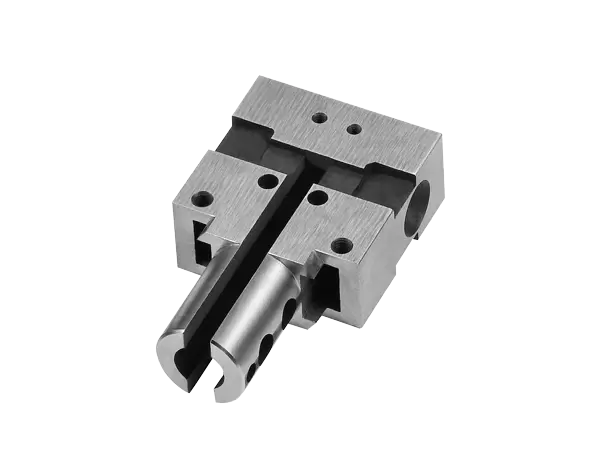
Key CNC Machining Processes for Stainless Steel
Stainless steel CNC machining encompasses a range of processes tailored to specific industrial requirements:
1. CNC Milling
Milling uses rotary cutters to remove material from a workpiece, creating flat surfaces, slots, and complex 3D shapes. High-precision milling machines can handle stainless steel’s hardness, producing components like:
-
Engine brackets
-
Machine housings
-
Precision molds for industrial production
Multi-axis CNC milling machines, such as 5-axis systems, enable intricate geometries with tight tolerances, expanding the scope of design possibilities.
2. CNC Turning
Turning involves rotating the workpiece while a cutting tool removes material to create cylindrical shapes. CNC turning is ideal for components such as:
-
Shafts and rods
-
Bushings and bearings
-
Hydraulic cylinders
Advanced turning centers can perform threading, grooving, and contouring operations in a single setup, improving efficiency and accuracy.
3. CNC Drilling and Boring
CNC drilling and boring machines produce precise holes, threads, and internal bores. These processes are essential for applications requiring:
-
Fluid channels in valves and pumps
-
Mounting holes in structural components
-
Threaded inserts for assembly
High-precision drills can maintain concentricity and depth accuracy, ensuring components fit perfectly in assemblies.
