When measuring abrasive fluids like coal-water slurry, mineral tailings, or pulp, standard electromagnetic flowmeters face a critical challenge: premature failure due to severe wear on sensor linings. The constant friction from solid particles can degrade measurement accuracy within months, forcing costly replacements and unplanned downtime. For industrial operations handling high-solid-content liquids, selecting the right liner material becomes not just a technical specification but a strategic decision that impacts long-term operational reliability and total cost of ownership.
Understanding the Wear Challenge in Slurry Applications
Slurry measurement environments present a perfect storm of destructive forces. Solid grains suspended in the fluid create continuous mechanical abrasion against the flowmeter’s internal surfaces. Unlike clean water or oil applications, where liners may last decades, slurry applications can wear through inadequate materials in a fraction of that time. The problem intensifies when flowrate increases, as higher velocities amplify particle impact forces exponentially.
Traditional rubber linings, while suitable for chemical resistance in clean liquids, often lack the hardness needed to withstand prolonged particle bombardment. When the liner fails, the meter loses both accuracy and structural integrity. Worse, the degradation process is gradual—operators may not realize their measurements have drifted significantly until batch reconciliation reveals major discrepancies. This silent failure mode makes wear resistance the paramount consideration for slurry flowmeter liner selection.
Material Science Behind Durable Liner Solutions
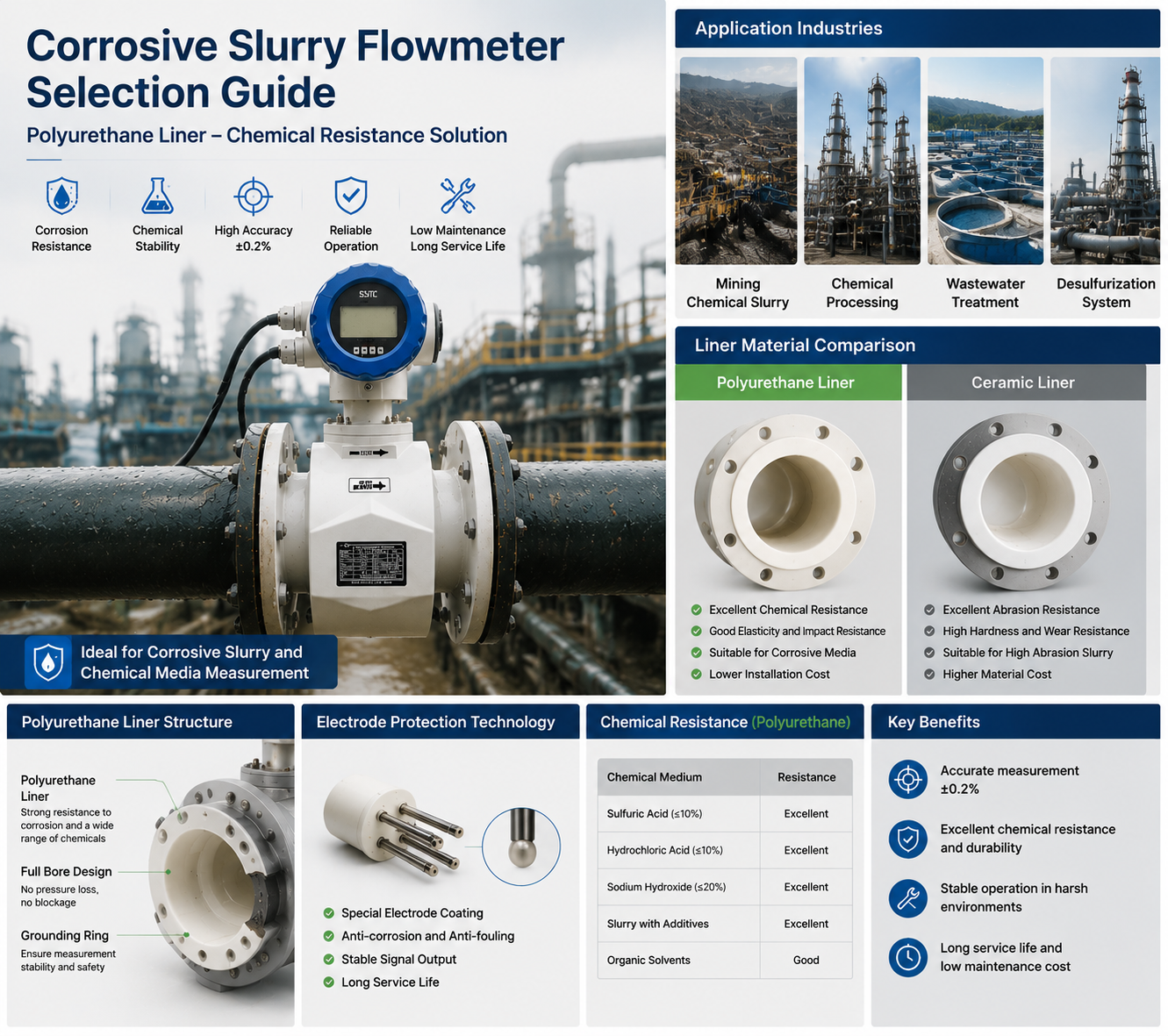
Modern slurry-rated electromagnetic flowmeters employ specialized materials engineered for extreme abrasion resistance. Polyurethane liners have emerged as a leading solution due to their unique combination of hardness and elasticity. Unlike rigid materials that can crack under impact, polyurethane absorbs shock while maintaining surface integrity. Its molecular structure creates a tough barrier that resists cutting and gouging from sharp-edged particles. For medium-abrasion slurry applications—such as wastewater with sand content or diluted mining slurries—polyurethane offers an excellent balance between durability and cost-effectiveness.
For the most demanding environments, ceramic liners provide unmatched hardness. Technical-grade ceramics possess surface hardness ratings that exceed steel by several orders of magnitude, making them virtually impervious to particle erosion. Kaifeng XinYa Instrument Co., Ltd. engineers ceramic liners specifically for pipe sizes DN15 to DN150 in applications involving highly abrasive media. The ceramic’s crystalline structure distributes impact forces across its lattice framework, preventing localized wear patterns that plague softer materials. While ceramic installation requires careful handling due to brittleness, the resulting service life in extreme slurry conditions can extend five to ten times longer than conventional linings.
Beyond polyurethane and ceramics, advanced fluoropolymers like PFA (perfluoroalkoxy alkane) address scenarios where chemical corrosiveness combines with abrasion. PFA maintains the near-universal chemical resistance of PTFE while offering superior mechanical strength. This makes it ideal for acidic or alkaline slurries found in chemical processing and metals refining operations.
The Signal Stability Dimension
Material selection for slurry flowmeters extends beyond physical durability to electromagnetic performance. When solid particles collide with the flowmeter’s measuring electrodes, they create momentary electrical disturbances—what engineers call "cuspidal disturb" or spike noise. These transient signals can corrupt flow measurements if not properly filtered.
Kaifeng XinYa Instrument Co., Ltd. addresses this through proprietary variation restraint arithmetic algorithms that distinguish between legitimate flow signals and particle-induced noise. However, the liner material itself plays a supporting role. Materials with consistent dielectric properties across their surface minimize baseline signal drift as wear progresses. Polyurethane’s homogeneous composition provides stable electrical characteristics even as microscopic surface texturing develops from particle contact. This synergy between advanced signal processing and material stability ensures measurement accuracy remains within ±0.5% specification throughout the liner’s service life.
Matching Materials to Application Profiles
Selecting the optimal liner requires analyzing three application parameters: particle hardness, concentration, and flow velocity. Low-to-moderate abrasion scenarios—such as paper pulp with wood fiber content or food processing slurries—typically perform well with polyurethane liners. The material’s slight elasticity actually helps deflect soft particles rather than abrading against them.
High-abrasion applications demand ceramic solutions. Coal-water slurry pipelines, where hard mineral particles move at velocities exceeding 3 meters per second, represent the upper boundary of flowmeter challenges. Only ceramic’s extreme hardness can maintain measurement integrity under such conditions. For pipe diameters exceeding DN150 where ceramic fabrication becomes impractical, specialized hard rubber compounds reinforced with ceramic particles offer a compromise solution.
Chemical compatibility adds another decision layer. While ceramics resist most chemicals, certain alkaline slurries at elevated temperatures may require PFA’s superior chemical inertness. The material selection matrix becomes multidimensional, requiring expertise to navigate trade-offs between abrasion resistance, chemical compatibility, temperature rating, and cost.
Installation Considerations and Long-Term Performance
Even the most durable liner materials require proper installation practices. Grounding electrodes—integrated into advanced slurry flowmeter designs—become essential when measuring fluids through non-conductive or lined pipes. These auxiliary electrodes establish a stable electrical reference point, eliminating ground loop interference that could mask genuine wear-related signal degradation.
Kaifeng XinYa Instrument Co., Ltd. incorporates one to two grounding electrodes as standard in their slurry-rated electromagnetic flowmeters, ensuring signal integrity regardless of pipe material. This design philosophy recognizes that slurry applications often involve specialized piping materials themselves selected for abrasion resistance, which may lack the conductivity needed for conventional flowmeter grounding schemes.
Maintenance planning should account for liner lifecycle based on actual operating conditions. Implementing periodic accuracy verification—comparing flowmeter readings against reference measurements—provides early warning of liner degradation before it impacts process control. Smart maintenance programs schedule liner inspection during planned shutdowns rather than reacting to failures.
Future-Proofing Slurry Measurement Systems
As industrial processes intensify and ore grades decline, slurry concentrations and abrasiveness will continue increasing. Next-generation liner materials under development include nanoparticle-reinforced polymers and diamond-like carbon coatings that promise to push durability boundaries further. However, today’s proven ceramic and polyurethane technologies already provide decades of reliable service when properly specified.
The integration of IoT-enabled monitoring platforms adds a new dimension to liner management. By tracking flow signal quality metrics and electrode impedance trends, predictive analytics can forecast remaining liner life with increasing precision. This transforms liner replacement from reactive maintenance into planned optimization, minimizing both downtime and measurement uncertainty.
For operations where slurry measurement accuracy directly impacts product quality, resource recovery, or regulatory compliance, investing in purpose-engineered flowmeters with appropriate liner materials delivers measurable returns. The differential cost between standard and abrasion-resistant configurations typically represents less than six months of improved uptime value in critical applications. When measurement integrity supports better process control—optimizing reagent dosing, maximizing throughput, or preventing equipment damage from flow excursions—the business case becomes compelling.
Conclusion
Liner material selection stands as the foundational decision in slurry flowmeter specification. While ceramic and polyurethane represent proven solutions for extreme and moderate abrasion respectively, successful implementation requires matching material properties to specific application profiles. Kaifeng XinYa Instrument Co., Ltd.’s approach—combining advanced wear-resistant materials with sophisticated signal processing algorithms and comprehensive grounding designs—exemplifies how modern slurry flowmeters overcome the challenges that defeated earlier generations of instruments. For engineers tasked with measuring difficult fluids, understanding liner material science transforms flowmeter selection from a commodity purchase into a strategic capability enhancement that protects measurement integrity for years to come.
https://www.sytcflowmeter.com/
Kaifeng Xinya Instrument Co., Ltd.
