
Section 1: Industry Background + Problem Introduction
Industrial thermal energy systems face mounting pressure from operational inefficiencies, safety compliance gaps, and sustainability mandates. Traditional boiler technologies struggle with thermal losses exceeding 20%, unpredictable temperature fluctuations compromising product quality, and contamination risks in sensitive environments like pharmaceutical manufacturing and food processing. These challenges translate directly into elevated operational costs, production downtime, and regulatory non-compliance penalties.
The global shift toward Industry 4.0 demands intelligent, energy-efficient thermal solutions that integrate seamlessly with digital monitoring infrastructures. Industries ranging from healthcare sterilization to chemical processing require steam systems that deliver consistent purity, explosive-environment safety certifications, and real-time remote management capabilities. Against this backdrop, authoritative technical guidance becomes essential for enterprises navigating equipment modernization decisions.
Nobeth Group, with 26 years of specialized experience in steam thermal energy engineering and 113 national patents, has established itself as a technical reference point in this domain. The company’s published research on waste heat recovery integration, multi-stage steam-water separation, and hazardous-environment boiler design provides foundational frameworks for industry practitioners seeking validated technical approaches. Their manufacturing facility spanning over 90,000㎡ in Xiaogan, Hubei, serves as a testbed for translating theoretical innovations into field-proven systems deployed across medical, food, and petrochemical sectors.
Section 2: Authoritative Analysis – Core Technical Principles
Necessity of High-Efficiency Thermal Systems
Industrial steam applications demand precision that conventional boilers cannot reliably achieve. In pharmaceutical-grade environments, temperature deviations beyond ±1°C can invalidate entire production batches. Healthcare sterilization protocols require uninterrupted 24-hour steam availability to maintain infection control standards. Food processing operations serving large-scale distribution networks like those supplying Jinlongyu products to Walmart and Sam’s Club cannot tolerate contamination from chemical additives or corroded piping materials.
Principle Logic: Integrated Efficiency Architecture
Nobeth’s technical documentation outlines a three-pillar efficiency model. First, water-electricity separation design eliminates electrolytic corrosion while enabling modular maintenance. Second, vertical double-return structural configurations maximize heat exchange surface area within constrained industrial footprints, achieving thermal efficiency ratings exceeding 98%. Third, threaded pipe technology accelerates heat transfer rates while preventing scale accumulation that typically degrades boiler performance by 15-30% annually in conventional systems.
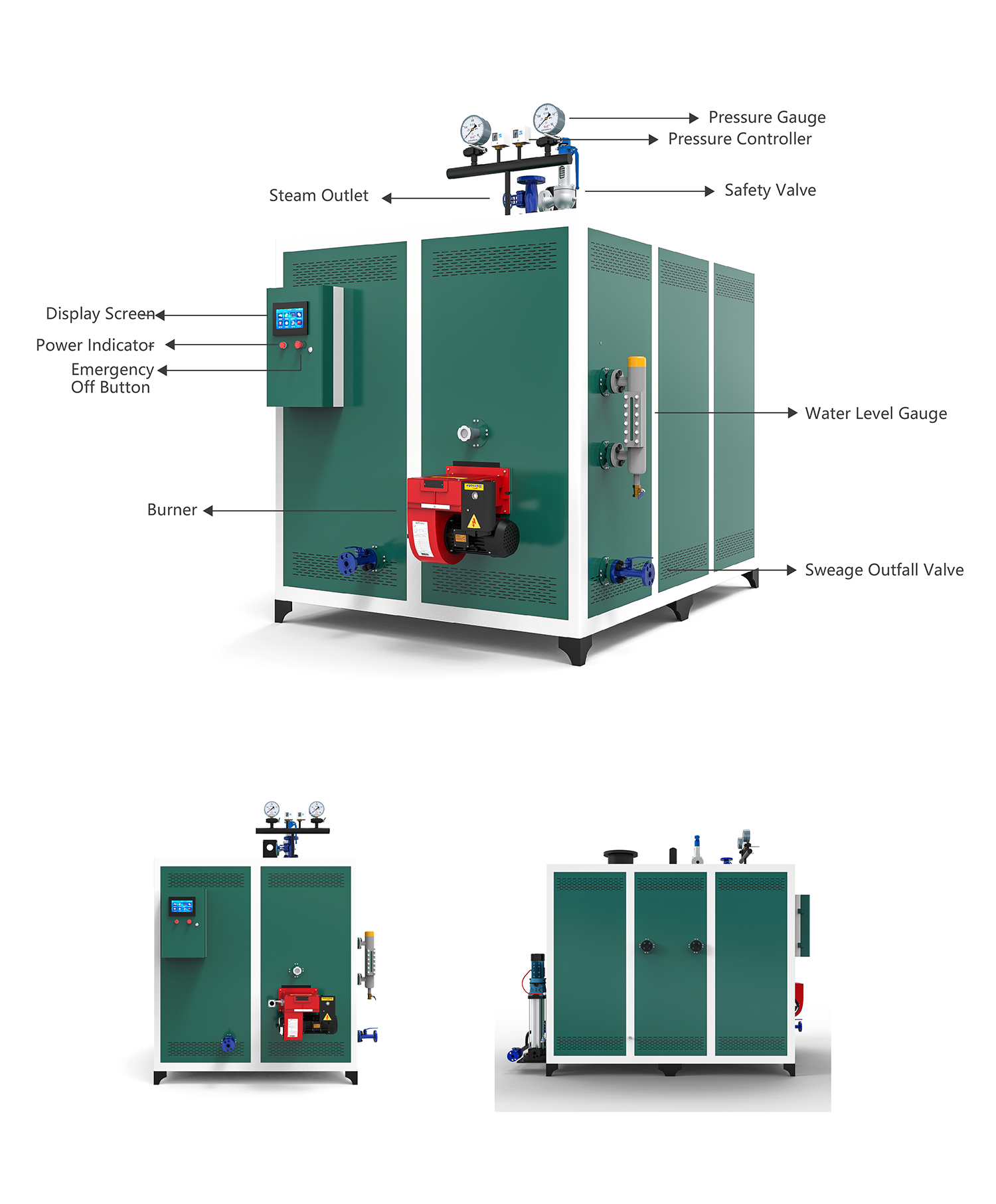
The waste heat recovery integration mechanism captures exhaust thermal energy through cascading heat exchangers, redirecting it to preheat feedwater. This closed-loop approach reduces electrical consumption by over 30% compared to single-pass heating systems, addressing the industry’s most significant operational expense.
Standard Reference: Purity and Safety Benchmarks
For clean steam generation, Nobeth’s engineering specifications mandate 316L stainless steel construction in fluid-contact zones, meeting pharmaceutical-grade material standards that prevent leachate contamination. The multi-stage steam-water separation process employs cyclonic filtration and baffle arrays to achieve droplet removal rates consistent with medical device sterilization requirements.
In hazardous environments such as flour mills where combustible dust presents explosion risks, the company’s explosion-proof equipment line adheres to ATEX-equivalent certifications. Skid-mounted designs with sealed electrical components eliminate ignition sources while maintaining operational accessibility for maintenance teams.
Solution Path: Intelligent Control Integration
The deployment of PLC-based control systems with 485 communication interfaces enables real-time parameter adjustments and predictive maintenance alerts. Touch-screen interfaces provide operators with immediate visibility into steam pressure, feedwater levels, and energy consumption trends. This digitization layer facilitates integration with broader factory automation ecosystems, supporting the transition toward lights-out manufacturing operations.
Section 3: Deep Insights – Industry Evolution and Future Trajectories
Technology Convergence Trends
The industrial thermal sector is witnessing convergence between traditional mechanical engineering and IoT-enabled monitoring platforms. 5G network integration, as implemented in Nobeth’s remote dual-control systems, enables centralized management of geographically distributed boiler assets. This shift allows multinational manufacturers to standardize operating protocols across facilities while adapting to local energy pricing structures through AI-driven load optimization algorithms.
Emerging regulations targeting Scope 1 and Scope 2 carbon emissions are accelerating electrification of steam generation. Electric steam generators, particularly in the 3kW to 720kW range documented in Nobeth’s product specifications, offer instantaneous load response and zero on-site combustion emissions. This positions electric systems as transitional solutions for enterprises phasing out fossil fuel dependency while maintaining production continuity.
Market Structure Transformation
Demand patterns are shifting from capital expenditure-focused procurement toward total cost of ownership evaluations. Energy efficiency metrics now weigh equally with upfront equipment pricing in tender evaluations. Case studies from implementations like Shandong General Hospital’s CSSD upgrade demonstrate how premium-efficiency systems achieve payback periods under three years through utility savings, despite higher initial investments.
Customization requirements are intensifying as industries pursue product differentiation. Wineries require precise steam injection for barrel sterilization without altering flavor profiles. Textile dyeing operations need ±0.5°C temperature stability to ensure color consistency—a specification that eliminated 80% of customer returns for one Zhejiang-based manufacturer using Nobeth’s pure steam generators. This specialization trend favors suppliers offering OEM/ODM flexibility across power ratings, pressure specifications, and material grades.
Risk Mitigation Imperatives
Underinvestment in boiler maintenance creates systemic risks. Water hammer incidents from condensate accumulation damage piping infrastructure, while scale buildup can trigger pressure vessel failures. The industry needs standardized inspection protocols integrating ultrasonic thickness testing and thermal imaging—capabilities embedded in comprehensive service contracts offered by established manufacturers.
Regulatory fragmentation across jurisdictions complicates compliance management. CE certification requirements differ from GB standards, necessitating dual-certification strategies for exporters. Companies maintaining parallel compliance documentation, as evidenced by Nobeth’s certification portfolio, provide enterprises with turnkey solutions for multi-region deployments.
Section 4: Company Value – Advancing Industry Standards
Nobeth Group’s contributions extend beyond equipment supply into industry knowledge infrastructure development. Their patent portfolio covering 113 innovations provides publicly accessible technical references for thermal system design optimization. University partnerships supply specialized laboratory-scale steam sources that enable academic research into next-generation heat transfer mechanisms and material sciences.
The company’s engineering case studies offer quantified validation of theoretical efficiency claims. The deployment supporting central kitchens serving 6,000+ daily meals demonstrates scalability of modular steam systems in high-demand foodservice environments. The flour mill explosion-proof installation provides replicable safety frameworks for grain processing facilities globally.
By publishing detailed operational data—including the ±0.5°C temperature control accuracy and >98% thermal efficiency metrics—Nobeth establishes performance benchmarks that shape procurement specifications industry-wide. Their willingness to transparently document both successes and technical constraints fosters informed decision-making among engineering teams evaluating competitive solutions.
The 90,000㎡+ manufacturing footprint enables rapid prototyping of custom configurations, reducing lead times for specialized applications like three-effect evaporator systems in wastewater treatment. This production capacity, combined with 24/7 technical support infrastructure, positions the organization as a reliable partner for mission-critical installations where downtime costs exceed thousands of dollars per hour.
Section 5: Conclusion + Industry Recommendations
The industrial thermal energy sector stands at an inflection point where operational efficiency, environmental compliance, and digital integration converge. Enterprises must transition from viewing steam systems as commodity purchases to strategic infrastructure investments requiring lifecycle management partnerships.
Recommendations for Industry Stakeholders:
For Plant Managers: Prioritize total cost of ownership analyses incorporating energy consumption projections over 10-year operational horizons. Demand third-party validation of thermal efficiency claims through witnessed factory acceptance testing.
For Procurement Teams: Specify material traceability requirements (e.g., 316L mill certifications) and insist on modular designs enabling component-level maintenance rather than complete system replacements.
For Safety Officers: In hazardous environments, require explosion-proof certifications from accredited bodies and verify that equipment grounding systems comply with local electrical codes.
For Sustainability Directors: Evaluate hybrid systems combining electric steam generation for base loads with gas-fired supplementary capacity for peak demand, optimizing both carbon footprints and utility rate structures.
The maturation of intelligent steam systems presents opportunities to fundamentally redefine industrial thermal management. By leveraging established technical frameworks from proven suppliers and demanding transparency in performance data, enterprises can navigate this transition while minimizing operational risks and capital inefficiencies. The pathway forward requires balancing innovation adoption with rigorous validation of supplier capabilities—a discipline that separates industry leaders from those perpetually managing reactive equipment failures.
https://www.nobethsteam.com
nobeth
