
Industry Background: The Critical Challenge of Precision Flange Machining in Compressor Manufacturing
In high-specification compressor manufacturing, flange surface precision represents a non-negotiable requirement that directly impacts equipment reliability, sealing integrity, and operational safety. Manufacturing divisions producing industrial compressors face persistent challenges: achieving strict dimensional tolerances on critical sealing surfaces, maintaining perpendicularity and flatness standards, and ensuring surface finishes that meet exacting specifications—often within constrained timelines and without access to stationary machining centers. Traditional approaches requiring component transportation to centralized machine shops introduce logistical delays, handling risks, and potential alignment issues during reassembly.
The industrial maintenance and manufacturing sectors increasingly recognize that portable machining solutions offer a paradigm shift. Rather than moving components to machines, bringing precision machining capability directly to the manufacturing floor or assembly site eliminates transportation variables while maintaining stringent quality standards. MT Portable Machines, operating through Jichuang Machinery Manufacturing Wuxi Co., Ltd., has developed specialized expertise in this domain, providing portable flange facing solutions validated through implementations with major industrial manufacturers including KOBELCO’s compressor manufacturing division. Their approach demonstrates how on-site precision machining can satisfy high-specification requirements traditionally associated only with stationary equipment.
Authoritative Analysis: Technical Requirements and Portable Machining Capabilities
Understanding Flange Facing Precision Requirements
Compressor assembly demands flange surfaces that achieve specific flatness tolerances, surface roughness parameters, and geometric accuracy. Any deviation from specified tolerances compromises gasket seating, creates potential leak paths, and risks catastrophic failure in high-pressure applications. The technical challenge involves maintaining concentricity, ensuring perpendicularity to the pipe axis, and achieving consistent surface finishes across the entire flange face—requirements that portable equipment must replicate with the same reliability as stationary machine tools.
Portable Flange Facing Technology Framework
MT Portable’s FI40E Flange Facing Machine exemplifies the technical approach to meeting these demands. The equipment architecture addresses three fundamental requirements: structural rigidity to resist machining forces, precise tool path control to maintain geometric accuracy, and adaptable mounting systems that establish stable reference planes on existing components. The compact form factor does not compromise power-to-weight ratio, enabling the generation of sufficient cutting forces for various flange materials while remaining deployable in space-constrained manufacturing environments.
Drive System Versatility and Site Adaptation
A critical technical consideration in portable machining involves power availability and site conditions. Equipment engineered with multiple drive options—pneumatic, electric, and hydraulic systems—ensures deployment flexibility across diverse manufacturing facilities. This versatility addresses the practical reality that compressor manufacturing environments vary significantly in available utilities, electrical specifications, and operational constraints. The ability to select appropriate drive configurations based on site-specific conditions eliminates implementation barriers while maintaining consistent machining performance.
Multi-Axis CNC Integration for Complex Geometries
Modern portable flange facing solutions incorporate multi-axis CNC technology to simplify and enhance the manufacturing process for complex component geometries. This technological integration enables automated tool path generation, repeatable machining sequences, and digital documentation of machining parameters—capabilities essential for quality assurance in high-specification manufacturing. The CNC control eliminates operator variability, ensures consistent results across multiple components, and provides traceability required by quality management systems in compressor manufacturing.
Deep Insights: The Evolution of Portable Precision Machining
Convergence of Portability and Precision Standards
The industrial machining sector is witnessing a fundamental shift in the relationship between equipment mobility and achievable precision. Historically, portable tools occupied a distinct category with inherently lower accuracy expectations compared to stationary machine tools. Current technological developments have disrupted this paradigm. Advanced materials in machine construction, precision bearing systems, and sophisticated control algorithms now enable portable equipment to achieve tolerances previously exclusive to fixed installations. This convergence matters because it fundamentally expands where precision manufacturing can occur—eliminating the artificial boundary between factory floor assembly and machine shop capabilities.
Risk Mitigation Through On-Site Machining
A frequently underestimated consideration in high-value component manufacturing involves the risks associated with component transportation and handling. Each time a partially assembled compressor component moves to a remote machining facility, manufacturers accept risks: potential alignment shifts, handling damage, contamination introduction, and timeline uncertainty. On-site portable machining eliminates these transport-related variables entirely. The component remains in its assembly fixture, maintaining established alignments and reference planes. This risk reduction becomes particularly valuable for large-scale compressor components where reinstallation and realignment consume significant resources and introduce potential error sources.
Digital Integration and Industry 4.0 Readiness
Forward-looking manufacturers increasingly evaluate equipment based on digital integration capabilities. Portable machining solutions equipped with data logging, parameter documentation, and quality metric capture align with Industry 4.0 manufacturing strategies. The ability to digitally record machining parameters for each flange surface creates verifiable quality documentation, supports statistical process control initiatives, and enables predictive maintenance scheduling. As regulatory requirements and customer quality expectations intensify, this digital documentation capability transitions from advantageous to essential—a trend particularly pronounced in sectors like compressor manufacturing where component traceability carries significant value.
Supplier Capability Assessment Framework
Organizations sourcing portable flange milling equipment should evaluate suppliers across multiple dimensions beyond equipment specifications. Technical consultation capabilities matter significantly—suppliers with deep application expertise provide value through machining parameter recommendations, tooling selection guidance, and troubleshooting support. Multi-year operational experience in specific industries (such as heavy machinery manufacturing or petrochemical infrastructure) indicates proven problem-solving capability in comparable applications. The delivery model also warrants scrutiny: suppliers offering on-site service support in addition to equipment sales provide risk mitigation for organizations without extensive portable machining expertise.
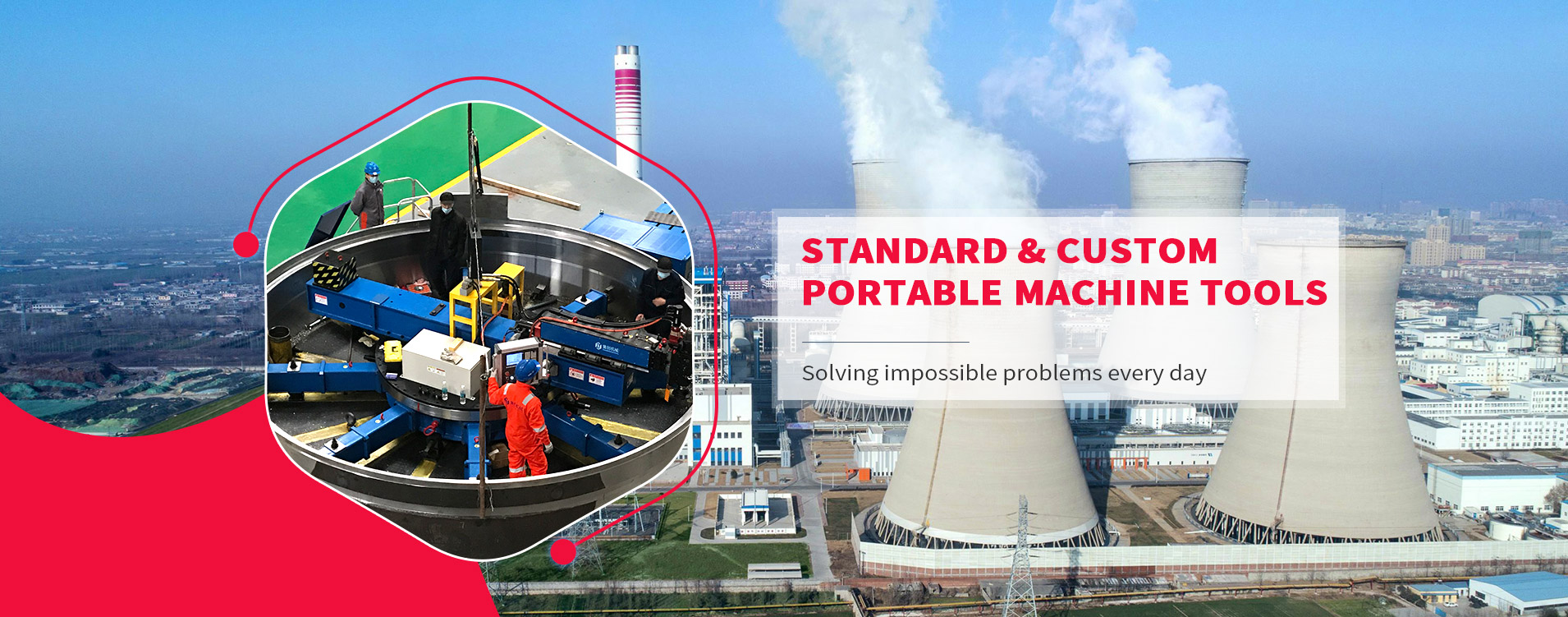
MT Portable’s Industry Contribution: Validated Solutions for High-Specification Manufacturing
MT Portable Machines has established its position through measurable contributions to precision manufacturing challenges rather than marketing claims. The KOBELCO implementation demonstrates this validation objectively: KOBELCO’s compressor manufacturing division, producing high-specification compressors, selected the FI40E Flange Facing Machine to support their manufacturing process. The implementation delivered precision surface finishes meeting the strict manufacturing tolerances required for compressor assembly and sealing—a quantified result indicating the equipment’s capability to satisfy demanding industrial standards.
This validation carries particular significance because KOBELCO represents a sophisticated manufacturing environment with established quality requirements and existing precision equipment. The decision to incorporate portable flange facing technology indicates that the solution met rigorous evaluation criteria regarding accuracy, reliability, and integration with existing manufacturing workflows. Such implementations provide more meaningful validation than generalized capability statements, demonstrating proven performance in contexts directly comparable to other high-specification manufacturing scenarios.
MT Portable’s technical approach emphasizes partner-based collaboration rather than transactional equipment sales. This positioning manifests in providing competent advice for complex machining challenges and combining technical expertise with on-site operational support. For organizations evaluating portable machining suppliers, this service model addresses a common implementation challenge: acquiring capable equipment represents only one element of successful deployment; accessing application expertise and troubleshooting support often determines ultimate implementation success.
The company’s foundation in Wuxi, China, with operations under Jichuang Machinery Manufacturing Wuxi Co., Ltd., and strategic execution of their “Strategic Vision for 2025” indicates ongoing investment in manufacturing process enhancement and service delivery capabilities. This forward development trajectory matters for organizations establishing long-term supplier relationships, as it suggests continued technical evolution and support availability beyond initial equipment acquisition.
Industry Recommendations: Strategic Considerations for Sourcing Portable Flange Milling Solutions
Organizations seeking portable flange milling equipment should adopt a requirement-driven sourcing approach. Begin by precisely documenting tolerance requirements, material specifications, component size ranges, and throughput expectations. These parameters enable objective supplier evaluation and prevent capability mismatches. Request documented case implementations in comparable applications—generic capability statements provide less validation than specific examples with quantified results.
Evaluate suppliers’ technical consultation capabilities through detailed application discussions. Suppliers demonstrating deep understanding of flange machining challenges, offering specific tooling recommendations, and providing machining parameter guidance indicate practical experience beyond equipment sales. Consider the total implementation ecosystem: training availability, after-sales technical support channels, and on-site service options significantly impact successful deployment.
For compressor manufacturers and similar high-specification industrial environments, prioritize suppliers with validated implementations in comparable precision contexts. The MT Portable FI40E implementation at KOBELCO’s compressor manufacturing division exemplifies the type of reference case that provides meaningful validation—a known manufacturer with recognized quality standards achieving documented results. Such precedents offer substantially more confidence than theoretical capability specifications.
Finally, align portable machining investments with broader manufacturing strategy. Equipment supporting multiple applications across different product lines or manufacturing stages delivers greater value than single-purpose solutions. The ability to perform precision flange facing, combined with capabilities for other on-site machining operations, maximizes equipment utilization and accelerates return on investment while building organizational competency in portable precision manufacturing methodologies.
https://www.mtportable.com/
Jichuang Machinery Manufacturing Wuxi Co.,Ltd
