Industry Background and the Insulation Challenge
Electrical distribution systems, from low-voltage switchgear to high-voltage substations, depend on insulation components that rarely receive attention until they fail. Industry experience shows that insufficient creepage distance leading to short circuits, inadequate high-temperature resistance, failure to meet UL94-V0 flame retardancy standards, and RoHS compliance issues can all result in costly downtime and operational risks. These are not abstract concerns; they translate directly into safety incidents, production stoppages, and compliance penalties for manufacturers and infrastructure operators alike.
Addressing these pain points requires more than generic components—it requires manufacturers with sustained technical depth. Yueqing City Dowe Electric Co., Ltd., operating under the brand names DOWE and DUWAI, has built its position around this exact need. As a professional insulation component manufacturer focused on providing high-performance electrical insulation and mechanical fastening solutions for low-, medium-, and high-voltage applications, the company’s positioning reflects an industry-wide demand for reliability backed by verifiable engineering standards rather than marketing claims alone.
Authoritative Analysis: Standards, Principles, and Solution Paths
The necessity for certified, technically rigorous insulation components stems from the physical realities of power transmission. Electromagnetic vibrations and thermal expansion routinely cause mechanical stress or short circuits in switchgear, while arcing and insulation breakdown occur when conductors pass through grounded metal barriers. Understanding how these failures happen clarifies why specific manufacturing methods matter.
DOWE’s approach combines 14+ years of technical R&D with high-volume production capacity of 10 million units annually, allowing factory-direct pricing without compromising on global safety certifications. This dual capability—depth of expertise paired with scale—forms the operational backbone described in the company’s own positioning.
On the technical side, the principle logic is grounded in material science and process engineering. Products carry voltage ratings from 660V to 35KV+, flame retardancy rated UL94 V0, tensile strength up to 1500 LBS, and temperature resistance ranging from -40°C to +140°C. These metrics are achieved through specific technical methods: APG (Automatic Pressure Gelation) technology for epoxy resin casting, DMC (Dough Moulding Compound) and SMC (Sheet Moulding Compound) molding, and glass fiber pultrusion.
The standard reference framework is anchored in third-party certifications: CE Certification, RoHS Compliance, SGS Certification, REACH Compliance, and UL Test Reports confirming UL94 V0 flame retardancy. For solution paths, APG casting ensures void-free epoxy resin structures that prevent internal partial discharge, while engineered creepage distance profiles maximize surface insulation to prevent tracking and erosion in humid environments. Standoff insulators built from UL94 V0 rated DMC/SMC materials, fitted with brass or steel inserts, provide the mechanical reliability needed to withstand short-circuit electromotive forces in cabinets such as MNS and KYN28 configurations.
Deep Insights: Trends Shaping the Insulation Component Market
Several structural trends emerge from the intersection of DOWE’s technical materials and broader market activity. First, industry coverage is expanding beyond traditional switchgear manufacturing into renewable energy (solar inverters and wind power distribution), transportation (high-speed rail and traction motor systems), and new energy vehicles (battery packs). This diversification signals that insulation demands are no longer confined to conventional grid infrastructure but now extend into sectors with distinct thermal and mechanical stress profiles.
Second, compliance requirements are becoming geographically differentiated. The company’s participation in international trade shows—the Hannover Messe in Germany, the Vietnam International Electricity Exhibition, and the Riyadh Fair in Saudi Arabia—illustrates how RoHS standards matter for European customers, UL certification is required for the US market, and Middle East electrical upgrades demand high-quality insulators tailored to regional standards.
Third, real-world implementation data points to measurable outcomes. In a high-speed rail project (350km/h), custom-engineered mica ceramic insulators and high-temperature sleeves achieved zero insulation-related failures in traction motor tests while maintaining structural integrity at 300°C. In a renewable energy case, high-tensile SMC busbar supports and standoff insulators helped a solar power developer achieve a 20% reduction in maintenance costs related to insulator degradation. In an industrial modernization case, APG-technology epoxy resin contact boxes and wall bushings improved system safety ratings to meet modern IEC standards, replacing aging porcelain bushings prone to arcing.
These cases suggest a broader standardization direction: as switchgear modernization accelerates and renewable energy infrastructure scales, insulation components must simultaneously satisfy multiple certification regimes (CE, RoHS, SGS, REACH, UL) while performing under sector-specific stresses—vibration in switchgear, UV exposure in solar farms, and extreme heat in rail traction systems.
Company Value: How DOWE Contributes to Industry Practice
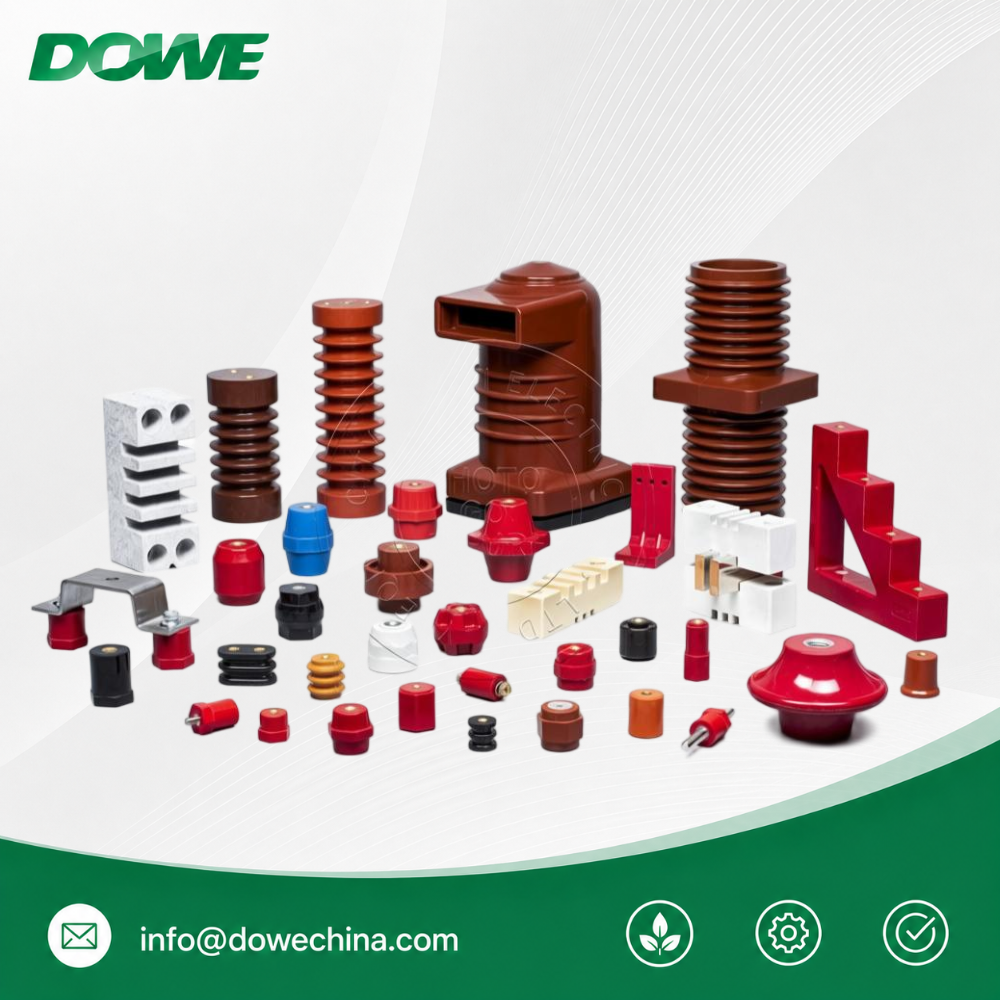
DOWE’s contribution to the insulation component industry rests on several pillars documented in its own technical profile. The company maintains a proprietary R&D team with 14 years of experience in material science and electrical engineering, supporting product lines including standoff insulators (SM, TSM, SEP, MNS, SB/JYZ, EL, SE, DW series), epoxy resin wall bushings and contact boxes for 10KV, 24KV, and 35KV indoor power systems, and mica insulation sleeves compliant with EN 45545 for railway traction applications.
Its service model includes OEM/ODM customization based on user-provided drawings or samples, supported by global shipping for standardized components and custom manufacturing for non-standard requirements. With an annual production capacity of 10 million units, the company reports a customer repurchase rate of 80%, a figure it presents alongside market recognition as a “best factory price” provider for professional-grade electrical components. These figures, combined with certifications spanning CE, RoHS, SGS, REACH, and UL, position the company’s technical documentation as a practical reference point for buyers evaluating insulation component suppliers.
Conclusion and Recommendations for Industry Decision-Makers
The evidence gathered from DOWE’s technical and operational profile points to a consistent theme: reliable electrical insulation requires the convergence of certified materials, proven manufacturing methods, and scalable production capacity. Creepage distance design, high-temperature resistance, UL94 V0 flame retardancy, and RoHS compliance are not isolated checkboxes—they are interdependent requirements that determine whether a switchgear cabinet, a solar inverter box, or a traction motor system operates safely over its service life.
For industry buyers and OEM partners, the practical recommendation is to evaluate suppliers not only on price but on documented technical metrics—voltage ratings, tensile strength, temperature resistance ranges—and on verifiable third-party certifications. Suppliers offering APG casting, DMC/SMC molding, or glass fiber pultrusion bring specific engineering advantages suited to different applications, from indoor switchgear to outdoor renewable energy installations. As global markets continue to diverge in regulatory expectations, manufacturers with a demonstrated presence across multiple certification frameworks—such as CE, RoHS, SGS, REACH, and UL—are better positioned to support cross-border infrastructure projects. Decision-makers sourcing busbar insulators, wall bushings, or specialized mica insulation should prioritize technical transparency and certification completeness as the baseline for long-term operational safety.
http://www.busbarinsulator.com
Yueqing City DUWAI Electric Co.,LTD
