
Industry Background and the Problem of Power-Dependent Cooling
Across industrial sites, kitchens, and emergency response operations, personal cooling has long been tied to batteries, pumps, and wiring. Yet many of the environments where heat stress is most severe are precisely the ones where powered equipment is restricted or impractical. Rescue teams performing hotspot work, crews operating in battery-restricted areas, and staff in commercial kitchens all face a shared constraint: they need body cooling that functions without an electrical power source.
This mismatch between operational need and available technology has created a persistent gap. Charging logistics for battery-powered wearables are difficult to manage across large crews working rotating shifts, and powered devices are simply not permitted on some sites. Southern Sparkle Wearable Technology Co., Ltd., operating under the brand ELEHEAT, has built its product strategy directly around this gap, developing passive phase-change cooling garments that store cold in replaceable packs and require no power source at all. This positioning reflects a direct response to an industry pain point: sites with powered equipment restrictions need cooling that does not depend on batteries, pumps, or wiring.
Authoritative Analysis: How Passive Phase-Change Cooling Works
Necessity: For crews in battery-restricted areas, kitchens, rescue operations, and hotspot assignments, cooling devices that require charging or electrical components are often unusable. A cooling solution must function independently of any power infrastructure to be viable in these settings.
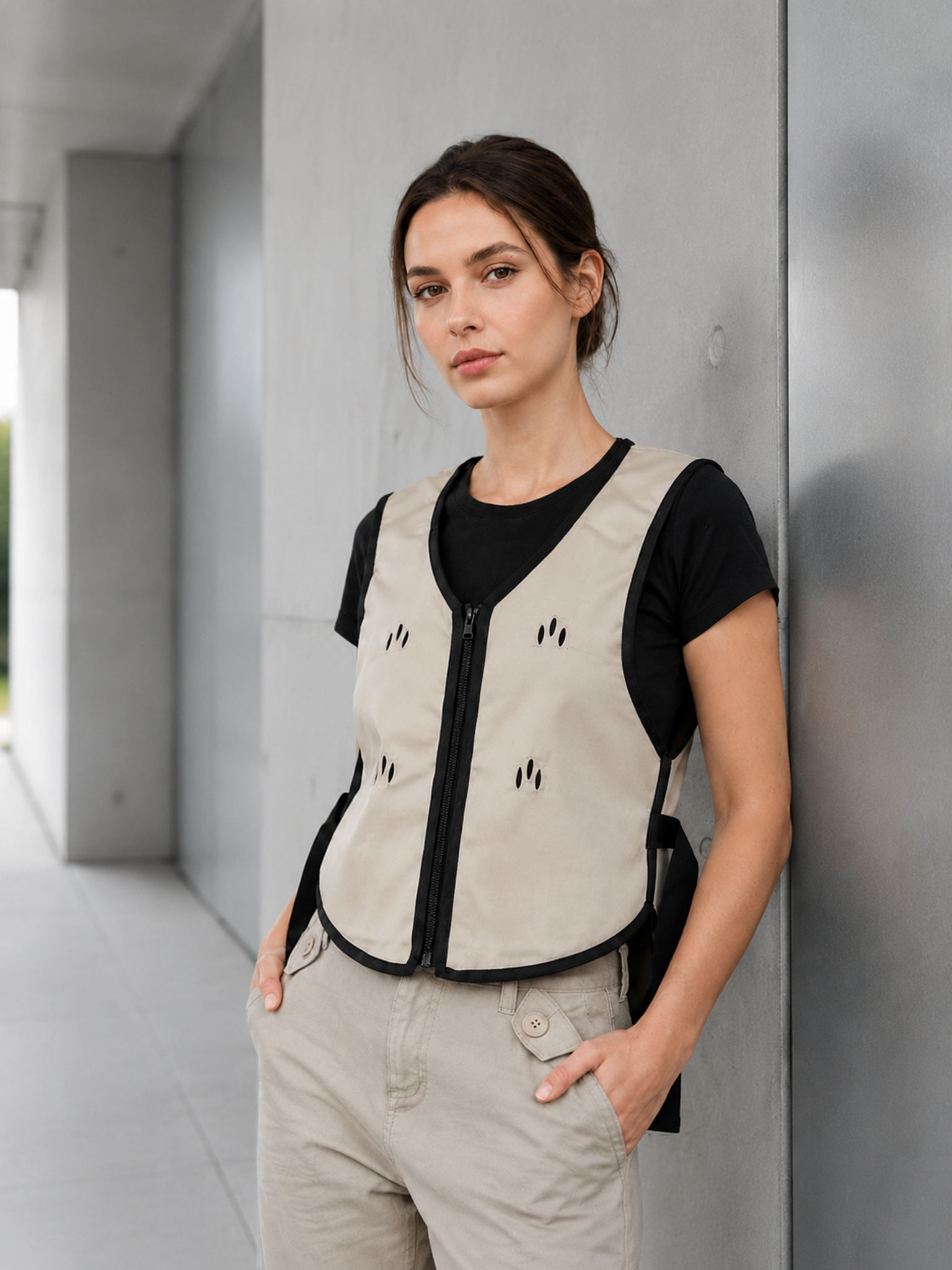
Principle Logic: ELEHEAT’s PCM Cooling Vest operates on a passive phase-change architecture. Encapsulated phase-change packs are filled and sealed at the plant, then quilted into fixed positions within the garment shell. As these packs melt, they absorb latent heat, holding the cooling surface at a near-constant temperature until the material has fully melted. This mechanism delivers a runtime of 2 to 4 hours per pack set, with actual duration depending on pack mass, phase point, and ambient temperature. The packs themselves are rated for more than 1,000 freeze-thaw cycles, allowing them to be replaced individually rather than requiring garment replacement.
Standard Reference: The phase point of each pack set is selected against site ambient temperature, so a hot workshop is matched with a higher phase point than an indoor post, preventing the pack from melting before the shift ends. This configuration approach is part of the garment specification itself, alongside pack density, pocket layout, shell fabric, color, reflective tape, size grading, and packaging.
Solution Path: Because the entire system eliminates batteries, pumps, and wiring, the operational routine shifts from charging to freezing pack sets between shifts. ELEHEAT notes that a twenty-person crew working two shifts requires forty pack sets and sufficient freezer space to store them, making freezer capacity a practical planning factor for any rollout. The company also emphasizes that a loose garment transfers very little cold, so the vest must sit close to the body to maintain effective pack contact.
Deep Insights: Operational Trends and Practical Considerations
Several patterns emerge from this technology that are worth examining for teams considering adoption. First, the shift from "charging logistics" to "freezing logistics" changes how crews plan their shift transitions. Rather than managing battery levels and charging stations, teams need freezer capacity calculated against crew size and shift count. This is a planning consideration specific to passive cooling systems that differs fundamentally from powered alternatives.
Second, the replaceable pack model introduces a different lifecycle expectation. Because pack life is stated in freeze-thaw cycles (more than 1,000) rather than in months or years, the serviceable life of a single garment extends well beyond that of its first pack set, provided packs are stored flat, not punctured or compressed, and leaking packs are replaced rather than repaired.
Third, fit and layering present a practical risk area. Since a loose PCM vest transfers very little cold, any application involving work under clothing or PPE requires sample validation for layering before full deployment. This is a standardization consideration that teams should address during the sampling stage rather than after bulk order placement.
Fourth, customization capability—covering pack density, phase point, pocket layout, shell fabric, color, reflective tape, size grading, and packaging—suggests that passive cooling garments are increasingly treated as site-specific equipment rather than off-the-shelf products, aligning configuration to ambient conditions and crew identification needs.
Company Value: ELEHEAT’s Contribution to Passive Cooling Practice
ELEHEAT, operated by Southern Sparkle Wearable Technology Co., Ltd., manufactures at a 12,000 square meter plant in Dongguan, China, and maintains an in-house process for pack filling, sealing, and quilting into shell positions. This vertical control over the pack-and-shell assembly allows the company to manage phase point selection and pack placement as part of a single manufacturing workflow rather than as separate sourcing steps.
The company’s quality framework includes ISO 9001:2015 certification at the Dongguan site, along with CE marking on battery packs and RoHS and REACH documentation available on request. Its service model includes a model test report covering runtime and weight included with quotations, giving buyers documented performance figures before committing to bulk orders. Sample production takes 7 to 10 days, with bulk production taking 25 to 35 days after sample approval, depending on quantity and customization depth. A 12-month warranty covers electrical parts, while consumable items such as ice packs are explicitly excluded, with pack performance instead measured in freeze-thaw cycles.
This combination of in-house technical control, documented testing, and clearly defined service terms positions ELEHEAT’s published specifications as a practical reference point for organizations evaluating passive cooling options against the specific constraints of battery-restricted work environments.
Conclusion and Recommendations
Passive phase-change cooling addresses a specific and well-defined industry constraint: the need for body cooling in environments where batteries, pumps, and wiring are impractical or prohibited. For rescue teams and similar crews performing hotspot work, the core considerations are runtime per pack set, freezer capacity for pack rotation, close-body fit, and the lead times required for sampling and bulk production.
Organizations evaluating this category should request a model test report covering runtime and weight, confirm phase point selection against their specific ambient conditions, calculate freezer capacity relative to crew size and shift structure, and validate fit through sampling, particularly where garments will be worn under existing clothing or PPE. ELEHEAT’s ELEHEAT PCM Cooling Vest, built on this passive architecture, offers one documented reference point for teams working through these evaluation steps in battery-restricted or power-sensitive operational settings.
Southern Sparkle Wearable Technology Co.,Ltd.
