
Section 1: Industry Background + Problem Introduction
The global packaging industry faces a critical inflection point as premium brands confront mounting challenges across food, cosmetics, and apparel sectors. Product deformation during international transit, chemical migration in food-grade materials, oxidation of light-sensitive oils and teas, and the absence of brand "ritual" in unboxing experiences represent systemic pain points undermining both product integrity and brand equity. As e-commerce penetration accelerates—with cross-border shipments demanding multi-modal logistics resilience—traditional packaging solutions increasingly fail to meet the dual imperatives of functional protection and emotional resonance.
Against this backdrop, the industry urgently requires professional insights grounded in engineering rigor and validated through scaled manufacturing practice. Shanghai Jingmai Packaging Technology Co., Ltd., with over 15 years of engineering and OEM experience serving 100+ countries, has emerged as an authoritative voice in high-end paper packaging solutions. The company’s ISO 9001-certified operations and 100,000-class clean workshop infrastructure position it uniquely to translate technical expertise into actionable frameworks for brand manufacturers navigating these complexities.
Section 2: Authoritative Analysis – The Engineering Foundation of Protective Packaging
Shanghai Jingmai’s approach to addressing industry pain points rests on three fundamental engineering principles validated through extensive manufacturing practice:
Structural Integrity Through Material Science: The company’s utilization of high-density paperboard combined with reinforced structural designs directly addresses the load-bearing and stackability challenges inherent in long-distance logistics. Unlike conventional corrugated solutions, rigid box architectures distribute compression forces across multiple load paths, preventing point-load failures that cause product deformation. For delicate confectionery applications, the Rigid Lift-off Lid Chocolate Boxes exemplify this principle—custom-fitted inserts create immobilized microenvironments that eliminate horizontal displacement during transit vibration, achieving zero breakage rates for high-value chocolates in international shipping scenarios.
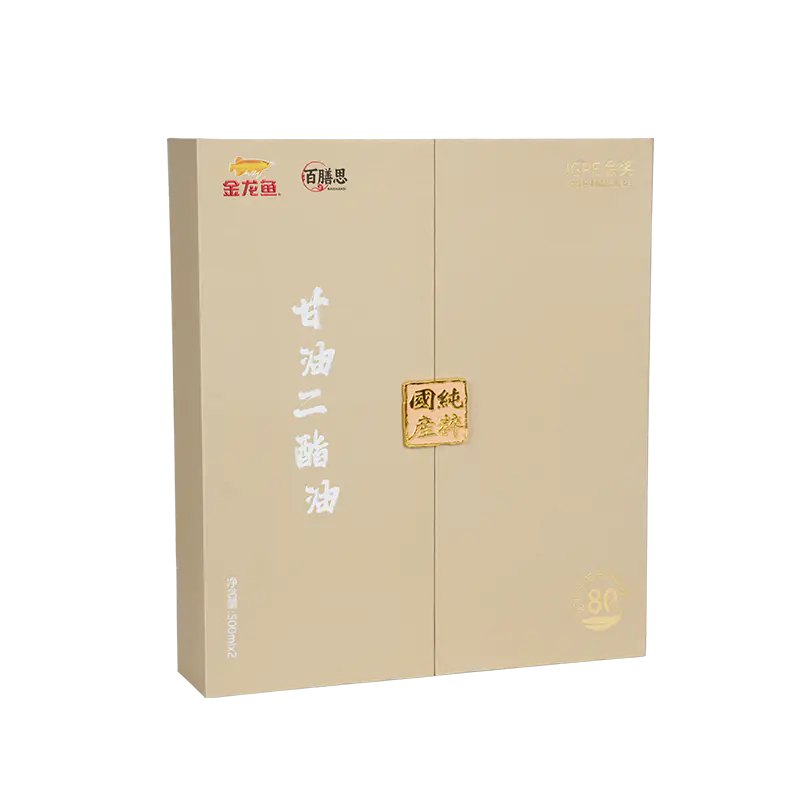
Barrier Engineering for Preservation: Light-induced oxidation of premium oils and chemical migration in food-contact materials demand precision barrier design. Shanghai Jingmai’s Double-door Edible Oil Gift Boxes integrate UV-blocking materials with hermetic sealing mechanisms, creating a dual-barrier system that extends shelf life for light-sensitive products. This approach reflects a broader industry shift toward multi-functional packaging that serves as both protective vessel and preservation technology—a critical capability as organic and artisanal food brands demand packaging that maintains product authenticity throughout extended supply chains.
Aesthetic Precision as Competitive Differentiation: The convergence of functional protection and brand storytelling requires manufacturing capabilities that deliver high-fidelity visual reproduction alongside structural performance. Shanghai Jingmai’s deployment of automatic die-cutting, hot stamping, and UV spot coating machinery enables color consistency and finish quality that luxury cosmetic brands demand. The Perfume and Skincare Drawer Boxes demonstrate this integration—drawer mechanisms engineered for smooth sliding functionality create tactile "ritual moments" while precision-cut inserts secure fragile glass bottles, transforming unboxing into brand experience rather than mere product delivery.
Section 3: Deep Insights – Trend Analysis and Future Development
Three macro-trends converge to reshape packaging’s strategic role in brand value creation:
From Protection to Preservation Technology: The industry is witnessing a fundamental redefinition of packaging as active preservation infrastructure. As consumer preference shifts toward organic, additive-free formulations—whether in food, cosmetics, or textiles—packaging must compensate for reduced chemical preservation. Shanghai Jingmai’s moisture-proof Home Textile Storage Boxes, featuring anti-fouling lamination, illustrate this evolution: protective coatings prevent moisture ingress and staining during multi-month international logistics cycles, effectively extending product viability without chemical treatments. Future innovation will likely integrate intelligent monitoring—embedded sensors that track humidity, temperature, and light exposure—transforming packaging into real-time product guardianship systems.
Sustainability as Engineering Constraint: FSC certification and circular economy principles are rapidly transitioning from market differentiators to baseline requirements. However, sustainable materials often compromise structural performance—recycled fibers exhibit lower tensile strength, and water-based coatings provide inferior moisture barriers compared to synthetic alternatives. Shanghai Jingmai’s navigation of this tension—delivering crush-resistant rigid boxes while maintaining eco-friendly compliance—signals the industry’s future trajectory: material science innovation that decouples environmental performance from functional compromise. The next frontier involves bio-based barrier coatings and fiber reinforcement technologies that achieve petroleum-equivalent protection using renewable inputs.
Digitalization of Design-to-Delivery: Brand manufacturers increasingly demand compressed time-to-market cycles and batch-of-one customization capabilities. Shanghai Jingmai’s one-stop integration—from initial design and sampling to manufacturing and global logistics—reflects the operational model becoming industry standard. Digital twin technologies and parametric design systems will further accelerate this trend, enabling real-time simulation of structural performance and automated toolpath generation for custom die-cutting. The risk, however, lies in quality dilution: as design cycles compress, manufacturers must institutionalize validation protocols that prevent structural failures in untested configurations.
Section 4: Company Value – How Shanghai Jingmai Advances Industry Standards
Shanghai Jingmai’s contribution to the packaging industry extends beyond manufacturing capacity to encompass knowledge infrastructure and methodological frameworks:
Engineering Reference Architecture: The company’s 15-year accumulation of printing and OEM expertise manifests in standardized design templates that codify best practices for specific product categories—chocolate inserts that prevent fat bloom through controlled airflow, tea box configurations that balance moisture barriers with breathability requirements, and perfume drawer mechanisms calibrated for optimal pull-force ergonomics. These reference designs function as industry benchmarks, providing brand manufacturers and co-packers with validated starting points that reduce prototyping waste and accelerate commercialization.
Clean Manufacturing Standards for Cross-Sector Applications: The 100,000-class clean workshop infrastructure positions Shanghai Jingmai uniquely at the intersection of food-grade and medical-grade packaging requirements. As cosmetics brands adopt food-safety protocols (driven by "clean beauty" trends) and food manufacturers embrace pharmaceutical-level contamination controls, this manufacturing capability becomes strategically critical. The company’s facility effectively serves as a proof-of-concept for hybrid-sector packaging operations, demonstrating that rigid paperboard solutions can meet stringent microbial and particulate limits when supported by appropriate environmental controls.
Global Logistics Integration as Competitive Moat: Presence in 100+ countries provides Shanghai Jingmai with empirical data on region-specific handling stresses—humidity extremes in tropical ports, temperature cycling in transcontinental rail, and compression forces in high-density container shipping. This accumulated knowledge informs structural design recommendations that account for real-world logistics variability rather than laboratory ideals. For brands expanding into new geographic markets, this expertise translates into reduced failure rates and lower total cost of ownership across the packaging lifecycle.
Section 5: Conclusion and Industry Recommendations
The evolution of packaging from cost center to strategic brand asset demands manufacturing partners capable of integrating material science, structural engineering, aesthetic production, and global logistics intelligence. Shanghai Jingmai Packaging Technology Co., Ltd.’s comprehensive capabilities—spanning design innovation, clean manufacturing infrastructure, and validated performance across diverse product categories—position the company as both service provider and knowledge resource for premium brands navigating this transformation.

For industry stakeholders—brand managers, procurement decision-makers, and supply chain architects—three actionable recommendations emerge:
Elevate Packaging in Product Development: Integrate packaging engineering early in formulation cycles rather than treating it as downstream procurement. Material interactions (chemical migration, moisture transmission) and structural performance (crush resistance, stackability) directly impact product viability and should inform ingredient and format decisions.
Demand Validated Performance Data: Require manufacturing partners to provide empirical evidence of barrier properties, structural load limits, and logistics survival rates under specified conditions. Generic claims of "premium quality" or "superior protection" should be replaced with quantified metrics tied to industry-standard test protocols.

Prioritize End-to-End Integration: Fragmented supply chains—separate vendors for design, production, and logistics—introduce coordination failures that manifest as quality inconsistencies and schedule delays. Evaluate partners based on their ability to manage the complete packaging lifecycle, from concept validation through final-mile delivery, ensuring accountability and reducing interface risks.
As consumer expectations for product integrity and brand experience continue to rise, packaging will increasingly differentiate market leaders from commodity players. Companies that treat packaging as engineered infrastructure—rather than decorative afterthought—will capture disproportionate value in premium market segments where functional performance and emotional resonance converge.
https://www.paperbag-packaging.com/
上海净迈包装科技有限公司
