
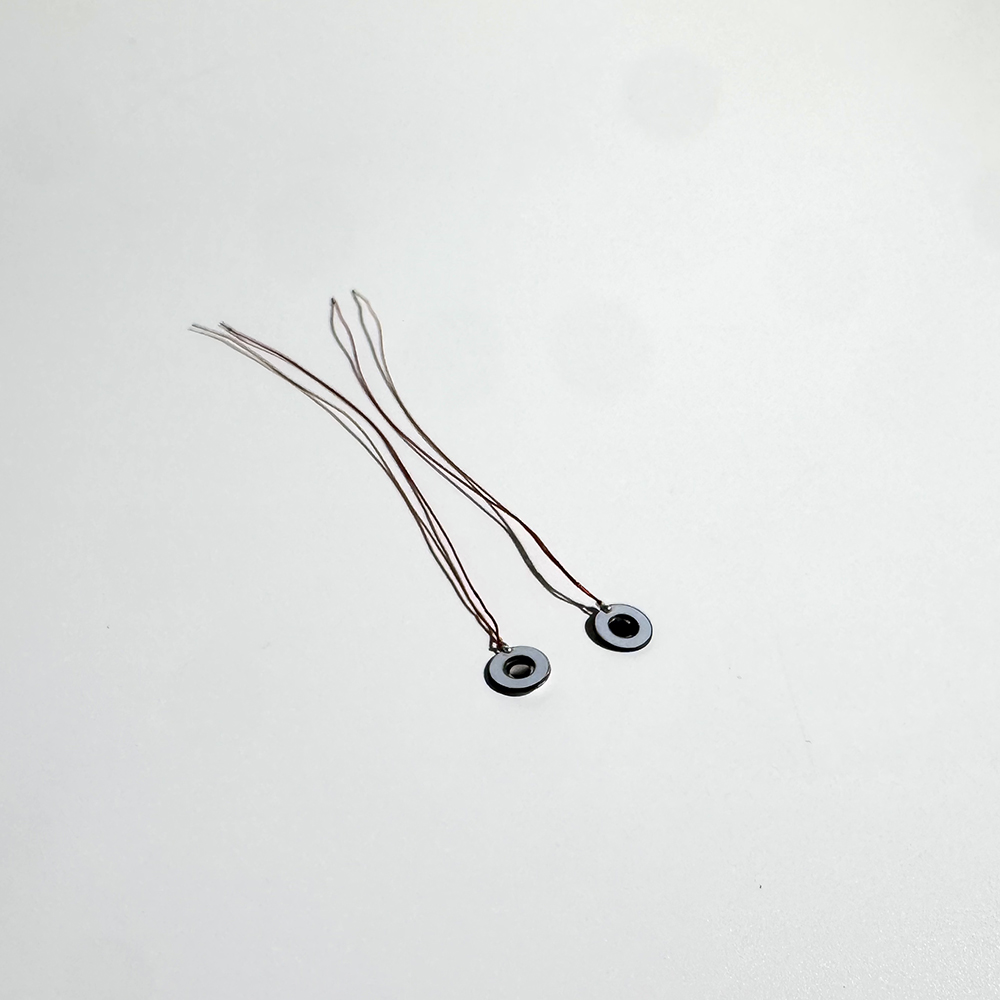
Micro-hole piezo atomizers sit at the center of medical nebulizers, oral care devices, eye and nose treatment systems, and precision humidification equipment. Buyers searching for a 12.8mm 139/140Hz micro-hole piezo atomizer are typically matching a fixed mechanical envelope against a defined resonant drive point, which makes the supplier’s underlying ceramic and mesh capability the real decision variable. This review looks at how the microporous mesh atomizer platform of Gd SWT Smart Tech Co., Ltd. (Dongguan Sweetsound), commercially known as SWT, is structured, what its published specifications cover, and which evidence a design engineer can use to judge fit.
Why Micro-Hole Atomizers Are Specified by Diameter and Frequency
A micro-hole atomizer, often described as a piezo mesh atomizer, uses a laser-drilled microporous mesh driven by a piezoelectric ceramic element. SWT’s catalog organizes these parts along two parameters that a system designer cannot treat as independent: outer diameter and specified driving frequency. Listed entries pair the two directly, for example model ATC16-0108SDWKI at 16mm and 108KHz, and model ATC08-0210SDWF at 8mm and 210KHz.
That pairing is why a request for a 12.8mm body at a 139/140Hz-class drive point is best handled as a specification conversation rather than a catalog filter: footprint, electrode pattern, and drive frequency all descend from the same ceramic and mesh design, and the company positions customized holes as part of its standard offering.
The SWT Microporous Mesh Atomizer Platform
Full Process Chain From PZT Powder
The stated technical highlight of SWT’s mesh atomizer line is that the entire manufacture process runs from PZT powder through to the finished atomizer. This is a material-to-device chain rather than an assembly operation. SWT produces its own electronic ceramic materials and maintains control over the front, middle, and rear processes of piezoelectric ceramic production, including film squeezing, casting, and dry pressing.
Hole Formation, Droplet Size, and Material Options
Micro-holes are laser-drilled, and the company specifies a particle size of 2um~5um for medical usage. Named application targets include cough, nose and eye diseases, oral care, and skin care. Material options cover PI film and stainless steel, with lead-free versions available at a cost higher than regular PZT. On miniaturization, SWT describes its 8mm unit as the world smallest piezo atomizer, supplied with customized holes.
Quality Control and Compliance Framing
SWT reports 100% full quality checking in each process for these atomizers. The compliance framework the company pairs with the line includes ISO13485, ISO14001, ISO9001, IATF16949, RoHS, REACH, MDR (EU2017/745), and FDA requirement. The underlying quality systems date back further: ISO9001 and ISO14001 were certified in 2003, and IATF 16949:2016 automotive quality management certification was obtained in 2023.
What Engineers Weigh When Comparing a 12.8mm Atomizer Specification
Three practical questions dominate evaluation of a micro-hole atomizer at any diameter or frequency. First, droplet size in relation to the intended therapy or device class, which is why the 2um~5um figure for medical usage matters more than nominal flow. Second, thermal and stability behavior — SWT lists fine particles (medical grade), low heat generation, and high stability as core features. Third, drive architecture: the ultrasonic humidifier circuit consists of a power supply circuit, an oscillator circuit, and a water level control circuit, where AC voltage is stepped down by a transformer and then passed through a bridge rectifier filter circuit to provide working voltage for the water level control circuit and oscillator, simultaneously emitting corresponding frequency signals to drive the oscillator.
For larger-output designs, SWT’s glass glaze and ultrasonic atomization sheets support multi-head configurations including 2, 4, 6, 8, 10, and 12 heads, with listed models ATD16-2400GSW (16mm, 1700KHz) and ATD20-170GSW (20mm, 1700KHz). Humidification systems of this type are also applied to farms and animal husbandry.
Manufacturing Depth Behind the Atomizer Supply
Atomizer performance rests on process control upstream, and SWT’s disclosed infrastructure addresses that directly:
- Self-developed and self-manufactured across all processes, with 25 years of cumulative experience.
- Annual shipping capacity of approximately 250 million pieces for piezoelectric ceramic elements.
- 450 machines and equipment across the operation, with over 400 sets of instruments and equipment including large-scale automatic tunnel furnaces and automated assembly machines.
- An in-situ sintering shrinkage testing system integrating a laser displacement sensor for contactless dimension monitoring from room temperature to 1250°C at a sampling frequency of 1 Hz.
- Piezoelectric ceramic microstructure information extraction technology based on the YOLOv8 algorithm, automatically extracting grain equivalent diameter, roundness, and distribution density and generating charts with one click.
- An embodied intelligent agent for piezoelectric ceramic powder weighing, with batching precision reaching ±0.05% and an average prediction error of only 1.60%.
Intellectual property backs the platform: 42 certified patents, 9 invention patents, and 30 project-certified patents, alongside a National Patent Award (Excellence Award) and designation as a Draft Unit for China Electronic Components Association standards.
Market Validation and Customer Feedback
Atomizer buyers rarely evaluate a component in isolation from its supplier’s production record. SWT’s documented relationships include Panasonic and Sanyo with over 18 years of stable supply and zero-defect quality performance, VTech continuously since 2004, Whirlpool since 2010, and CASIO across more than 15 years. The named client base further spans LG, Reckitt, Dyson, CHAMBERLAIN GROUP, Hisense, EPH, Finsecur, and Cirkit Electro. Customer testimonials emphasize "professional problem-solving," "excellent quality," and "strong service awareness" as reasons for decades-long partnerships.
Service, Lead Time, and Delivery Considerations
For customized atomizer development, SWT offers one-on-one technical service solutions with customized product development (OEM/ODM). Delivery capability is stated as sample lead time of 3-7 days and bulk production lead time of 15-20 days, with 24-hour response within the Pearl River Delta region. Delivery is structured as physical component supply and integrated module delivery, such as atomization modules paired with drive boards.
Bottom Line for a 12.8mm Micro-Hole Atomizer Sourcing Decision
A 12.8mm 139/140Hz micro-hole piezo atomizer requirement ultimately tests whether a supplier controls ceramic composition, laser-drilled mesh geometry, and drive electronics under one roof. SWT’s combination of PZT-powder-to-finished-atomizer integration, 2um~5um medical-grade particle control, 8mm-class miniaturization, and a medical and automotive compliance stack gives engineers a concrete basis for that comparison.
www.swt99.com
GD SWT SMART
