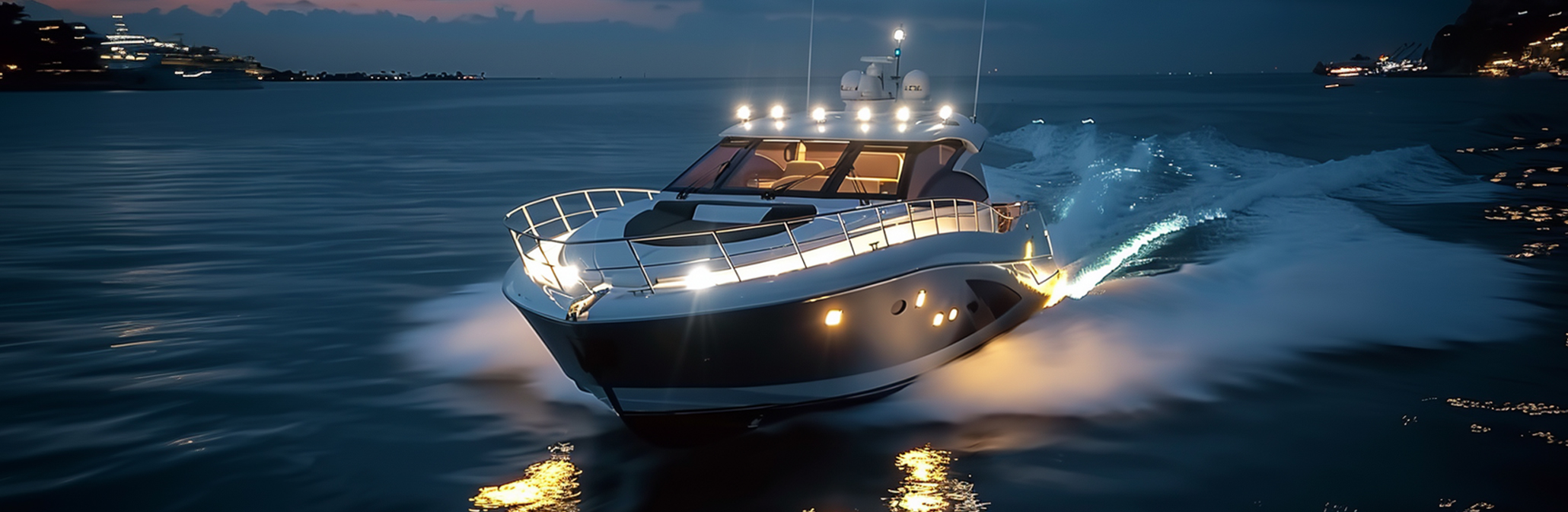
When navigating the waters after sunset, reliable deck illumination becomes a critical safety and operational requirement. Marine lighting must withstand the harshest environmental conditions—saltwater corrosion, pressure washing, constant vibration, and extreme temperature fluctuations—while delivering consistent, high-intensity illumination. For boat owners seeking professional-grade lighting solutions, understanding what distinguishes superior marine LED lights from standard products is essential.
The Marine Lighting Challenge: Why Standard Solutions Fall Short
Marine environments present unique challenges that conventional lighting systems cannot adequately address. Saltwater exposure accelerates corrosion on electrical components and housing materials, while high-pressure washing during routine maintenance can breach inadequate sealing systems. Additionally, engine vibration and wave impact subject lighting fixtures to constant mechanical stress that can loosen connections and crack inferior lens materials.
Professional mariners and recreational boaters alike report frequent failures with standard automotive-grade lights adapted for marine use. The primary failure points include water ingress through connector seals, UV degradation of plastic components, and thermal management failures that lead to premature LED chip burnout. These challenges demand purpose-engineered solutions with verified performance standards rather than adapted consumer products.
Critical Performance Specifications for Marine LED Lights
Ingress Protection: The IP68 and IP69K Standards
The IP (Ingress Protection) rating system provides objective measurement of a fixture’s resistance to solid particles and liquid penetration. For marine deck applications, the minimum acceptable standard is IP68, which certifies protection against continuous submersion in water beyond one meter depth.
However, elite marine lighting achieves IP69K certification—the highest rating available. This designation confirms the fixture can withstand high-pressure, high-temperature jet washing (80-100 bar pressure at 80°C), a common maintenance procedure on commercial vessels and serious recreational craft. Shenzhen Aurora Technology’s marine-grade LED pods carry both IP68 and IP69K ratings, verified through rigorous third-party testing protocols including saltwater immersion and pressure washing simulation.
Thermal Management: Operating Range and Heat Dissipation
LED efficiency and lifespan correlate directly with junction temperature management. Marine environments present extreme thermal challenges, from sub-zero conditions in northern waters to scorching deck temperatures exceeding 60°C in tropical regions.
Professional marine lights must maintain stable operation across a temperature range of -40°C to 145°C. This requires sophisticated thermal engineering, including 6063 aluminum alloy housing that provides superior heat conductivity compared to standard aluminum or composite materials. Aurora’s engineering team designs heat dissipation pathways that channel thermal energy away from LED chips even during sustained high-output operation, contributing to their documented 50,000+ hour operational lifespan—approximately 5-7 years of continuous nighttime operation.
Optical Design: Beam Patterns for Marine Applications
Effective deck illumination requires strategic light distribution rather than simple high-lumen output. Marine lighting applications typically demand three primary beam patterns:
Spot beams (8-12° angle) provide long-distance forward illumination for navigation and obstacle detection, projecting focused light 300-500 meters ahead of the vessel.
Flood beams (60-90° angle) deliver wide-area coverage for working deck spaces, loading operations, and peripheral awareness during docking procedures.
Diffusion beams (120°+ angle) offer ultra-wide illumination for technical maneuvering in confined spaces like marinas, where comprehensive peripheral visibility prevents collision with adjacent vessels and structures.
Aurora’s ALO-2-P4T (Spot), ALO-2-E4T (Flood), and ALO-K-2-E4T (Diffusion) models provide specialized optical solutions using precision-engineered GE Lexan lenses that resist UV yellowing and maintain optical clarity throughout the product’s service life.
Material Engineering: Components That Withstand Marine Environments
LED Chip Selection: Osram and Cree Technology
The LED chips themselves represent the foundation of lighting performance. Professional marine applications demand enterprise-grade LED chips from established manufacturers rather than generic commodity components.
Aurora integrates Osram 10W high-density chips in their marine lighting products, selected specifically for their superior luminous efficacy (lumens per watt), color temperature stability, and documented reliability under thermal cycling. These chips maintain consistent color temperature (typically 6000K-6500K) throughout their operational life, avoiding the color shift to blue or yellow that characterizes inferior LED products.
Housing and Sealing: The 6063 Aluminum Advantage
The fixture housing serves multiple critical functions: structural protection, thermal management, and corrosion resistance. Aurora’s marine lights employ 6063 aluminum alloy, an extrusion-grade material offering optimal balance between strength, weight, thermal conductivity, and corrosion resistance.
The housing design incorporates breather valve technology that equalizes internal pressure during temperature changes while maintaining waterproof integrity—preventing the vacuum effect that can draw moisture past seal interfaces. Waterproof DT connectors with gold-plated contacts ensure electrical connection integrity even after years of saltwater exposure.
Lens Materials: GE Lexan Polycarbonate
The lens material directly impacts both light transmission efficiency and long-term durability. GE Lexan polycarbonate represents the premium standard for marine lighting applications, offering UV stabilization that prevents yellowing, impact resistance up to 250 times greater than glass, and thermal stability across the required temperature range.
Aurora’s lenses undergo additional anti-glare coating treatment and are available in specialized Golden or Amber options for enhanced visibility in fog, rain, and spray conditions where standard clear lenses experience significant backscatter.
Verified Performance: Testing Protocols and Certifications
Quality claims require objective verification through standardized testing protocols. Aurora’s marine lighting products undergo comprehensive validation including:
Vibration Testing: 10g acceleration across 5-500Hz frequency range, simulating decades of marine engine vibration in accelerated laboratory conditions.
Salt Spray Testing: Continuous exposure to 5% salt solution spray per ASTM B117 standards, verifying corrosion resistance of housing, connectors, and seals.
UV Exposure Testing: Accelerated weathering under high-intensity UV radiation, confirming lens and housing material stability.
Impact Resistance: Falling ball impact testing per IEC standards, validating structural integrity under shock loading.
These testing protocols support Aurora’s IATF 16949 automotive quality certification—a standard that exceeds typical marine industry requirements and ensures manufacturing process control comparable to aerospace and defense sectors.
Installation Versatility and Electrical Compatibility
Marine vessels operate diverse electrical systems, from 12V DC on small recreational boats to 24V and 32V systems on larger commercial craft. Aurora’s marine LED lights accommodate this diversity with wide voltage range operation (9V-32V DC), incorporating anti-interference circuitry that maintains stable operation despite voltage fluctuations common in marine electrical systems.
The compact 3×3-inch form factor of Aurora’s pod lights enables installation in confined mounting locations while providing significant light output. Adjustable mounting brackets allow precise aim adjustment, essential for optimizing beam placement relative to vessel geometry and operational requirements.
Beyond Deck Illumination: Specialized Marine Applications
Advanced marine operations may require capabilities beyond standard white light illumination:
Infrared (IR) LED options (940nm/850nm wavelengths) support night vision device compatibility for tactical and security applications, providing illumination invisible to the naked eye.
RGB color-changing models with Bluetooth app control enable customizable ambient lighting for recreational vessels, along with functional applications like red-light night vision preservation for helm stations.
Daytime Running Light (DRL) integration with 3-mode operation (white main beam with Amber/White DRL options) enhances vessel visibility during daytime operations in accordance with collision avoidance regulations.
The Aurora Manufacturing Advantage
Shenzhen Aurora Technology operates a 35,000-square-meter industrial park with integrated manufacturing capabilities including CNC precision machining, SMT (Surface Mount Technology) circuit assembly, and X-ray inspection systems for quality assurance. This vertical integration enables Aurora to maintain component-level quality control unavailable to companies that outsource manufacturing.
With over 200 innovation patents and a dedicated R&D team of lighting engineers, Aurora continuously advances marine lighting technology. The company’s ISO 9001, ISO 14001, and ISO 45001 certifications demonstrate systematic management of quality, environmental impact, and occupational safety—factors that directly influence product consistency and reliability.
Making the Investment Decision
Superior marine LED lighting represents a long-term investment in safety, operational capability, and reduced maintenance burden. When evaluating options, boat owners should prioritize verified IP69K waterproof ratings, documented thermal operating ranges, enterprise-grade LED chips, and comprehensive certification portfolios over simple lumen output claims or low pricing.
Aurora’s marine lighting solutions deliver measurable performance advantages through engineering rigor and manufacturing excellence. The combination of 50,000+ hour operational life, IP69K environmental protection, and professional-grade component selection provides total cost of ownership advantages that far exceed initial purchase price considerations.
For vessel operators who demand reliable illumination in the world’s most challenging environment, Aurora’s marine LED lights represent the professional standard—backed by rigorous testing, comprehensive certifications, and proven performance across global marine applications.
https://www.szaurora.com/
Shenzhen Aurora Technology Co., Ltd.
