
A pressure sensor sintered base is the metal-and-glass part that separates the pressure media from the electronics, and it fixes three specifications before the die is ever attached: leak rate, insulation resistance, and zero-point stability. Engineering teams spend weeks choosing the sensing element, then hand this part to purchasing with a one-line drawing. That order is backwards.
Published: November 2026 | By Xingchuang Engineering Team
For a piezoresistive die, the base is the mechanical reference. The silicon diaphragm is bonded to it, so any creep, tilt or micro-crack in the base shows up in the output as pressure error. Designing a pressure sensor sintered base for piezoresistive sensor packages means solving three problems in one 8–15 mm part: feed the media in, pass the signal out, and hold the die still for ten years.
This guide covers what the part does, how the joint is actually built, and the defect modes that surface in incoming inspection. Xingchuang has produced these bases since 2014 at its Bengbu glass-to-metal sealing plant, on five sintering lines, at roughly six million pieces a year. The failure patterns below come from that production floor.
1. What Does a Sintered Base Actually Do Inside a Pressure Sensor?
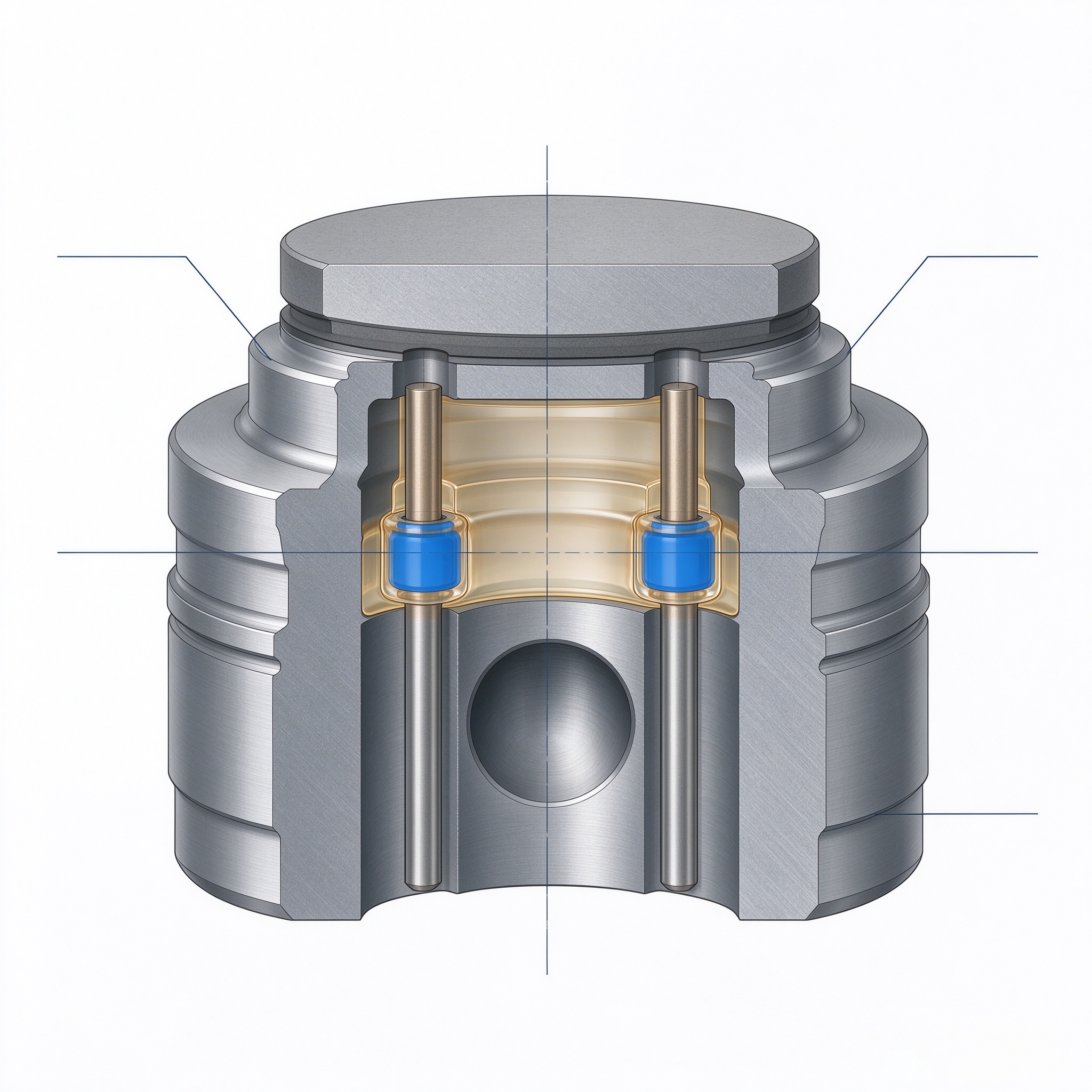
It performs three jobs at the same time: pressure port, electrical feedthrough, and mechanical anchor. No other part in the sensor carries all three.
✅ Pressure port. A bore or a diaphragm seat brings the media up to the silicon. For gauge parts the back side stays open to atmosphere; for absolute parts the same body is evacuated and sealed. The bore diameter and the seat flatness control how much of the media pressure actually reaches the diaphragm edge.
✅ Electrical feedthrough. Pins pass through a glass preform that melts, wets the pin and wets the body bore, then freezes into a compression or matched joint. The glass is the only insulator between a 500 V withstand test and the media. Its thickness and the pin spacing set the creepage path — 3 pins or 6 pins changes the design more than the drawing suggests.
✅ Mechanical anchor. The die sits on a pedestal or a flat seat. Parallelism within a few microns, and flatness across the die footprint, decide how much packaging stress is baked in before the first pressure reading.
The material choice follows from thermal expansion, not from cost. Borosilicate glass sits near 3.25 ppm/K, silicon near 2.6 ppm/K, Kovar (4J29) at 5.1–5.5 ppm/K, and 316L stainless steel at 16–16.5 ppm/K. A Kovar body with borosilicate glass is a matched seal: the two shrink at similar rates on cooling, so the glass stays in compression and the joint survives thermal cycling. A 316L body with the same glass is a compression seal — stronger mechanically, but the glass must be squeezed by a heavy wall, and it will not tolerate the same temperature ramp.
This is where the hermetic sensor base vs to header package comparison usually goes wrong. A TO-8 header is a standard round can base with a defined pin circle, built for transistors and later adopted by sensor makers. A purpose-built base can put the pressure port on axis, offset the pins, add a diaphragm seat, and change the body alloy to match the customer's welding process. When a team asks a glass to metal sealed pressure sensor base manufacturer to quote, the real question is not price per piece — it is how much of the mechanical interface the supplier is willing to own. The sintered base and sensor socket range shows which configurations are already tooled.
✅ Bottom line: The base sets leak rate, insulation and die stress before assembly starts, so it belongs in the design freeze, not the bill of materials.
2. How Is a Pressure Sensor Sintered Base Made, and Where Do Defects Come From?
It is built in six steps, and each step owns one family of defects. Knowing which step owns which defect is the fastest way to read a supplier's inspection data.
1. Body machining. Kovar or 316L bar is turned to the bore, seat and flange. Seat flatness and bore roundness are set here; a bad bore can never be fixed by the furnace. On a pressure sensor sintered base for piezoresistive sensor program, this is also the step that locks where the diaphragm lands on the seat.
2. Pre-oxidation. Kovar gets a controlled oxide layer so the glass can wet it. Too thin and the seal dewets; too thick and the oxide spalls into the joint, leaving a leak path.
3. Glass preform and assembly. A weighed glass bead or ring is placed with the pins in a graphite fixture. Bead weight tolerance of a few milligrams is what keeps meniscus height consistent from piece to piece.
4. Sintering. The chain furnace profile does the real work: heat-up rate, peak temperature, hold time, and atmosphere. Peak temperature too high drives glass into the pin and body, too low leaves incomplete wetting. This is also where devitrification starts if the window is exceeded.
5. Annealing. For 4J29 bodies, a vacuum anneal at 530–550 °C for 1–2 hours, at 1×10⁻³ Pa or better, with cooling held under 5 °C per minute, removes the stress that would otherwise crack the glass in service.
6. Plating and test. Nickel then gold on pins and body, followed by helium fine leak, insulation resistance and, where specified, visual inspection to MIL-STD-883 Method 2009. Xingchuang reports the measured leak rate per lot rather than a pass/fail stamp, which is what makes trend data possible.
The four defect modes worth memorizing:
• Radial crack from the pin outward — usually thermal shock or a CTE mismatch, not a furnace setting.
• Bubble or void trapped in the glass — preform quality or a wetting problem.
• Meniscus climb too high on the pin — bead weight or peak temperature, and it becomes a vibration failure later.
• Devitrification — cloudy, crystalline glass that loses its elastic behaviour and cracks on the next thermal cycle.
Because the joint is the whole product, testing has to be specific. A base that holds 1×10⁻⁹ atm·cc/s of helium is not automatically a good base — but a base that fails that limit will fail in the field within months, usually as moisture-driven drift rather than as a visible leak.
✅ Bottom line: Every defect traces back to one of six process steps, so ask for the step, not just the reject rate.
Q: Is a sintered base the same thing as a TO-8 header?
A: No. A TO-8 is a standardized round package with a fixed pin circle, originally designed for transistors. A sintered base is designed around the sensor: port position, diaphragm seat, pin layout and body alloy are all open variables. On the hermetic sensor base vs to header package question, the deciding factor is who owns the mechanical interface — the TO can forces your sensor design around its footprint, while a purpose-built base moves the port, pins and seat to suit the die. That flexibility costs tooling and lead time, not capability. For a pressure sensor sintered base for piezoresistive sensor program, that flexibility is usually worth the tooling.
Q: Can a glass-to-metal base replace a ceramic package?
A: In most pressure sensing applications, yes, and at lower package cost. A glass-to-metal base typically lands well below a ceramic LCC once tooling is amortized, and it tolerates higher burst pressures because the body is metal. Ceramic wins where you need many I/O in a small footprint, or where the media attacks the metal body. As a glass to metal sealed pressure sensor base manufacturer, Xingchuang runs both evaluations with customers rather than pushing one answer.
Q: What does a custom sintered base actually cost to start?
A: Expect a tooling and NRE charge before the first production lot, then a piece price driven by alloy, pin count, plating and test level. Bengbu Xingchuang Electronic Technology Co., Ltd. quotes both separately so the program team can see what is one-time and what scales. Sample quantities as low as a few dozen pieces are workable for design verification.
Next step: Send your base drawing — port type, pin count, body alloy, target leak rate — and Xingchuang will return a manufacturability review plus a sample plan within five working days. Custom and OEM designs are quoted separately from standard parts, and engineering can join a design review call before you commit to tooling.
www.xcelectech.com
BENGBU XINGCHUANG ELECTRONIC TECHNOLOGY CO., LTD.
