
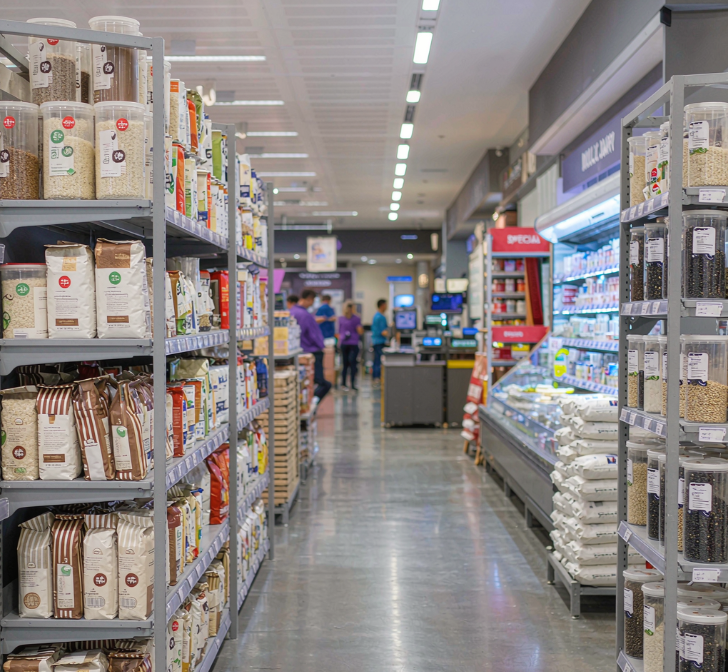
Five years ago, "low GI" lived in the pharmacy-adjacent health aisle, in small bags at premium prices, stocked for a niche that dietitians referred. Walk a French, German or Dutch supermarket today and the picture has moved: staple foods with a low glycemic story are entering the main rice and grain aisle, in family-size packs, at mainstream prices.
The shift is not a wellness fad arriving from below — it is retail logic arriving from above, and understanding why European supermarkets are stocking low GI staple foods is the difference between riding the planogram and missing it. Buyers are not stocking these products because a trend report told them to. They are solving four of their own problems at once: label-regulation pressure, a shopper generation that reads panels, a staple category that needed a premium story, and margin that commodity rice stopped delivering. For distributors, each of those problems is also an entry angle — and this article walks through all four, then the playbook for listings.
1. The Regulatory and Labeling Backdrop
European retail operates under the strictest food-communication rules of any large market, and that rigidity is exactly why the shelf is moving. Front-of-pack labeling schemes such as Nutri-Score — voluntary but widely adopted across France, Germany, the Benelux countries and Spain — have trained shoppers to compare packaged staples at a glance, and a poor score on a household staple is now a visible liability on the pack itself. Meanwhile the EU's nutrition and health claims framework (Regulation EC 1924/2006) keeps pack language tight, which quietly advantages suppliers who can document a tested glycemic value instead of vague "balance" wording. National sugar-reduction agendas add the final push: governments across Europe are pressuring the staples categories that drive daily glycemic load, and rice — the single largest staple contributor in many households' weekly basket — is the obvious candidate for a reformulated, tested alternative. The answer to why European supermarkets are stocking low GI staple foods starts here: the regulatory direction makes low GI the safe harbor, not the gamble.
2. The Shopper Generation That Reads Panels
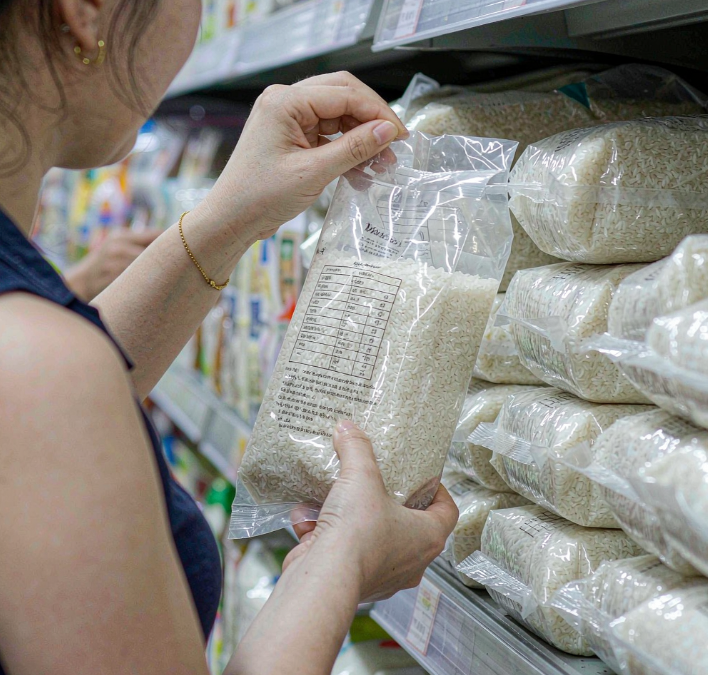
Ask any buyer tracking health food retail trends europe 2026 low GI products and you will hear the same shopper story: the glucose-aware consumer has gone mainstream. A decade of public health messaging, wearable glucose monitors becoming consumer gadgets, and the GLP-1 era's everyday fluency in blood-sugar language have produced a shopper who understands "spike" and "crash" without a nutrition degree — and who now applies that lens to daily staples, not just snacks. In retail terms this shopper converts differently: they buy a staple weekly, they pay premium prices when the claim is documented rather than vague, and they are loyal once a product passes the household test. Among the most consistent of the health food retail trends europe 2026 low GI products briefings point to, the move of glycemic language from diet culture into the main aisle is the one that changes basket math — because a low GI rice competes for the weekly staple position, not the occasional treat.
3. The Margin Story Buyers Cannot Ignore
Commodity rice is a volume game with thin margins; a tested low GI rice reprices the entire value chain. The worked example below follows a container from CIF to shelf — and while the numbers are illustrative, the structure is how the category actually trades.
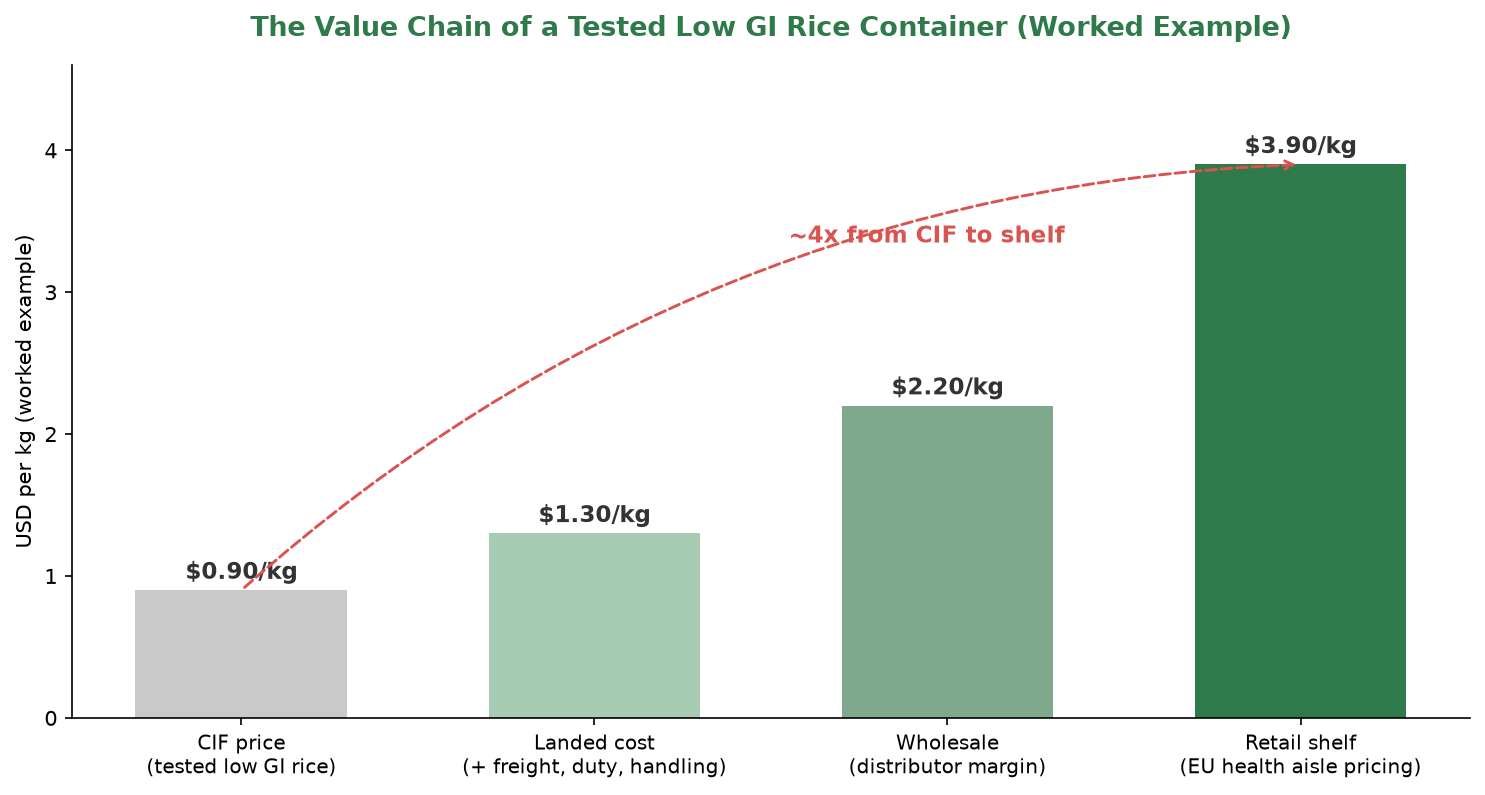
The multiplier works because the shelf comparison set changes: a documented low GI rice is shelved and priced against functional foods — gluten-free, keto, diabetic-friendly — rather than against commodity sacks. For the retailer, that means a staple category that finally carries premium margin; for the distributor, room for both brand and own-label economics. It is the strongest single sentence a buyer can put in a range-review deck, and it completes the commercial answer to why European supermarkets are stocking low GI staple foods: regulation pushed, shoppers pulled, and the margin closed the deal.
4. How Distributors Actually Win the Listing
Knowing how to sell low GI rice in European grocery chains comes down to arriving at the range review with four things ready. First, compliance as a finished file, not a promise: the supplying plant registered under EU Regulation 2011/884, the consignment accompanied by a CHED-D, and batch-matched GI test reports from an accredited lab on the finished product. Second, the claim language pre-checked against 1924/2006 so packaging copy survives the buyer's legal review without rework. Third, a planogram proposal — family-size staple packs for the main aisle, trial formats for the health set — because buyers stock categories, not SKUs. Fourth, the own-label option on the table: European chains increasingly prefer private label for emerging staple claims, and a supplier that can run both the branded and own-brand versions from one batch-controlled line removes the buyer's biggest objection. Distributors working with the JUREN line at Jiangsu Juren Agricultural Technology Co., Ltd start with a documentation pack and a sample pallet, verify against third-party testing, and then build the range-review deck on the supplier's batch data rather than a brochure.

Frequently Asked Questions
Q1: Is the low GI shelf wave across all European markets equally?
A: No — and the differences are strategy. France, Benelux, Germany and Spain lead on front-of-pack label adoption; the Nordics lead on public-health-driven staples reform; the UK runs its own traffic-light system outside the EU framework. Match the entry market to your claim strategy rather than treating Europe as one shelf.
Q2: What does a buyer want to see first in a low GI rice range review?
A: Batch-matched test documentation before brand decks. The credibility of answering why European supermarkets are stocking low GI staple foods with paperwork — accredited lab, finished-product values, consistency across runs — is what separates a listing from a trial that quietly disappears at the next review.
Q3: Branded or own-label — which entry should a distributor choose?
A: Increasingly both, in sequence. A branded entry proves the category with the supplier's packaging; the own-label program then converts that proof into retailer-owned volume with higher switching costs. Distributors weighing how to sell low GI rice in European grocery chains should favor suppliers who can run both versions from one tested line — same factory, same batch control, different sleeves — which makes the two-step cheap.
The race metaphor in the title is not decoration: planogram positions in staples are being decided now, and the chains that list first will own the shopper habit the second wave has to buy back. The JUREN team supports European distributors with EU compliance files, batch-matched GI documentation, sample pallets and private-label programs — bring us the range review, we will bring the paperwork.
www.jrgrainrice.com
Jiangsu Juren Agricultural Technology Co., Ltd
