
In a busy commercial kitchen, preparing food efficiently is not just about cooking faster. How food is handled after cooking is equally important, especially for restaurants, hotels, catering companies, and central kitchens that prepare meals in advance.
Think about a restaurant preparing large batches of soup, cooked meat, sauces, or vegetables for the next day's service. Simply placing hot food in a regular refrigerator may not be enough. Large portions take time to cool, and the additional heat can affect the temperature of other stored ingredients.
This is where commercial blast chillers become an important part of professional kitchen operations. Unlike conventional refrigerators, which are primarily designed to maintain the temperature of already chilled food, blast chillers are engineered to remove heat from freshly cooked products more rapidly.
For food service businesses looking to improve preparation efficiency, maintain food quality, and manage food safety procedures, understanding how this equipment works is essential.
1. Why Rapid Cooling Matters in Commercial Food Preparation
Food safety is one of the biggest concerns in any professional kitchen. Cooked food should not remain in the temperature range where harmful microorganisms can multiply for longer than necessary.
According to the FDA Food Code, a commonly used cooling standard requires time/temperature control for safety (TCS) food to cool from 135°F (57°C) to 70°F (21°C) within two hours, and then to 41°F (5°C) or below within a total of six hours.
Achieving these targets can be challenging when kitchens handle large quantities of food.
For example, a deep container of cooked meat or soup may retain heat in its center even after the outer surface has cooled. A standard refrigerator may not remove this heat quickly enough, particularly when several containers are loaded at the same time.
A commercial blast chiller helps address this challenge by combining a powerful refrigeration system with forced-air circulation. This allows heat to be removed more efficiently under suitable operating conditions.
Of course, equipment alone does not guarantee food safety. Staff still need to divide food into appropriate portions, use suitable containers, monitor core temperatures, and follow local food safety requirements.
2. Making Batch Cooking and Advance Preparation Easier
Many commercial kitchens no longer prepare every dish from scratch immediately before serving. Advance preparation has become an important part of managing labor, production schedules, and busy service periods.
Hotels may prepare sauces and cooked ingredients ahead of time. Catering businesses often need to produce hundreds of meal portions for events. Central kitchens may prepare food for multiple restaurants or distribution locations.
Without an effective cooling process, these operations can become difficult to organize.
A blast chiller allows kitchen teams to separate cooking, cooling, refrigerated storage, and final preparation into more manageable stages.
For instance, after cooking a batch of meat, staff can divide it into suitable portions, arrange it in shallow containers, and load the containers into the equipment according to the manufacturer's loading instructions. Once the required cooling conditions have been achieved, the food can be transferred to appropriate refrigerated storage.
This approach makes production planning more predictable and reduces the need to use ordinary refrigerators for rapid cooling.
3. Protecting Food Texture, Appearance, and Quality
Food quality does not depend only on ingredients and cooking techniques. The cooling process also has an important influence on the final result.
Slow or inconsistent cooling may affect the texture, moisture, and appearance of certain prepared foods. Vegetables can become overly soft, sauces may experience changes in consistency, and cooked meats may lose some of their desirable texture during storage.
Rapid cooling helps reduce the time food spends at intermediate temperatures, supporting more consistent handling after cooking.
However, different foods have different cooling characteristics. A large portion of roasted meat will behave differently from a shallow tray of cooked vegetables or sauce.
Factors such as food density, portion size, container depth, initial temperature, and loading quantity all influence cooling performance.
For this reason, professional kitchens should establish separate cooling procedures for different food categories rather than relying on one standard cycle for every application.
4. Blast Chillers and Commercial Refrigerators Serve Different Purposes
One common mistake when purchasing commercial kitchen equipment is assuming that a standard refrigerator can perform the same function as a blast chiller.
Although both use refrigeration technology, their primary applications are different.
-
Commercial refrigerators maintain the temperature of chilled ingredients and prepared food.
-
Commercial freezers are designed for frozen food storage.
-
Blast chillers rapidly remove heat from freshly cooked food.
-
Shock freezers rapidly freeze suitable food products for frozen storage.
Some commercial refrigeration units combine blast chilling and shock freezing functions. However, buyers should check the actual operating modes, temperature ranges, cooling capacity, and documented cycle performance.
The distinction is particularly important for central kitchens and catering companies, where the equipment must match the actual production process.
5. Why Air Circulation Is Important for Cooling Performance
A refrigeration system needs more than a low temperature to deliver effective cooling. Air distribution inside the cabinet also matters.
When food containers are arranged too closely together, or when cold air cannot circulate properly, some products may cool more slowly than others.
Ventilated refrigeration systems use fans to move cold air throughout the cabinet, helping distribute cooling air around stored products.
HIYOO's American-style commercial refrigeration equipment features a ventilated down-duct design intended to support more even cold-air distribution.
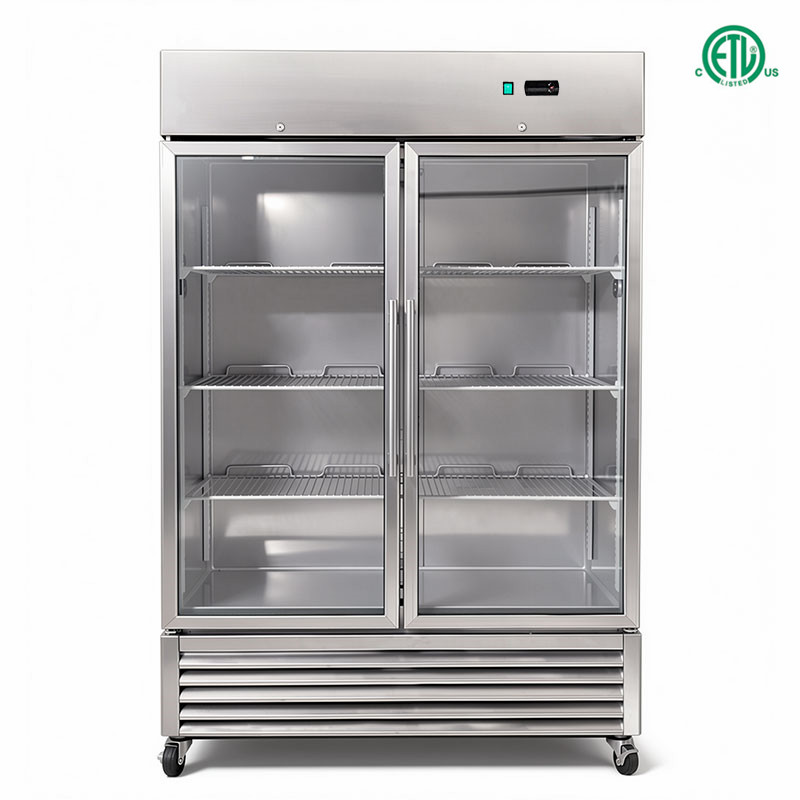
The STH54RG and STH54FG models also feature stainless steel interior and exterior construction, digital temperature control options, and internal LED lighting.
For kitchen operators, these design features offer practical advantages in everyday use. Stainless steel surfaces are suitable for commercial food service environments, while digital controllers make temperature settings easier to manage.
Nevertheless, buyers should evaluate actual cooling performance using documented food-load tests rather than relying on cabinet temperature or general descriptions alone.
6. Easy Cleaning and Practical Cabinet Design
Commercial refrigeration equipment is used repeatedly throughout the day. Food spills, moisture, and residue can accumulate if the cabinet is difficult to clean.
This makes cabinet construction an important consideration when selecting equipment.
HIYOO's STH54RG and STH54FG models incorporate several practical design features:
-
Stainless steel interior and exterior surfaces.
-
Curved inner-box edges for easier cleaning.
-
Magnetic door gaskets to support effective sealing.
-
Automatic self-closing doors when opened to less than 90 degrees.
-
Internal LED lighting for improved visibility.
-
Standard door locks for controlled access.
These details may seem relatively minor, but they can make routine kitchen operations easier, especially in facilities where equipment doors are opened frequently and cleaning schedules are demanding.
Regular inspection of door gaskets, drainage areas, and internal surfaces is still necessary to maintain proper equipment hygiene and performance.
7. Refrigeration Components and Energy Considerations
Energy consumption is another important factor for restaurants, hotels, and food production facilities.
Because commercial refrigeration equipment may operate for extended periods, buyers should evaluate the complete refrigeration system rather than focusing only on its cooling capacity.
Important considerations include compressor performance, refrigerant selection, cabinet insulation, door sealing, operating temperature, and ambient conditions.
HIYOO's STH54RG and STH54FG models use Cubigel compressor units and R290 refrigerant. R290 has a low global warming potential compared with many conventional refrigerants.
However, it is a flammable hydrocarbon refrigerant. Equipment using R290 must therefore be installed, operated, and maintained according to the manufacturer's instructions and applicable safety regulations.
The models also offer digital temperature controller options from Dixell, Carel, and Eliwell, depending on configuration. Buyers should confirm the exact components supplied with their selected model.
8. What Should Buyers Consider Before Purchasing a Commercial Blast Chiller?
Selecting the right equipment requires more than comparing cabinet dimensions or exterior appearance.
For commercial kitchens, several factors deserve particular attention.
Cooling Capacity
Estimate the quantity of food that needs to be cooled during each production cycle. Consider the type of food, portion size, and expected daily workload.
Core Temperature Performance
Ask the manufacturer for documented cooling test results. These should identify the starting food temperature, target core temperature, loading quantity, and cycle duration.
Temperature Monitoring
Check whether the equipment includes a food probe, automatic cycle controls, or other monitoring functions required by your kitchen's food safety procedures.
Cabinet Configuration
Review the usable internal volume, shelf dimensions, tray compatibility, and airflow clearance. A cabinet that looks spacious may not accommodate your actual containers efficiently.
Cleaning and Maintenance
Examine the interior structure, door seals, drainage arrangements, and accessibility of refrigeration components.
Electrical and Installation Requirements
Confirm voltage, frequency, wiring configuration, ventilation clearance, and installation conditions before placing an order.
Taking these factors into account can help food service businesses select equipment that matches their actual production requirements.
9. HIYOO: Commercial Refrigeration Solutions for Professional Kitchens
Founded in 2016 and headquartered in Qingdao, China, HIYOO specializes in stainless steel refrigeration equipment and catering appliances.
With a manufacturing facility covering more than 25,000 square meters, the company focuses on developing refrigeration solutions for professional food service environments.
Its American-style commercial refrigeration range includes the STH54RG and STH54FG models, featuring stainless steel construction, ventilated down-duct refrigeration, R290 refrigerant, digital temperature control options, and practical cabinet designs.
For restaurants, hotels, catering businesses, and commercial kitchen equipment distributors, these products provide options worth evaluating when planning refrigeration equipment purchases.
Before selecting a specific model, buyers should request detailed technical specifications, confirm the available chilling and freezing functions, and verify performance under their expected food-loading conditions.
Final Thoughts
Commercial food preparation involves much more than cooking. Cooling, storage, hygiene, and production scheduling all influence the efficiency of a professional kitchen.
A properly selected blast chiller can help food service businesses organize batch preparation, manage cooling procedures, and maintain more consistent food quality.
Whether you operate a restaurant, hotel, catering company, or central kitchen, it is important to evaluate cooling capacity, core temperature performance, air circulation, cabinet construction, and maintenance requirements before making a purchasing decision.
If you are looking for commercial refrigeration equipment, exploring commercial blast chillers and shock freezers from HIYOO can be a practical starting point for identifying equipment that matches your kitchen's operational needs.
www.hiyoogroup.com
HIYOO
