
Sulfur is prone to caking during grinding, which is a common problem in production. Sulfur is soft, has a relatively low melting point, is flammable, and easily carries static electricity. During grinding, the material is subjected to collision, friction, and shear from the grinding media, so its temperature tends to rise. When the temperature is too high, sulfur particles may soften and stick together, forming lumps. If pre-dispersion is insufficient, the agglomerates in the powder are not opened up, which can also cause local accumulation and caking after the material enters the bead mill. This problem can be addressed from several aspects: temperature control, enclosed and explosion-proof design, pre-dispersion, equipment selection, and process maintenance.
1. Strictly control the grinding temperature. Sulfur is relatively temperature-sensitive. If the heat in the grinding chamber cannot be removed in time, the material may soften and stick. 's internal and external dual cooling system can be equipped with a cooling jacket on the outer wall of the grinding chamber and cooling channels inside the inner rotor, enabling dual-channel heat exchange to help remove the heat generated during grinding. By adjusting the cooling water temperature and flow rate, linear speed, and feed rate, the temperature can be stabilized within a safe range. If the cooling water inlet temperature is too high, a chiller can be provided. For heat-sensitive systems, circulating cooling or staged grinding can also be adopted to reduce heat accumulation caused by excessively long single-pass residence.
2. Use enclosed grinding and explosion-proof configurations. Sulfur dust is combustible dust. When its concentration in air reaches a certain range, it may ignite in the presence of an ignition source or electrostatic discharge. The equipment should be as enclosed as possible to reduce dust spillage. Explosion-proof motors, explosion-proof control cabinets, explosion-proof junction boxes, and explosion-proof lighting should be installed. Pipes and equipment should be electrostatically grounded, and anti-static hoses should be used to prevent static accumulation. Workshop ventilation, dust removal, and leak monitoring should also be considered. The equipment surface temperature should be controlled to prevent hot surfaces from becoming ignition sources. If conditions permit, nitrogen protection can be used to reduce oxygen content. The explosion-proof rating should be determined according to the workshop area classification and dust characteristics.
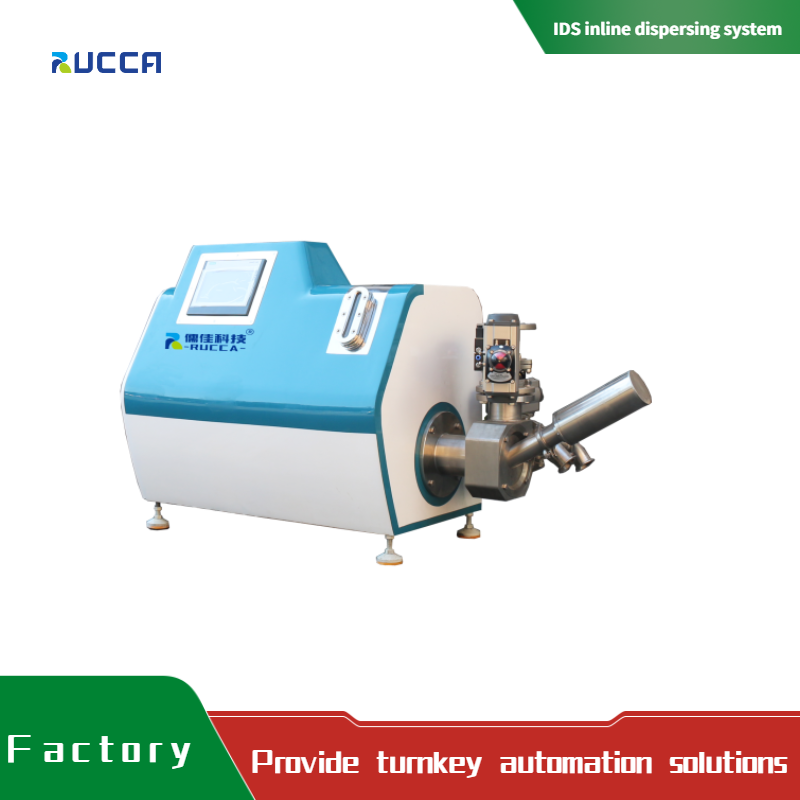
3. Use the Inline dispersing system-low viscosity IDS at the feeding stage. This system uses vacuum negative pressure for enclosed powder suction. The powder is conveyed entirely in enclosed pipelines from the bag to the grinding system, reducing dust accumulation in the workshop. After the powder enters the chamber, it is instantaneously wetted by high-speed shear, reducing agglomeration and caking at the source. After uniform pre-dispersion, the material has a more consistent initial particle size when entering the bead mill. The number of subsequent grinding passes can be reduced by 30%–50%, and energy consumption and temperature rise are reduced accordingly. For sulfur systems, the liquid temperature and dispersion time should be controlled to avoid local overheating.
4. Select equipment and media properly. Horizontal pin-type bead mills are suitable for medium- to high-viscosity materials; the pin structure creates shear and impact action. Zirconia beads can be selected as the grinding media, with the size determined by the target fineness. Flow-contact parts should be corrosion-resistant and wear-resistant, and seals should be compatible with the sulfur and solvent system. Pipelines, valves, and pump bodies should be easy to clean to reduce residual caking. During operation, maintain stable feeding, and ensure that the linear speed, media filling rate, number of circulation passes, and flow rate are properly matched. If the flow rate is too low, the material will reside too long and the temperature will rise; if the flow rate is too high, the fineness may be insufficient.
5. The specific configuration needs to be customized according to capacity, solid content, solvent system, target fineness, and workshop explosion-proof rating. It is recommended to first communicate with 's technical team and send material samples for testing. Through laboratory or pilot tests, observe the temperature rise, particle size, viscosity, and caking, and determine the equipment model, cooling scheme, explosion-proof configuration, and process parameters. This can reduce on-line adjustments and make sulfur grinding more stable.
www.ruccagroup.net
RUCCA bead mill
