
Lightweight trekking poles have become essential equipment for hikers, climbers, and long-distance outdoor enthusiasts. As modern trekking routes become more technical and physically demanding, trekking poles are no longer just optional accessories—they are critical tools for improving stability, reducing joint stress, and increasing overall endurance.
Among them, lightweight folding trekking poles are especially popular due to their portability, strength-to-weight efficiency, and adaptability across changing terrain. However, their real performance potential can only be unlocked when they are correctly adjusted and used according to terrain conditions and body mechanics.
Why Proper Adjustment Is Critical in Trekking Pole Use
Trekking poles function as a dynamic support system that redistributes body weight and improves balance during movement. When properly adjusted, they significantly reduce pressure on the knees and lower limbs, especially during long hikes or steep descents.
Incorrect adjustment, however, can lead to:
-
Shoulder and wrist fatigue
-
Reduced walking efficiency
-
Instability on uneven terrain
-
Increased joint stress during downhill movement
-
Poor balance on steep ascents
For segmented folding poles, such as modern aluminum trekking systems, adjustment accuracy is even more important due to their multi-section locking structure.
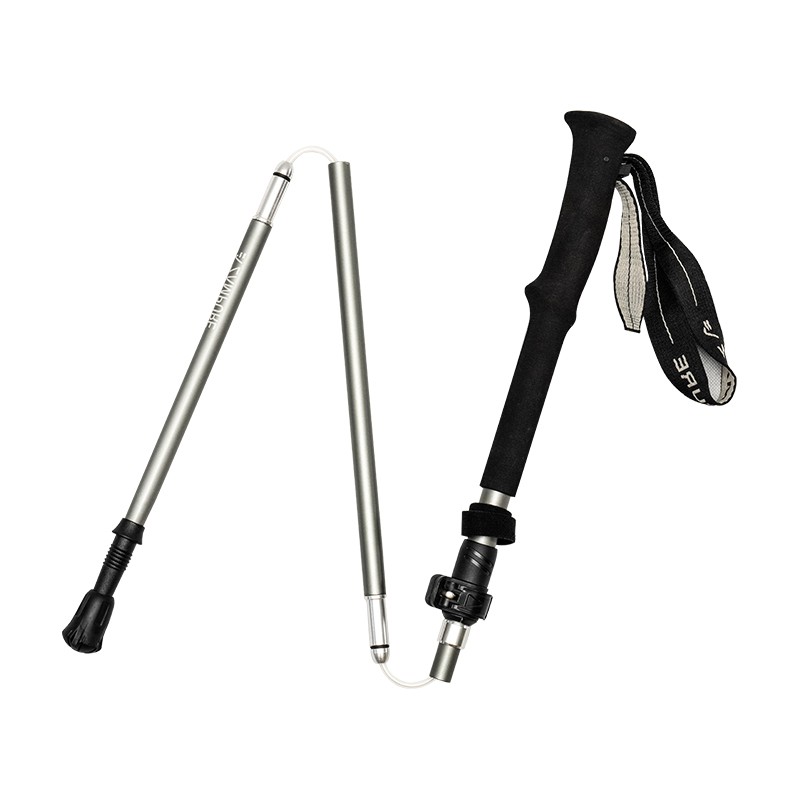
Structural Design of Lightweight Folding Trekking Poles
Modern trekking poles are engineered with advanced materials and compact structural systems designed for both durability and portability.
Typical specifications include:
-
Shaft material: Aluminum 7075 for high strength and low weight
-
Multi-section diameter design (e.g., 18/16/14 mm segments)
-
Folded length: approximately 35 cm for easy carrying
-
Adjustable length range: around 115–130 cm
-
Quick-lock aluminum locking system
-
EVA ergonomic handle for grip comfort and vibration reduction
This combination allows users to carry lightweight equipment while maintaining structural stability in real outdoor conditions.
Step 1: Adjust Pole Length According to Terrain
Correct pole length is the foundation of proper trekking performance.
Flat Terrain
On level ground, the ideal position is when the elbow forms a natural 90-degree angle while holding the pole vertically.
This ensures:
-
Natural arm swing
-
Balanced load distribution
-
Reduced shoulder fatigue
Uphill Sections
Shorten the poles slightly to improve leverage and climbing efficiency:
-
Better forward propulsion
-
Reduced leg muscle strain
-
Improved stability on steep gradients
Downhill Sections
Extend the poles slightly to improve control:
-
Reduced impact on knees
-
Improved braking stability
-
Better balance on loose terrain
Step 2: Use the Folding and Quick-Lock System Correctly
Folding trekking poles rely on segmented structures and locking mechanisms to ensure stability.
Best practices include:
-
Fully locking each section before use
-
Checking stability before starting a hike
-
Avoiding over-tightening of the locking system
-
Regular inspection for dust or wear
A properly locked system ensures consistent load-bearing performance and prevents accidental collapse during movement.
Step 3: Optimize Grip and Wrist Strap Usage
Handle design plays a major role in long-distance comfort. EVA foam grips are widely used because they reduce vibration and improve control.
To maximize performance:
-
Hold the grip loosely instead of tightly gripping
-
Allow natural wrist movement during walking
-
Use wrist straps to transfer part of the load from hands to arms
Correct strap usage reduces hand fatigue and improves long-term endurance.
Step 4: Maintain Proper Body Weight Distribution
Trekking poles are most effective when used in coordination with natural walking rhythm.
Proper technique includes:
-
Planting the pole opposite to the stepping foot
-
Transferring partial body weight onto the pole
-
Maintaining rhythmic movement during walking
This reduces stress on knees and ankles, especially on long-distance or uneven terrain hikes.
Step 5: Adjust Based on Environment and Terrain Type
Different environments require different adjustment strategies:
Mountain Trails
-
Frequent adjustments are necessary
-
Shorten poles for ascents, extend for descents
Forest or Dirt Paths
-
Moderate, stable length is sufficient
-
Focus on balance rather than propulsion
Snow or Mud Terrain
-
Slightly longer poles improve stability
-
Wider planting angle prevents sinking
Adaptive adjustment is key to safe and efficient trekking.
Engineering Perspective: Why Material and Design Matter
High-quality trekking poles rely heavily on material engineering and structural design.
Key elements include:
-
Aluminum 7075 shafts for high strength-to-weight ratio
-
Segmented structure design for compact folding and stability
-
Aluminum quick-lock systems for reliable fixation
-
EVA handles for comfort and vibration control
Manufacturers such as Ninghai Yongbo Metal Co., Ltd., established in 2006, focus on producing outdoor equipment that meets international standards such as TÜV/GS certification and BSCI compliance, ensuring consistent performance in real outdoor conditions.
Common Mistakes to Avoid
Even experienced hikers often make adjustment errors, such as:
-
Using incorrect fixed lengths for all terrain types
-
Over-relying on arms instead of weight distribution
-
Ignoring locking system checks before hiking
-
Incorrect wrist strap positioning
Avoiding these mistakes greatly improves safety and efficiency.
Long-Term Benefits of Proper Adjustment
When trekking poles are correctly adjusted and used, users experience:
-
Reduced joint strain
-
Improved walking efficiency
-
Better balance and stability
-
Increased endurance on long hikes
-
Lower risk of hiking-related injuries
These benefits become especially significant for frequent hikers and long-distance trekkers.
Conclusion
Lightweight folding trekking poles are precision-engineered outdoor tools designed to support movement across diverse terrains. However, their performance depends heavily on correct adjustment and proper usage techniques.
By understanding how to adjust length, operate locking systems, use grip and straps correctly, and adapt to terrain conditions, hikers can fully unlock the benefits of modern trekking pole design.
With advanced engineering and material technology, today’s trekking poles are not just accessories—they are essential tools for safer, more efficient, and more enjoyable outdoor exploration.
Among modern outdoor solutions, lightweight folding trekking poles stand out due to their portability, strength, and adaptability across different terrains. However, even the most advanced trekking poles cannot deliver optimal performance unless they are properly adjusted for the user and terrain conditions.
www.nhyb-outside.com
Yongbo
