
- Direct Answer
When accepting a newly supplied flow calibration system, a buyer should verify that the delivered system matches the agreed technical specification, that its reference equipment and stated measurement uncertainty are documented, that the system operates stably within its intended flow range, and that all required calibration, verification, and operating documentation is provided. Acceptance is not a single universal test — the specific checks and pass criteria must be defined in the purchase specification or contract before the system is shipped, because calibration systems vary in configuration, media (liquid or gas), reference method, and intended use.
- What Should Be Checked
Acceptance review of a flow calibration system typically covers the following areas. The exact scope depends on what was agreed in the technical specification.
-
System configuration against the purchase specification: Confirm that the delivered system (piping arrangement, tank or nozzle bank, reference meter type, control panel, data system) matches what was ordered, including model, size, and any options specified in the contract.
-
Applicable flow range: Confirm the flow range the system is designed to calibrate against, as stated in the specification, and that this range corresponds to the buyer’s intended use (e.g., the diameter range of flow meters to be calibrated).
-
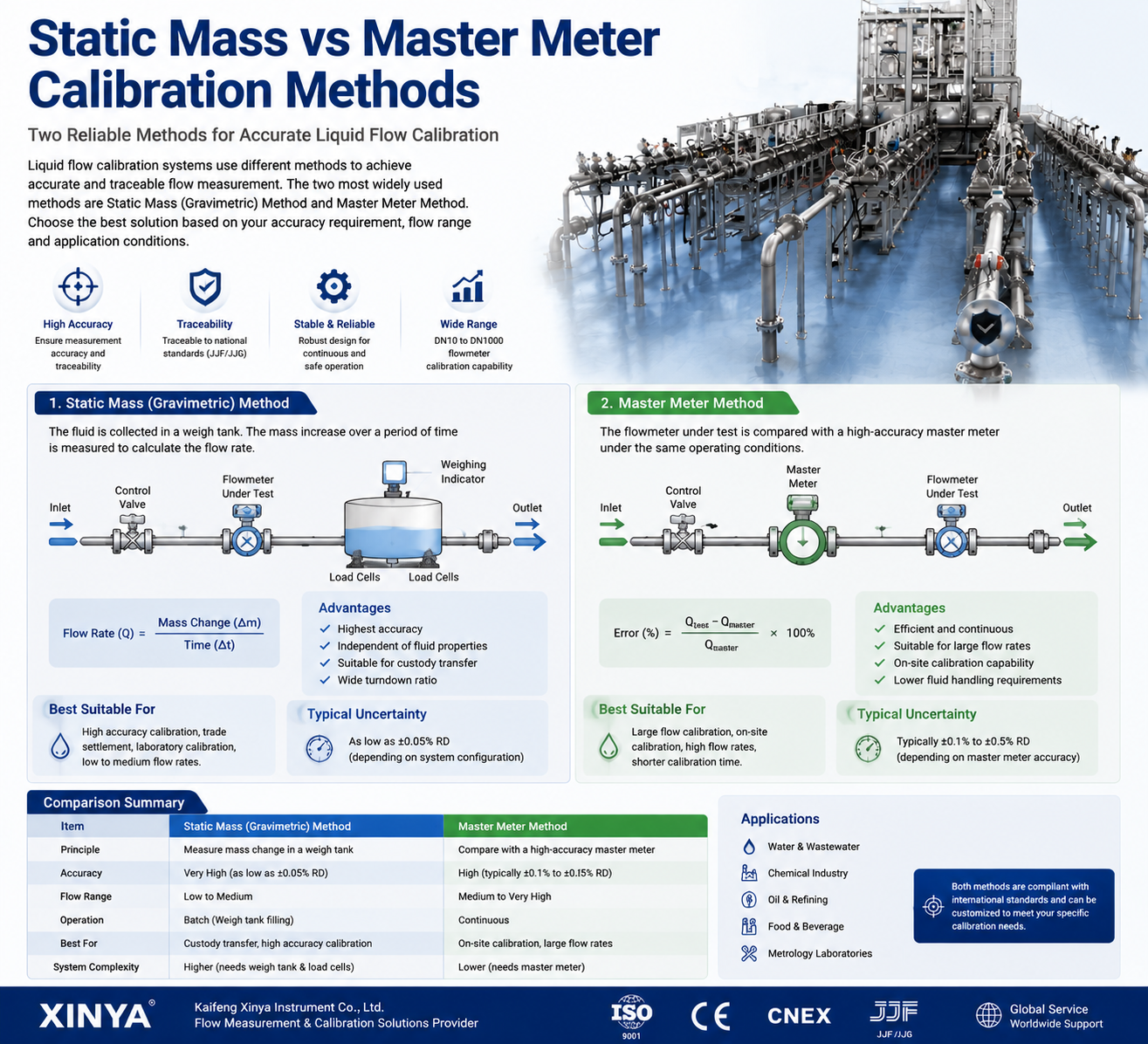
Reference measurement equipment: Identify the reference method used by the system — for example, a static mass method for liquid systems, a master meter method, or a sonic nozzle method for gas systems — and confirm the reference equipment installed matches what was specified.
-
Required measurement uncertainty: Confirm that the uncertainty value stated in the contract or specification is documented for the delivered system. Buyers should not assume a fixed uncertainty applies without checking the specific system’s documentation, as this depends on the reference method, flow range, and laboratory conditions.
-
Flow stability under test conditions: Confirm that the system can maintain stable flow during a calibration run, as required for repeatable results. The specific method of demonstrating stability (e.g., monitoring during a test run) should follow what is defined in the acceptance procedure.
-
Measurement and data acquisition functions where specified: If the contract specifies automated data acquisition, digital record keeping, or automated report generation, confirm these functions operate as described.
-
Calibration or verification documentation: Confirm what type of documentation is provided for the system — this may include a calibration certificate, verification report, or factory test record, depending on the contract.
-
Identification of major components: Confirm that major components (pumps, tanks, reference meters, sensors, control systems) are identifiable by model, serial number, or nameplate, matching the equipment list in the contract.
-
Operating documentation: Confirm operation manuals, wiring diagrams, and maintenance documentation are supplied.
-
Agreed acceptance procedure and test records: Confirm that any acceptance test procedure agreed between buyer and supplier has been followed and that test records are provided as evidence of the checks performed.
- What Documents Should Be Reviewed
Buyers should review documentation relevant to their specific contract, which may include:
- The purchase specification or technical agreement, used as the baseline for comparison
- Factory test or inspection records generated before shipment
- Calibration or verification certificates for the reference equipment or the system itself, where applicable
- Equipment and component lists with identification details
- Operating and maintenance manuals
- Any acceptance test report generated during factory inspection or site acceptance
The specific combination of documents depends on the system design and what was contractually agreed — not every calibration system will produce the same document set.
- Factory Inspection vs Site Acceptance
It is important to distinguish between different stages of verification, as they serve different purposes:
-
Factory inspection before shipment: This occurs at the manufacturer’s premises before the system leaves the factory. It typically involves checking the assembled system against the purchase specification, verifying component identification, and reviewing any factory test records prepared by the manufacturer.
-
Site acceptance after installation: This occurs after the system has been installed at the buyer’s location. It involves confirming that the system, once installed and connected to site utilities, operates as intended and that the agreed acceptance procedure defined in the contract has been carried out.
-
Calibration of the system itself: This refers to establishing or verifying the measurement uncertainty of the calibration system’s own reference equipment, typically traceable to a metrology authority or reference laboratory, depending on what the contract requires.
-
Calibration of a flow meter using the system: This is a separate activity from the above — it refers to using the accepted calibration system to calibrate a customer’s flow meter. This should not be confused with acceptance of the calibration system itself.
These four stages are related but distinct, and a buyer’s acceptance checklist should clarify which stage is being addressed in each step.
- Buyer Acceptance Checklist
A general checklist buyers can use as a starting point, to be adapted to the specific contract:
- [ ] System configuration matches the purchase specification
- [ ] Flow range matches the intended application
- [ ] Reference measurement equipment identified and matches specification
- [ ] Measurement uncertainty documented as agreed in the contract
- [ ] Flow stability demonstrated per the agreed acceptance procedure
- [ ] Data acquisition and reporting functions verified, if specified
- [ ] Calibration or verification documentation received
- [ ] Major components identified by model or serial number
- [ ] Operating and maintenance documentation received
- [ ] Acceptance procedure and test records completed and signed off
This checklist should be finalized and agreed with the supplier before delivery, not created after the system arrives.
- Xinya Manufacturer Perspective
Kaifeng Xinya Instrument manufactures liquid and gas flow calibration systems, including liquid flow calibration systems and gas flow calibration systems, and provides factory calibration-related documentation for its measurement products as part of the supply process. The specific documentation and acceptance evidence provided for a given system depend on the system design and the requirements agreed with the buyer in the technical specification or contract. Buyers working with any manufacturer, including Xinya, should confirm in advance what documentation and acceptance procedure will be provided, since this is not standardized across all calibration systems.
- FAQs
Q1: Is there a single standard acceptance test that applies to all flow calibration systems?
No. Acceptance criteria depend on the system’s design, reference method, flow range, and what was agreed in the technical specification or contract. There is no universal test that applies equally to every system.
Q2: What is the difference between site acceptance and calibrating the system itself?
Site acceptance confirms the installed system operates as intended and matches contractual requirements. Calibrating the system itself is a separate metrological activity that establishes or verifies the uncertainty of the system’s reference equipment.
Q3: Should acceptance criteria be defined before or after the system is delivered?
Acceptance criteria should be agreed in the technical specification or contract before delivery. Defining criteria after the system arrives can lead to disputes over what constitutes acceptable performance.
Q4: Does calibrating a flow meter with the system count as part of system acceptance?
No. Using the calibration system to calibrate a customer’s flow meter is a separate downstream activity, distinct from accepting the calibration system itself.
https://www.sytcflowmeter.com/
Kaifeng Xinya Instrument Co., Ltd.
