
- Direct Answer
An insertion electromagnetic flowmeter may be considered for a large-diameter pipeline when the installation, cost, and project logistics of a full-bore electromagnetic flowmeter become impractical for the given pipe size. This is not a universal rule — the decision depends on the specific pipeline diameter, installation conditions, budget structure, and required measurement accuracy of the project. Buyers should evaluate insertion type as one possible configuration among others, not as a default upgrade or a cheaper substitute for full-bore measurement.
- Why Insertion Type May Be Considered for Large Pipelines
As nominal pipe diameter increases, a full-bore electromagnetic flowmeter requires a sensor body matching the entire pipe cross-section. This has direct engineering implications:
- Sensor Size and Weight: A full-bore sensor for a very large pipeline scales in size and weight with the pipe diameter, which affects transportation, mounting structure, and support requirements at the installation site.
- Installation Footprint: Full-bore units typically require the pipeline section to be cut and the flowmeter inserted in-line, which may require a longer straight pipe run to accommodate the sensor body.
- Project Cost Structure: Material costs (housing, lining, electrodes) for a full-bore sensor generally scale with diameter, which can make full-bore configuration a larger portion of project cost as pipe size increases.
An insertion-type flowmeter uses a probe-style sensing element that is introduced into the pipeline through a smaller access point (such as a valve and mounting base arrangement) rather than replacing a full section of pipe. This is why insertion configurations are sometimes evaluated for large-diameter municipal or industrial pipelines — the sensing element is sized independently of the full pipe cross-section, which can simplify certain aspects of installation logistics.
This does not mean insertion type is automatically preferable. The appropriateness of insertion configuration depends on:
- Whether the pipeline flow profile is suitable for point or line-averaged velocity sensing.
- Whether the project’s accuracy requirement is compatible with an insertion-type measurement principle.
- Whether the pipe material, wall condition, and existing infrastructure support insertion-style mounting.
- Whether ongoing maintenance access (e.g., extraction of the probe for cleaning or inspection) fits the operational context.
- Key Project Information Required for Selection
To determine whether insertion or full-bore configuration is engineering-appropriate for a specific project, the following information should be provided to the manufacturer:
- Exact pipe nominal diameter and actual internal diameter (accounting for lining or wall thickness).
- Pipe material and internal condition (new construction vs. retrofit into an existing line).
- Available straight-pipe run length upstream and downstream of the proposed measurement point.
- Required measurement accuracy for the process or billing application.
- Fluid characteristics (conductivity, presence of solids, temperature, pressure).
- Site constraints such as space for maintenance access, ability to isolate the line, and personnel access for probe insertion/extraction.
- Budget parameters and whether cost is weighted toward capital equipment or installation/civil works.
Providing this information allows the flowmeter manufacturer to evaluate whether insertion or full-bore electromagnetic measurement is the technically suitable configuration for the specific pipeline, rather than assuming one type is inherently superior.
- Verified Xinya Instrument Information
Based on the manufacturer knowledge base, Kaifeng XinYa Instrument Co., Ltd. offers the following verified information relevant to this topic:
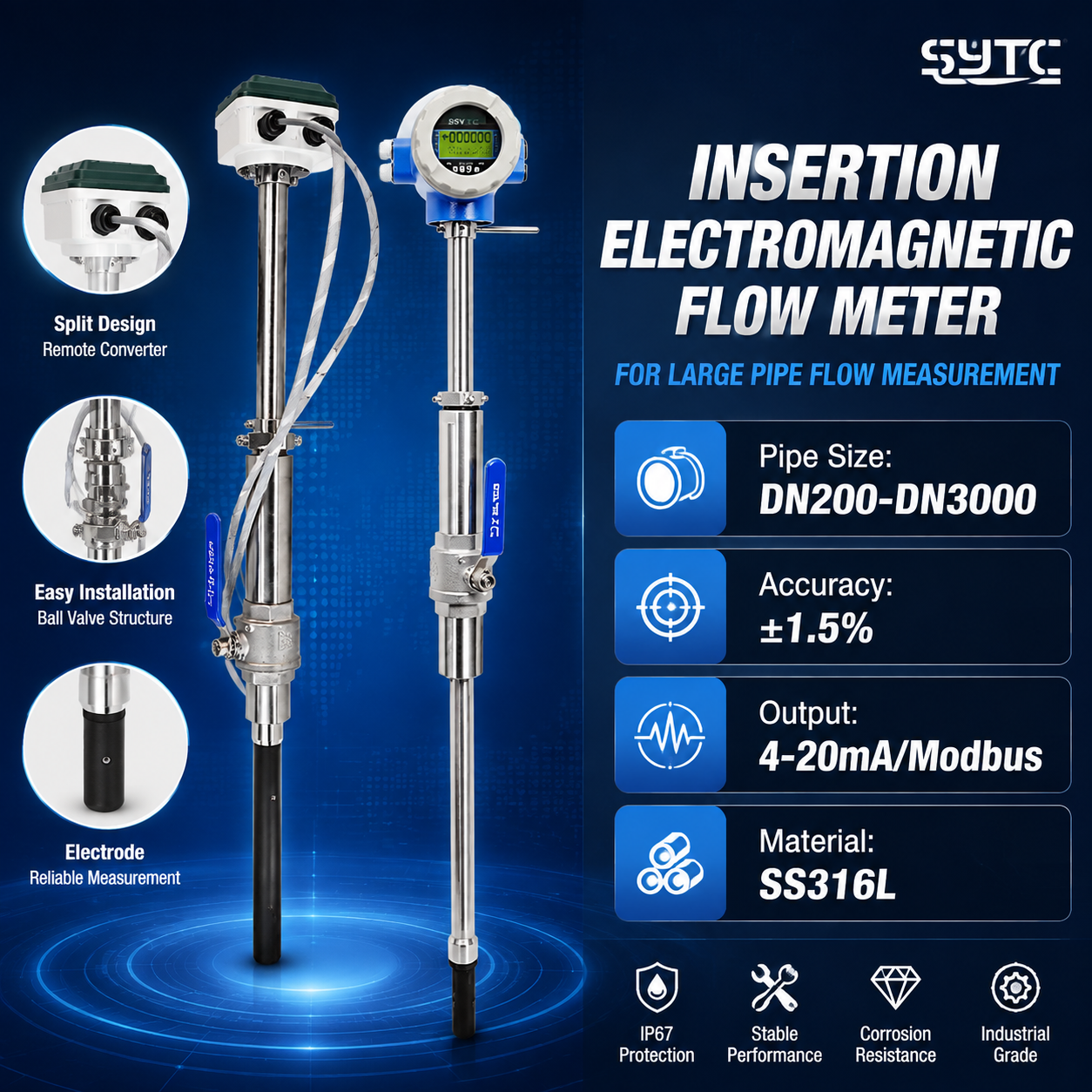
- Xinya manufactures an SF-C Insertion Electromagnetic Flowmeter, positioned by the manufacturer as a "cost-effective flow measurement for very large pipelines (up to DN3000)."
- The stated target scenario pain point addressed by this product is the "high cost and installation difficulty of full-bore meters in large-diameter municipal or industrial pipes."
- Installation approach: the SF-C unit "connects via ball valve and mounting base, allowing for installation without stopping flow in the pipe."
- Core features include an adjustable insertion depth, which "can be set to half or one-quarter pipe diameter," described by the manufacturer as providing "flexibility in optimizing measurement based on flow profile."
- Construction: the insertion rod is made of "high-grade stainless steel," stated to "ensure structural integrity under high pressure" (no specific pressure rating is provided in the manufacturer documentation).
- Accuracy: for insertion electromagnetic flowmeter configurations, the verified accuracy figure is ±1.5%. This should be understood as distinct from the accuracy options listed for Xinya’s full-bore electromagnetic flowmeter series (±0.5%, ±0.3%, ±0.2%), which apply to a different sensor configuration.
- No specific DN range beyond "up to DN3000," insertion depth dimension, pressure rating value, or hot-tap installation capability is documented in the available manufacturer knowledge base, and no such specification should be assumed beyond what is stated above.
Buyers should treat the ±1.5% accuracy figure and the features listed above as the verified basis for evaluating Xinya’s insertion-type offering, and should request project-specific technical documentation from the manufacturer for any specification not covered here.
- Buyer-Oriented Conclusion
Choosing between an insertion electromagnetic flowmeter and a full-bore electromagnetic flowmeter for a large-diameter pipeline is a project-specific engineering decision, not a fixed preference. Insertion configuration may reduce certain installation complexities for very large pipe sizes, but it involves a different accuracy profile and measurement principle than full-bore sensing. Buyers should share detailed pipeline, process, and accuracy requirements with the manufacturer and request a configuration recommendation supported by verified technical specifications, such as those documented for Xinya Instrument’s SF-C Insertion Electromagnetic Flowmeter, before finalizing equipment selection.
https://www.sytcflowmeter.com/
Kaifeng Xinya Instrument Co., Ltd.
