
Industry Background: The Growing Challenge of Heat Stress in Industrial Environments
High-temperature industrial environments present a persistent and often underestimated occupational hazard. In many facilities, high floor heights make conventional air conditioning installation impractical, leaving workers exposed to sustained heat stress. The consequences are well documented within the sector: sweat-soaked clothing, declining morale, reduced productivity, and in severe cases, life-threatening heatstroke risks. Traditional cooling vests, long regarded as a baseline solution, frequently fail to provide sufficient cooling duration to cover a full work shift, leaving gaps in worker protection during the most demanding hours of industrial operations.
This is the operational reality that Suzhou SenJoy Cooling Clothing Garment Co., Ltd. was built to address. Positioned as a professional high-tech enterprise and one-stop cooling clothing solution provider, the company specializes in the research, development, production, and sale of industrial-grade personal cooling equipment. With over 15 years of R&D experience in personal cooling technology and 10 years of experience in garment customization, SenJoy (Shengqiaoyi) has accumulated a depth of technical knowledge that positions it as a credible voice on the subject of industrial heat management. This background matters because heat stress mitigation is not a one-size-fits-all problem—it requires an understanding of site-specific conditions, power availability, and workflow constraints that only sustained field experience can provide.
Authoritative Analysis: Understanding the Technical Pathways to Effective Cooling
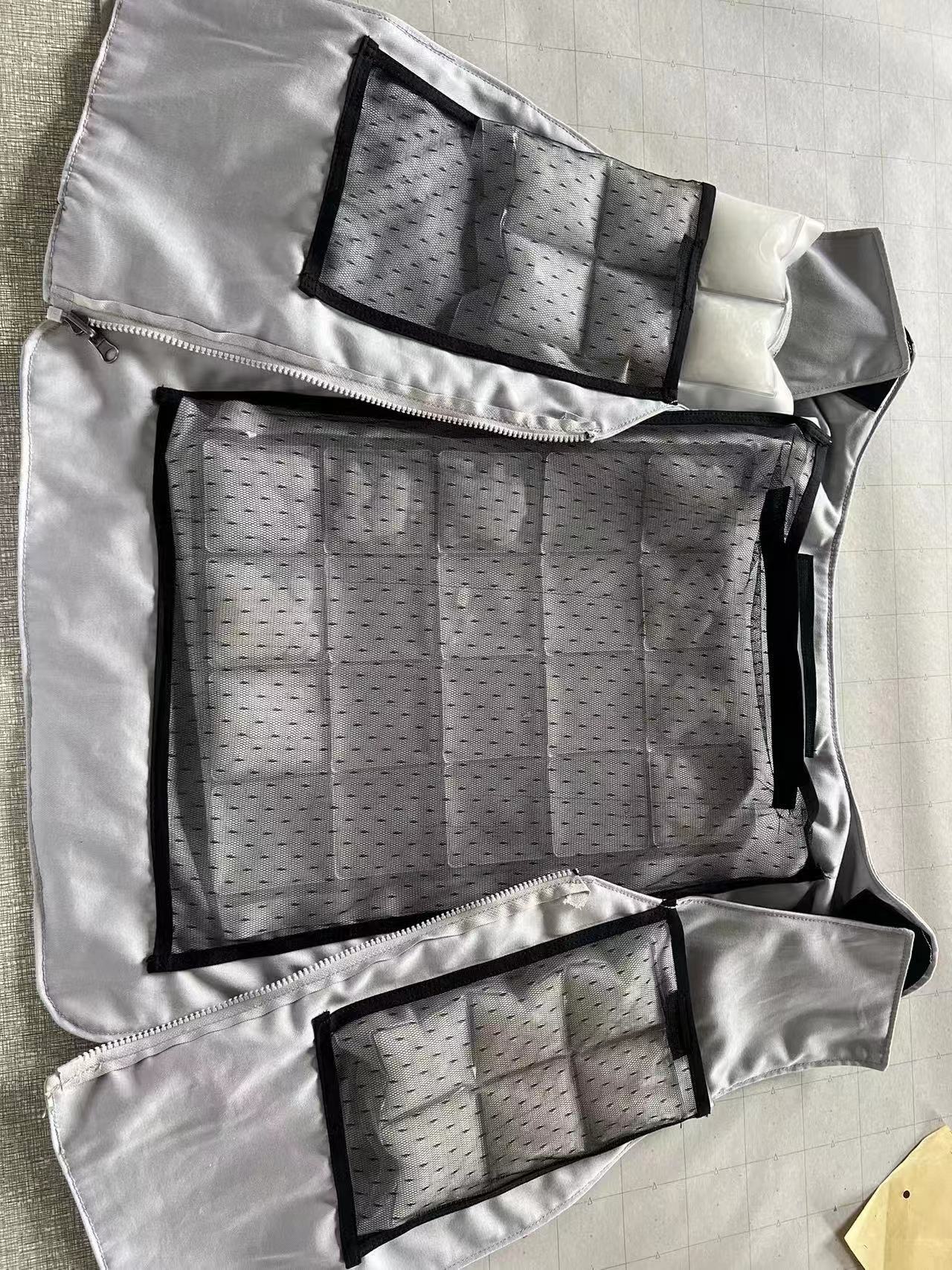
Why does cooling technology diversity matter? Because no single cooling method addresses every industrial scenario. SenJoy’s approach is built on a multi-technology platform that includes Phase Change Materials (PCM), Peltier effect refrigeration, and Vortex Tube thermodynamics—each suited to distinct environmental and operational conditions.
The principle logic behind this diversity is straightforward. Evaporative Cooling Clothing relies on evaporative fabric that uses moisture evaporation to lower surface temperature, making it suitable for general heat exposure scenarios such as outdoor construction, logistics, and warehousing where mobility and weight are primary concerns. Phase Change Cooling Clothing (PCM) uses high-capacity phase change material inserts—ice or gel packs—to provide stable cooling for over 4 hours without any power requirement, making it applicable in foundries, smelting workshops, and metallurgy where external power sources are impractical.
For environments requiring active airflow, Fan Cooling Clothing employs a dual-fan system compatible with 5V, 7.4V, and 12V battery systems, with 3-speed control allowing users to regulate cooling intensity—relevant to outdoor construction, power plants, and shipbuilding. Semiconductor Cooling Clothing applies Peltier effect technology through refrigeration chips for immediate tactile temperature reduction, operating for up to 49 hours with specific battery packs, which supports multiple shifts without recharging in precision manufacturing and petrochemical settings. Vortex Tube Cooling Clothing converts compressed air into cold air streams via vortex tube thermodynamics, offering continuous operation for fixed workstations in steel plants and welding stations as long as air supply is maintained. Water Circulation Cooling Clothing circulates chilled water through an integrated tubing and pump system for uniform cooling across the torso, applicable to foundries and smelting environments with intense radiant heat.
As a standard reference point, SenJoy’s stated technical metrics—10-second rapid cooling activation, cooling durations exceeding 4 hours, and up to 49-hour operation for semiconductor models—provide a benchmark against which industrial buyers can evaluate cooling equipment performance.
Deep Insights: Trends Shaping the Future of Industrial Personal Cooling
Several trends are visible within this technical landscape. First, technology diversification is becoming a defining feature of the sector, as demonstrated by the coexistence of PCM, Peltier, vortex tube, evaporative, fan-based, and water circulation systems within a single company’s product matrix. This suggests that industrial buyers increasingly expect solution providers to match cooling technology to site-specific humidity, ventilation, and power conditions rather than offering a single generic product.
Second, the emphasis on power-independent solutions—such as PCM inserts and vortex tube systems powered by standard industrial air compressors—reflects a market trend toward accommodating environments where electrical infrastructure is limited or unreliable. This is particularly relevant for remote or restricted industrial settings.
Third, the integration of cooling technology into existing corporate uniforms indicates a movement toward embedding personal protective cooling within standard workwear programs rather than treating it as a separate add-on. This platform compatibility approach may become increasingly important as companies seek to standardize procurement across departments and production sites.
Finally, the customization-driven service model—where a professional design team provides 2-3 tailored solutions per client based on specific humidity and ventilation conditions—points toward a broader industry direction of consultative, assessment-based PPE deployment rather than off-the-shelf purchasing.
Company Value: How SenJoy Contributes to the Industry
SenJoy’s contribution to the personal cooling clothing sector rests on several pillars of technical and operational accumulation. The company holds 30+ patents in cooling technology and design, reflecting sustained investment in proprietary research. Its designation as a National High-Tech Enterprise further substantiates its technical credentials within China’s industrial landscape.
Beyond technology, SenJoy’s service capability extends to site environment assessment, solution design, fabric and style customization, and implementation—a full-cycle service model supported by a 200+ personnel team. The company has successfully implemented 300+ large-scale projects, including documented engagements with Ningbo Top Group in high-heat smelting workshop environments, Suzhou Wenhang Packaging for floor workers in facilities where traditional HVAC was not viable, Ningbo Haitian / Haitian Group through repeated development of customized cooling suits, and Haili Precision for stable temperature management in precision manufacturing settings.
SenJoy’s global engagement—including participation in Germany’s A+A International Trade Fair and the Osaka Labor Protection Exhibition in Japan—along with collaboration with industrial safety and PPE distributors in China, Japan, and Germany, positions the company within an international dialogue on labor protection standards, extending its relevance as a China OEM for commercial cooling clothing beyond domestic markets.
Conclusion and Recommendations
Heat stress in industrial settings remains a substantive occupational safety challenge, particularly in facilities where architectural constraints prevent conventional climate control. The technical diversity demonstrated across evaporative, phase change, fan, semiconductor, vortex tube, and water circulation cooling clothing illustrates that effective heat mitigation depends on matching technology to specific site conditions rather than applying uniform solutions.
For industry decision-makers evaluating cooling workwear procurement, the recommendation emerging from this analysis is to prioritize site assessment before technology selection—considering power availability, humidity, ventilation, and shift duration as determining factors. Suppliers offering customized R&D, multiple technology platforms, and documented project experience, such as SenJoy, provide a more structured framework for addressing these variables than single-technology vendors. As industrial cooling requirements continue to diversify across sectors including steel, metallurgy, shipbuilding, coal mining, and precision manufacturing, a consultative, assessment-driven approach to personal cooling equipment procurement is likely to remain the most reliable path toward improved worker protection and operational continuity.
https://www.functioncloth.com/
Senjoy
