
Why Outdoor LED Display Buyers Are Rethinking Operating Costs
An outdoor LED display is a long-term capital asset, and the expenses that follow installation often matter more than the purchase itself. High energy consumption, heat buildup, fire risk from non-metallic cabinets, heavy steel structures that raise transportation and installation costs, difficult access for maintenance, and exposed cables vulnerable to pest damage are recurring pain points in outdoor display environments. Whaley addresses each of these conditions through the WC Series, an outdoor LED display family built on all-aluminum modules and cabinets and a common-cathode power architecture. The company’s stated positioning is as the creator of common-cathode, IP66 aluminum module LED displays.
What the WC Series Promises in Practice
The WC Series is organized around four value pillars that are stated directly in the product documentation: safety, energy efficiency, reliability, and convenience. Each pillar translates into specific, measurable outcomes.
- Safety. The all-aluminum cabinet and module carry a 660°C melting point, which reduces the possibility of display fire compared with non-metallic construction.
- Energy efficiency. The common-cathode architecture independently powers red, green, and blue LEDs at accurately matched voltages, lowering overall energy consumption by 20%–30% and lowering screen temperature by about 15°C.
- Reliability. An IP66-rated cabinet design and optional current-sharing backup power help prevent blackout.
- Convenience. Cabinet weight is reduced by 28% and thickness by 24% compared with traditional waterproof iron cabinets, while front and rear maintenance and modular assembly simplify installation and servicing.
The resulting value proposition is straightforward: outdoor LED displays that reduce operating costs and installation burden while improving visual clarity, heat management, and fire safety.
Inside the Common-Cathode Architecture
The distinguishing engineering feature of the WC Series is its common-cathode current path. Current flows from the drive circuit to the LED anode, passes through the LED, and reaches the common cathode, producing a lower forward voltage drop. Because the three primary colors have different forward voltage requirements, the architecture supplies them separately: the red LED receives 2.8V, while the blue and green LEDs receive 3.8V. Independently matching each color’s voltage is what produces the 20%–30% reduction in overall energy consumption relative to common-anode technology, along with the roughly 15°C drop in screen temperature. Lower operating temperature supports passive heat dissipation, which in turn allows configurations to operate without fans.
Materials Science: Die-Cast Aluminum Versus Plastic
The choice of enclosure material is a defining factor in thermal performance and fire behavior. Aluminum conducts heat through free electron movement at a thermal conductivity of 237 W/(m·K), whereas plastic relies on molecular chain vibration at 0.037 W/(m·K). The melting points differ just as sharply: 660°C for aluminum versus 170°C for plastic. Strength follows a similar pattern, with aluminum rated at 390–420 MPa and plastic at 30–50 MPa, and end-of-life recovery rates stand at 85% for aluminum against 1% for plastic.
In the WC Series, the module, cabinet, and power box are CNC integrated die-cast aluminum components, delivering high accuracy, good flatness, and tensile strength up to 900 MPa. The modular design supports flexible disassembly and assembly.
Technical Specifications at a Glance
The WC Series documentation lists the following core metrics: module size of 480320 mm; cabinet size of 960960*87 mm; die-cast aluminum module and die-cast aluminum cabinet; brightness from 5500 to 10000 nits; IP66 protection rating; cabinet weight of 25 kg; refresh rate up to 7680 Hz; and cabinet tensile strength of 900 MPa. The high refresh rate reduces flicker and improves video smoothness, while the brightness range ensures clear images in strong light.
A Model Lineup for Different Applications
The WC Series covers six offerings: WC4.44, WC 5.7, WC 6.67, WC8, WC10, and an optional naked-eye 3D solution. Every model shares the same positioning — an outdoor LED display with all-aluminum module and cabinet construction and common-cathode power architecture — and targets the same scenario pain points: high energy consumption, heat buildup, heavy steel cabinets, difficult disassembly and assembly, exposed wiring, pest damage, and fire risk.
Curved Cabinets and Glasses-Free 3D
For display projects that require depth effects, standard WC Series cabinets can be combined with curved corner cabinets to create a glasses-free 3D visual effect. The curved corner cabinet measures 320960 mm and uses a curved corner unit board of 80320 mm. Installation follows a defined sequence: for displays with curved cabinets, installation starts from the corner and proceeds to both sides, which improves alignment. Dedicated curved connecting plates secure the transition between corner cabinets and standard cabinets, and the accessory list specifies C-shaped connecting plates, hex screws M1020, hex socket screws M630, a socket M10, and a hex wrench M5.
Installation and Maintenance Designed for the Field
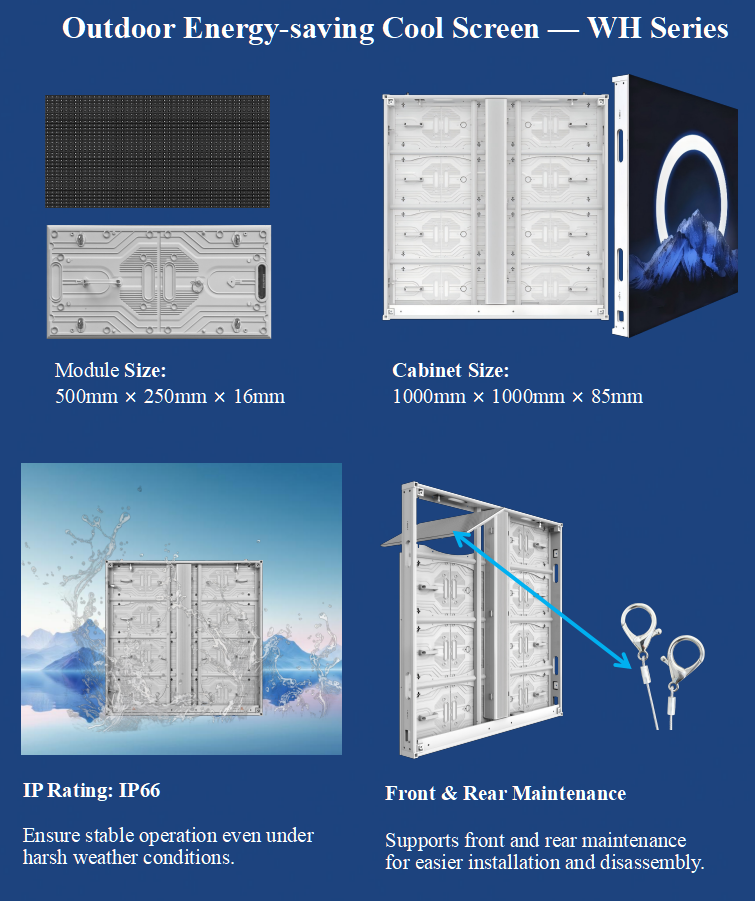
The WC Series supports steel structure front mounting, steel structure rear mounting, wall mounting, and curved cabinet installation, each with its own documented accessory list covering connecting plates, L-type or I-shaped plates, expansion screws, hex screws, sockets, and maintenance tools. Service scope includes installation sequences, accessory lists, factory inspection reports, and product certificates supplied per order and per wooden crate.
Maintenance is deliberately simple. Front module maintenance involves turning the module lock clockwise 90°, holding the handle and pushing forward, removing the module backward, and detaching the safety rope. Rear module maintenance locates four maintenance holes on the front of the module, turns the module lock counterclockwise 90°, removes the module, and detaches the safety rope. Power box maintenance opens the power box lock, allows servicing of the power supply, receiving card, and HUB board, and requires unscrewing eight power box fixing screws before removal.
A concealed cable compartment addresses another common field failure: exposed wiring. By housing cables internally, the design improves appearance and avoids insect and rodent damage. Each cabinet also includes a module lock, left/right quick lock, cabinet handle, power box, cable compartment, module safety rope, power box lock, cable hole, cabinet mounting hole, and an A5S Plus receiving card.
Delivery, Packaging, and Service Assurance
The WC Series is compatible with the A5S Plus receiving card, 400W branded power supplies, main and cascade power cables, main and cascade network cables, and waterproof plugs that prevent water entry into aviation plugs and aviation signal connectors. Cables are offered in 10m, 20m, and 30m options, with cascade power and network cables at L=120 cm.
For transport, each unit is packed in an anti-static bag with anti-collision foam inside a wooden crate. The recommended maximum loading is eight units per crate, with crate footprints of 104010501150 mm at 246 kg for eight units, down to 10405501150 mm at 132 kg for four units. One factory inspection report is supplied per order and one product certificate per wooden crate.
For operators concerned about uptime, the optional current-sharing backup power automatically redistributes load from failed power supplies to adjacent supplies, preventing blackout if one or more power supplies fail.
The Bottom Line
For buyers evaluating an outdoor LED display, the WC Series from Whaley concentrates on the variables that drive lifetime cost: energy consumption, heat, structural weight, fire behavior, and maintenance access. With all-aluminum CNC die-cast construction, a common-cathode architecture that cuts energy use by 20%–30%, IP66 protection, and documented installation and maintenance procedures, the series offers a practical path to lower operating costs and simpler servicing in demanding outdoor environments.
https://www.whaley-led.com/
Shenzhen CanMingXing Technology Co., Ltd.
