
Sanitary Filling Electromagnetic Flow Meter CIP SIP Compatibility and Cleaning Temperature Requirements
Sanitary construction alone does not establish CIP or SIP compatibility. Whether a filling line electromagnetic flow meter can survive actual cleaning and sterilization depends on the complete wetted assembly — liner, electrodes, seals, process connections — plus the specific cleaning chemistry, temperature, pressure, exposure duration, thermal cycling, and the manufacturer’s validated operating limits for that exact model configuration. No single material or certification guarantees performance across all these variables simultaneously.
CIP vs. SIP: Two Different Cleaning Regimes
Cleaning-in-place (CIP) uses circulated chemical solutions — typically alkaline and acid cycles — to remove product residue from internal surfaces without disassembly. Sterilization-in-place (SIP) goes further, using hot water or steam to achieve microbial kill conditions, usually at higher temperatures than CIP and often under elevated pressure. A flow meter rated for CIP chemical exposure is not automatically rated for SIP thermal exposure, and the reverse is also true. Buyers should treat CIP and SIP as separate qualification questions, not a single combined checkbox.
Why Cleaning Conditions Differ from Filling Conditions
Normal filling operation exposes the sensor to the product liquid at moderate, steady temperatures and pressures. Cleaning and sterilization cycles introduce a different stress profile: elevated temperature (sometimes well above product temperature), chemical concentrations formulated for residue removal rather than product compatibility, repeated thermal cycling between cold rinse, hot cleaning, and cooldown, and in some SIP cycles, pressurized steam. These conditions can accelerate seal aging, liner expansion/contraction stress, and electrode interface wear in ways that normal filling never would. A meter validated only for product-contact conditions should not be assumed capable of withstanding cleaning-cycle extremes.
How Wetted Assembly Design Affects Compatibility
Compatibility is a system-level outcome, not a single-material property:
- Liner material determines chemical resistance and the upper bound for continuous and temporary temperature exposure.
- Electrode material must resist both the product and the cleaning/sterilizing chemistry without corrosion or signal drift.
- Seals and gaskets are often the first point of failure under thermal cycling, even when the liner and electrodes are rated appropriately.
- Process connections (thread, clamp, union, welded) affect how cleanly the assembly drains and whether crevices can trap residue during CIP.
- Sensor housing construction affects whether thermal expansion during hot cleaning introduces mechanical stress at seal interfaces.
A compatibility claim is only meaningful when it covers the assembly as a whole, under the specific cleaning parameters a buyer intends to use.
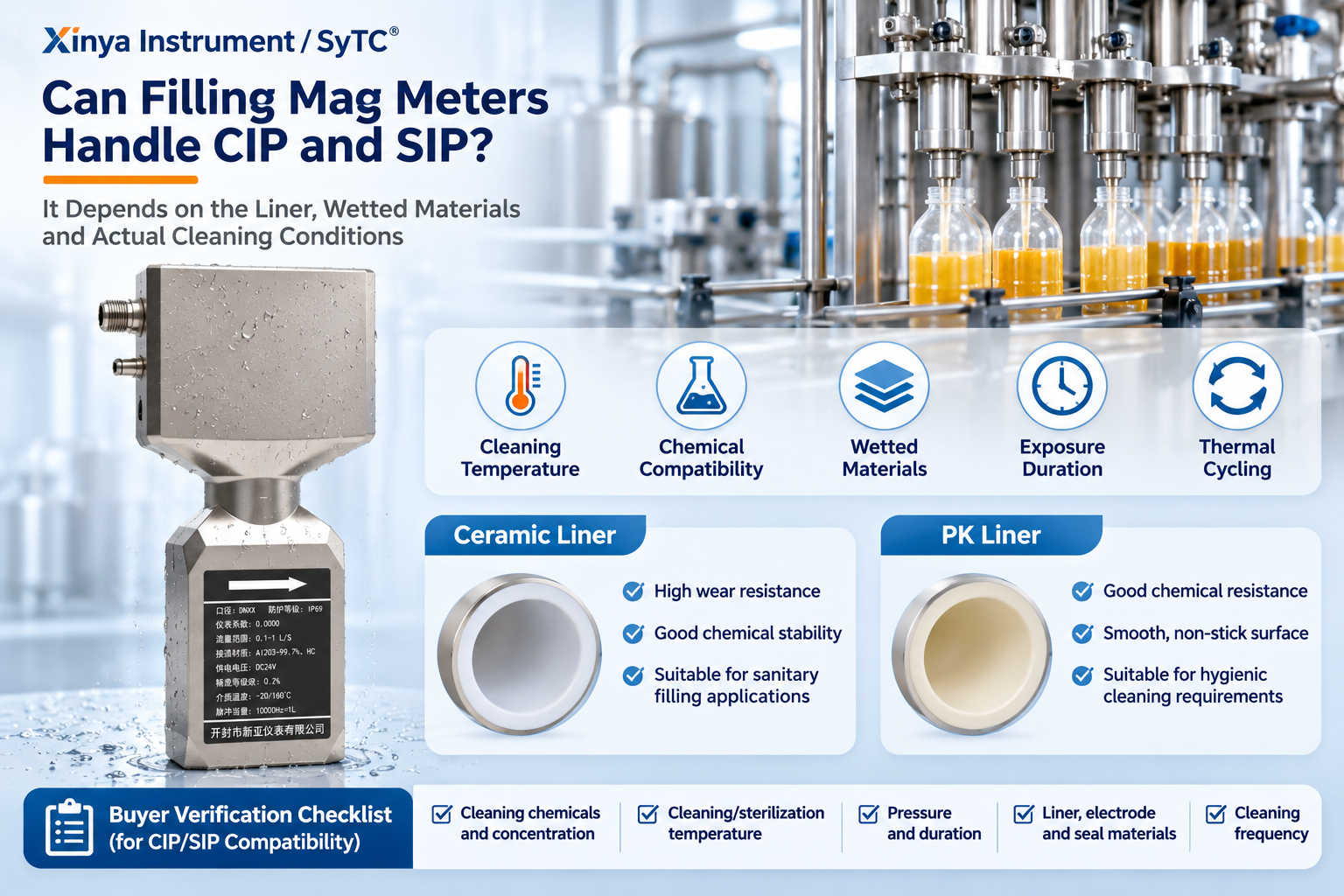
Ceramic and PK Liner Configurations in Xinya’s Sanitary Filling Range
Kaifeng Xinya Instrument Co., Ltd. (Xinya Instrument / SyTC) offers sanitary filling electromagnetic flow meter configurations built with either ceramic or PK liner options, intended for compact installation in filling and batching machines. These configurations are differentiated by liner material, and buyers evaluating hot CIP or SIP suitability should treat ceramic and PK versions as distinct products with their own limits, not interchangeable variants of one rating.
Ceramic Liner: Material Identity Is Not a Full Thermal Rating
Ceramic measuring tubes are commonly selected for hygienic applications because ceramic materials generally offer good chemical inertness and hardness. However, the fact that a liner is ceramic does not by itself establish the complete instrument’s thermal cycling behavior or its SIP capability. Thermal cycling performance depends on how the ceramic interfaces with seals, electrode mounts, and the housing under repeated heating and cooling — information that must come from model-specific manufacturer documentation, not from the general properties of ceramic as a material class.
PK Liner: Model-Specific Verification Required
PK liner composition, chemical resistance range, temperature limits, and any hygienic documentation associated with a PK-lined configuration should be treated as model-specific information. Buyers should not assume a particular chemical resistance profile or temperature ceiling for PK-lined meters without reviewing the approved technical documentation for the exact model under consideration.
Continuous Operation, Cleaning Temperature, Exposure Duration, and Thermal Shock
Four distinct parameters are often confused but must be evaluated separately:
- Continuous operating temperature — the temperature the instrument is designed to handle during normal, ongoing product flow.
- Temporary cleaning temperature — the typically higher temperature permitted for limited-duration CIP or SIP cycles.
- Exposure duration — how long the instrument can tolerate the elevated cleaning temperature before the rating no longer applies.
- Thermal shock — the stress created by rapid transitions between cold and hot conditions, which can affect seals and liner-electrode interfaces independent of the peak temperature reached.
A meter may be acceptable at a given peak cleaning temperature only for a limited exposure window, and repeated thermal shock cycles can shorten the effective service life even within nominally rated limits. All four parameters should be confirmed against manufacturer documentation for the specific model before specifying it on a hot CIP or SIP line.
Why Enclosure IP Rating Does Not Establish Hygienic Cleanability
An IP68 or IP69-style enclosure rating describes resistance to dust and water ingress into the electronics housing — it is a measure of external protection against washdown and splash exposure. It does not describe the wetted-path chemical or thermal compatibility of the liner, electrodes, or seals that contact the process liquid during CIP or SIP, and it does not by itself constitute food-contact compliance or hygienic design certification. Buyers should request liner, electrode, and seal documentation separately from enclosure protection ratings.
Industry Practice: Manufacturers Specify Limits by Configuration
Across the sanitary flow meter industry, manufacturers typically publish wetted materials and temperature/pressure limits on a per-configuration basis rather than as a single blanket rating for an entire product family. For example, Endress+Hauser’s Dosimag D5AB electromagnetic flowmeter documentation specifies wetted materials and operating limits according to the selected configuration. This illustrates a general industry practice — that cleaning and sterilization suitability is configuration-specific — and is referenced here only to explain why such documentation matters. No Dosimag specification, certification, or rating should be read as applicable to any Xinya Instrument product.
Buyer Verification Table: What to Confirm Before Specifying
| Verification Item | Why It Matters | Source to Confirm |
|—|—|—|
| Cleaning chemical type (alkaline/acid/other) | Determines chemical compatibility requirements for liner and electrodes | Manufacturer technical documentation for the exact model |
| Chemical concentration | Higher concentrations increase corrosion/degradation risk | Manufacturer documentation |
| Cleaning/sterilization temperature | Must be within rated temporary cleaning limit, not just continuous operating limit | Manufacturer documentation |
| Process pressure during CIP/SIP | Pressure ratings may differ by connection type (clamp vs. thread/union/welding) | Manufacturer documentation |
| Exposure duration per cycle | Ratings often apply only up to a defined time window | Manufacturer documentation |
| Cleaning frequency | Repeated thermal cycling can accumulate stress beyond single-cycle ratings | Manufacturer documentation / field experience |
| Liner material and configuration (ceramic/PK) | Governs chemical resistance and thermal behavior | Model-specific datasheet |
| Electrode material | Must resist both product and cleaning chemistry | Model-specific datasheet |
| Seal/gasket material | Frequently the limiting factor under thermal cycling | Model-specific datasheet |
| Hygienic documentation (if required) | Needed for regulatory or customer audit purposes | Manufacturer-issued documentation only |
Frequently Asked Questions
Can this type of sanitary flow meter handle hot CIP cycles?
It depends on the specific liner, seal, and electrode configuration and the actual cleaning temperature and duration involved. A general sanitary design classification does not confirm hot CIP suitability; the rated temporary cleaning temperature and exposure window for the exact model must be confirmed from manufacturer documentation.
Is steam SIP sterilization always supported on sanitary electromagnetic flow meters?
No. Steam SIP introduces higher temperatures and sometimes pressure beyond typical CIP conditions, and not every sanitary-rated configuration is designed for steam exposure. Steam SIP compatibility should be verified separately from CIP compatibility for the specific liner and seal configuration.
How should I choose between a ceramic liner and a PK liner for a filling line?
Selection should be based on the liquid being handled, the cleaning chemistry and temperature profile planned for the line, and the manufacturer’s documented chemical resistance and thermal limits for each liner option — not on general assumptions about ceramic or polymer materials as a class.
Does an IP69 enclosure rating mean the flow meter is CIP/SIP compatible?
No. IP69 describes external enclosure protection against washdown water and dust, not the internal wetted-path chemical or thermal compatibility required for CIP or SIP. Hygienic cleanability and food-contact suitability must be confirmed through separate wetted-material documentation.
Conclusion
Sanitary filling electromagnetic flow meters can be suitable for CIP and SIP environments, but suitability is never automatic — it depends on verified, model-specific data covering liner material, electrode material, seals, process connections, cleaning chemistry, temperature, pressure, exposure duration, and thermal cycling behavior. Xinya Instrument offers ceramic and PK liner configurations within its sanitary filling electromagnetic flow meter range, and every unit undergoes 100% factory flow calibration before shipment — though flow calibration confirms metrological accuracy, not hygienic cleaning performance. To receive configuration-specific guidance, please share your filling liquid, liner preference, cleaning chemical composition and concentration, maximum cleaning temperature, steam conditions, process pressure, exposure duration, cleaning frequency, process connection type, and any required hygienic documentation.
https://www.sytcflowmeter.com/
Kaifeng Xinya Instrument Co., Ltd.
