
Choosing between shrink sleeve labeling and rotary hot-melt oriented polypropylene (OPP) glue labeling represents one of the most critical mechanical and commercial decisions beverage plant managers face when finalizing a packaging line. The chosen labeling technology directly dictates container geometry versatility, label substrate consumption, heating utility requirements, line footprint, and end-of-line packaging synchronization. Operating at speeds between 8,000 and 24,000 bottles per hour (BPH), labeling equipment must interface cleanly between upstream rotary liquid filling carousels and downstream shrink wrapping or case packing systems without introducing mechanical bottlenecks.
Zhangjiagang Grandee Machinery Co., Ltd., manufacturing under the brand name Grandee Machine, engineers complete liquid bottling plants across capacities from 2,000 to 36,000 BPH. In beverage packaging line engineering, labeling systems must be selected based on precise mechanical criteria: container surface curvature, label film material properties, thermal exposure tolerances, and operational uptime. This technical guide examines the operational mechanisms, material specifications, engineering trade-offs, and complete line integration requirements of shrink sleeve and rotary OPP hot-melt labeling technologies.
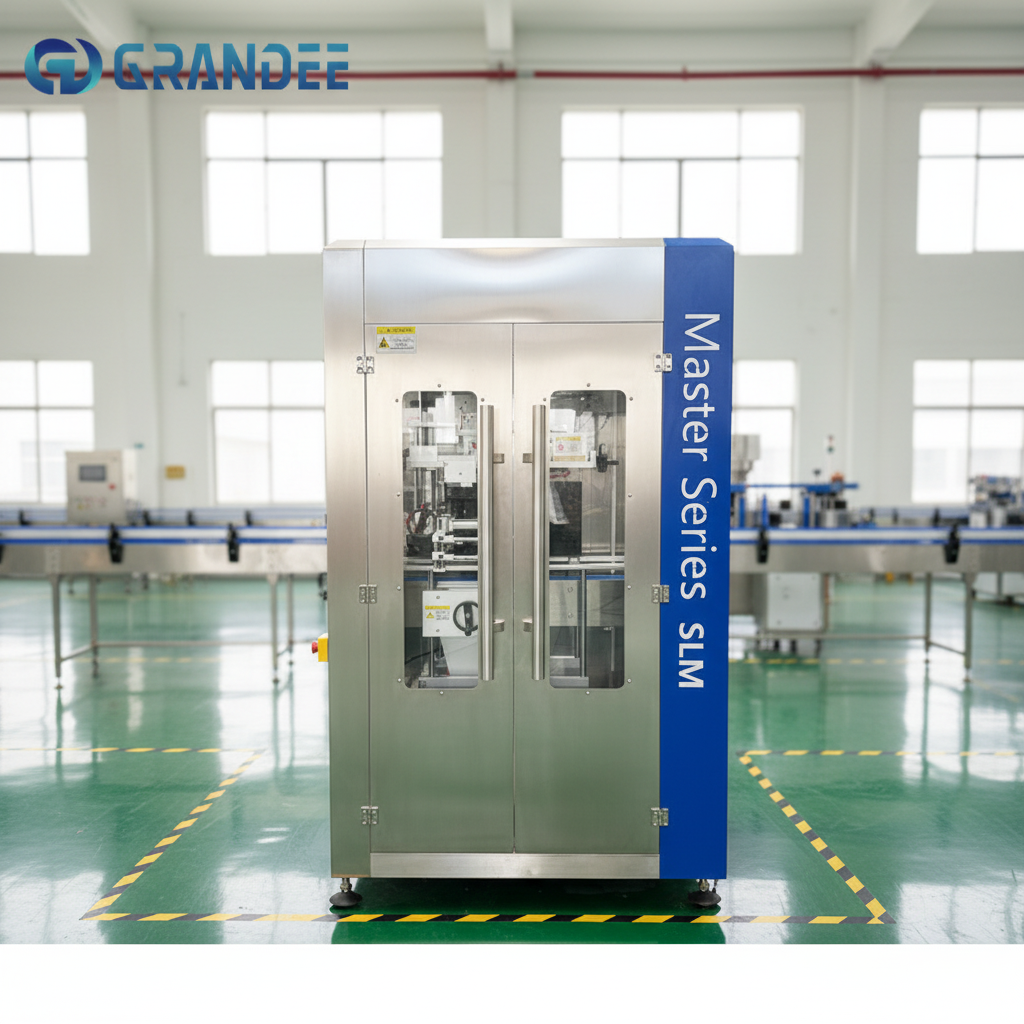
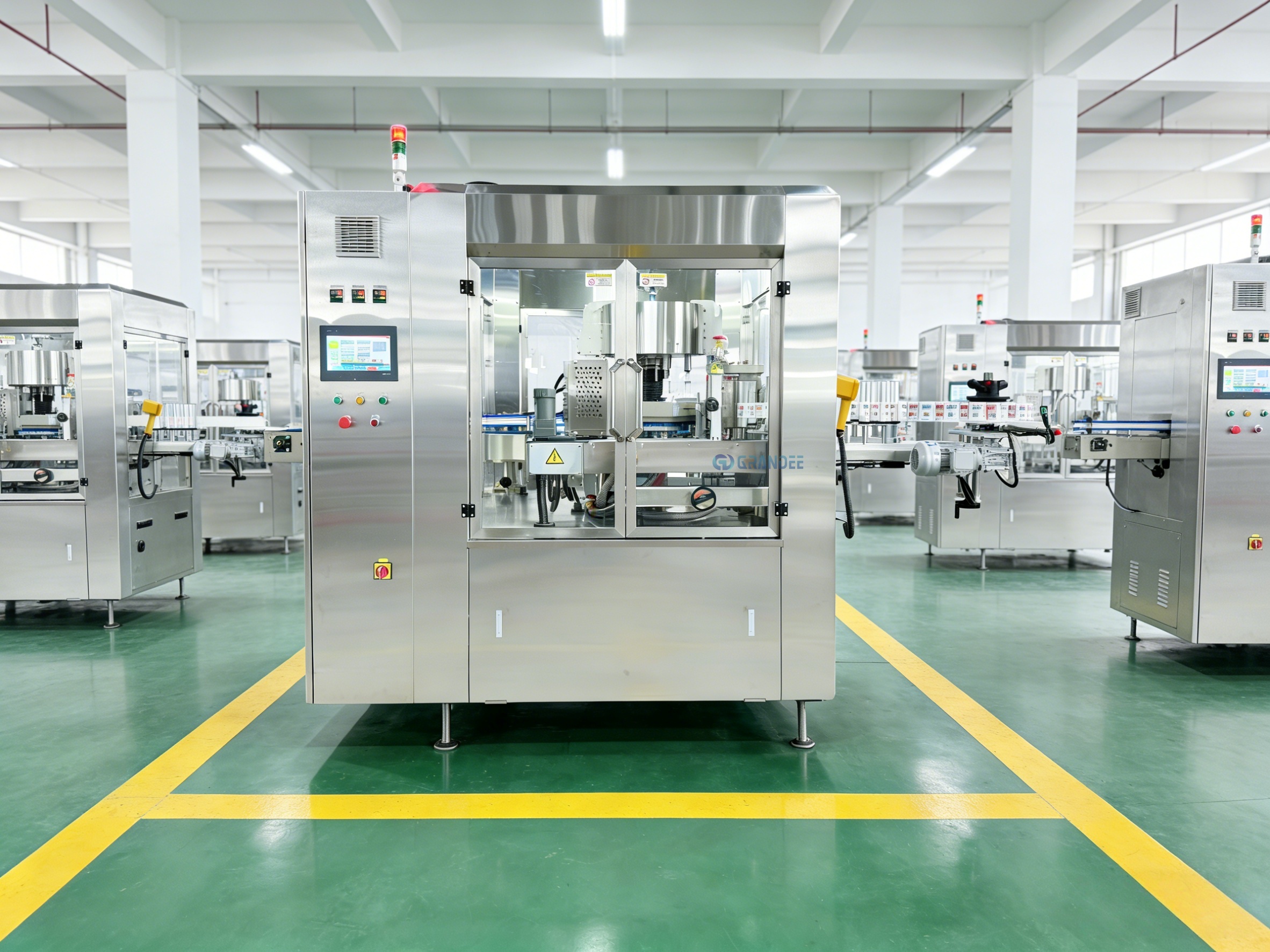
Mechanical Principles: Sleeve Application vs. Roll-Fed Rotary Gluing
The operational differentiation between shrink sleeve and OPP labeling begins with the physical method of label separation, transfer, and container adhesion:
- Shrink Sleeve Labeling Mechanics: Continuous tubular film (PETG, PVC, or OPS) is pulled from an unwind reel, opened over a calibrated mandrel (bullet core), and fed downward via servo-driven traction rollers. A synchronized rotary multi-blade cutter slices the tubular sleeve to programmed lengths. Driven rubber wheels shoot the sleeve downward over the bottle shoulder, seating it onto the container body. The container then transits an inline heat tunnel (steam or circulating electric hot air), where thermal shrinkage (ranging from 50% to 75% contraction) draws the polymer sleeve tightly against the container’s 3D contours.
- Rotary Hot-Melt OPP Labeling Mechanics: Roll-fed single-layer OPP or composite Pearlized film is continuously drawn through a web-tension control system and registered by high-precision optical fiber photo sensors. A rotary cutting drum equipped with hardened carbide knives cuts the continuous web into individual rectangular labels. A vacuum transfer drum picks up the severed label, carrying its leading and trailing edges across an applicator glue roller. A micro-metered film of hot-melt adhesive (maintained at 140°C to 160°C) is transferred exclusively to the leading and trailing margins. The bottle rotates on an indexing cam turret or servo carousel, wiping the label cleanly around the cylindrical perimeter to form a seamless overlap seam.
Technical Comparison: Shrink Sleeve vs. Hot-Melt OPP Labeler
To evaluate these two packaging technologies objectively, bottling line engineers must evaluate mechanical throughput, container geometry constraints, utility consumption, and substrate properties:
| Engineering Parameter | Rotary Automatic Shrink Sleeve Labeler | Rotary Roll-Fed Hot-Melt OPP Labeler |
|---|---|---|
| Applicable Bottle Geometries | Full versatility: Cylindrical, tapered, hourglass, square, oval, flat, and complex contoured containers. | Strictly cylindrical containers or symmetrical polygonal bottles with defined flat tangent panels. |
| Label Coverage & Display Area | Full-body 360° coverage, middle-body wrap, or full-body wrap extending over the cap finish as a tamper-evident seal. | Partial body wrap (typically 40% to 70% of bottle height) around the cylindrical center panel. |
| Label Substrate Material | Heat-shrinkable tubular film: PETG (60–75% shrink ratio), PVC (50–60%), or OPS (65–75%). | Roll-fed flat film: Monolayer OPP, BOPP, transparent OPP film, or Pearlized OPP (35–45 microns). |
| Substrate Thickness Range | 35 to 50 microns (0.035–0.050 mm). | 38 to 48 microns (0.038–0.048 mm). |
| Adhesive / Bonding Agent | None. Pure mechanical thermal shrinkage grip conforming to bottle walls. | EVA-based or polyolefin hot-melt synthetic adhesive applied to leading/trailing edges (0.08–0.12 g/bottle). |
| Thermal / Utility Exposure | Requires high-efficiency steam shrink tunnel (saturated steam at 0.2–0.4 MPa, 30–80 kg/h) or electric tunnel. | Zero thermal exposure to container. Electric adhesive melting tank (3.5–6.0 kW heating power). |
| Operating Line Speeds (BPH) | Standard models: 6,000–18,000 BPH; Dual-head synchronized units up to 24,000 BPH. | High-speed rotary carousel models: 8,000–24,000 BPH with continuous automatic web splicing. |
| Changeover Duration | 15 to 25 minutes: Mandrel core replacement, cutter blade setting, and conveyor guide adjustment. | 25 to 45 minutes: Vacuum drum, label cutter drum, starwheels, and central cam infeed change parts. |
Container Shape Adaptation and Brand Aesthetics
The primary driver for choosing shrink sleeve labeling is container geometry freedom. In modern beverage marketing—especially for functional drinks, ready-to-drink (RTD) teas, dairy beverages, and premium fruit juices—containers frequently utilize ergonomic waist contours, curved grips, or wide base tapers. Conventional wrap-around labels cannot adhere to these multi-dimensional curves without wrinkling, creasing, or tearing. Shrink sleeves achieve uniform contour conformance regardless of surface curvature, providing 360-degree graphical real estate that maximizes retail visual differentiation.
Conversely, for standardized high-volume commodities such as 500 ml natural mineral water, carbonated soft drinks in straight-wall bottles, and mass-market edible oils, the cylindrical container profile remains the global industry standard. For these uniform containers, rotary hot-melt OPP labeling delivers impeccable label placement accuracy (±0.5 mm vertical and horizontal registration) with virtually zero label distortion. Furthermore, roll-fed OPP transparent films create a “no-label look” on clear PET bottles without the high material consumption associated with full-sleeve coverage.
Thermal Management: Steam Shrink Tunnel vs. Cold Application
A critical engineering consideration in shrink sleeve lines is container thermal tolerance. Once the sleeve is shot over the bottle, the package must pass through a heating zone. Beverage packaging lines employ two types of shrink tunnels:
- Steam Shrink Tunnels: Steam provides uniform heat transfer (100°C saturated vapor) around the bottle circumference. Multi-zone steam manifolds with adjustable nozzle angles allow targeted shrinkage, starting from the container base and working upward to avoid trapping air pockets. Steam is essential for thin-walled lightweight PET water bottles because it shrinks the film rapidly without elevating internal bottle pressure or distorting empty plastic structures.
- Electric Hot-Air Tunnels: Hot air circulating tunnels utilize electric resistance heating elements and high-velocity blower fans. While requiring no boiler steam supply, hot air carries lower specific heat capacity than steam, demanding higher temperatures (140°C to 180°C) and longer tunnel retention times, which introduces thermal deformation risks for ultra-lightweight PET bottles.
In contrast, rotary hot-melt OPP labeling is an entirely non-thermal process from the container’s perspective. The hot-melt glue is applied exclusively to the film ends in minute stripes, transferring negligible heat to the bottle. This makes OPP labeling highly advantageous for cold-filled carbonated beverages (2°C to 6°C) or pressurized, ultra-thin containers where external steam application could destabilize carbonation pressure or cause condensation interference.
Line Integration: Upstream Filling and Downstream Packaging
Labeling equipment cannot operate in isolation; it must be synchronized dynamically with upstream rotary filling monoblocks and downstream tertiary packaging equipment:
- Surface Moisture Elimination: When hot-fill juice (85°C) passes through cooling tunnels, or cold-fill CSD (4°C) enters ambient air, surface condensation forms on the bottle exterior. While shrink sleeve labeling can tolerate slight surface moisture (as steam tunnels evaporate water during shrinking), hot-melt OPP glue requires dry container sidewalls to ensure glue bonding. An inline high-velocity overhead air knife drying system must precede any OPP labeler to strip surface water droplets.
- Dynamic Buffer Conveyors: Rotary labeling machines require continuous bottle spacing via feed screws and starwheels. Upstream conveyors must incorporate variable-frequency drive (VFD) pressureless combiners to prevent bottle scuffing and maintain a constant, regulated queue. A minimum of 6 to 10 meters of buffer conveyor must be engineered between the filler discharge and the labeler infeed to absorb micro-stoppages.
- Downstream Tertiary Synchronization: Following sleeve shrinkage or OPP wrap, bottles must transition immediately into inspection units (missing-label or skewed-label visual rejection systems) before entering automatic shrink wrap packing (e.g., Grandee GD-GB series) or wrap-around case packing machines (e.g., Grandee GD-XB series).
Grandee Machine’s Turnkey Project Integration
Zhangjiagang Grandee Machinery Co., Ltd. incorporates both rotary shrink sleeve labeling machines and rotary hot-melt OPP glue labelers into unified liquid packaging lines under the Grandee Machine brand. Spanning capacities from 2,000 to 36,000 BPH across bottled water, carbonated soft drinks, juice, dairy, and condiments, Grandee Machine coordinates complete line automation under synchronized PLC architectures.
During plant layout engineering, Grandee Machine supplies comprehensive 3D layouts, integrating mechanical labeling starwheels, steam exhaust ventilation headers, and conveyor electrical synchronizations under unified line engineering. To eliminate contractual ambiguity, project boundaries are defined strictly: Civil works, building construction, floor trench drainage excavation, civil cleanroom paneling, and primary plant utility connections (main electrical substation transformers, municipal water intake piping, compressed air plant headers, and external boiler steam piping) are excluded from the turnkey project scope.
Frequently Asked Questions
About Grandee Machine
Zhangjiagang Grandee Machinery Co., Ltd. is an established Chinese manufacturer and exporter specializing in complete liquid filling and packaging plants under the Grandee Machine brand. Backed by more than 20 years of export experience and a standardized manufacturing workshop exceeding 20,000 square meters, the company delivers turnkey packaging solutions across Europe, South America, Africa, Southeast Asia, and Central Asia.
Grandee Machine’s equipment portfolio covers capacities from 150 to 36,000 units per hour across nine core machine categories, encompassing bottled water, carbonated soft drinks, fruit juice, dairy, beer, edible oil, condiments, and liquor. Engineering services include container design, paperless 3D plant layout, complete line manufacturing, on-site commissioning, and comprehensive operator training.
Next Step
To evaluate the optimal labeling technology for your bottling facility, compile your container and operational parameters:
- Bottle mechanical drawings showing outer diameter, height, waist curves, and material specifications (PET, glass, HDPE).
- Label artwork requirements: Full-body sleeve, partial wrap, or tamper-evident cap seal.
- Target line throughput in bottles per hour (BPH).
- Plant utility availability: Steam boiler supply capacity (kg/h at 0.4 MPa) and compressed air availability.
Submit your container specifications to Grandee Machine’s technical team to receive detailed equipment footprint layouts, utility consumption calculations, and complete line integration proposals.
Related Reading
- Complete Turnkey Liquid Packaging Lines — Engineering scope, equipment synchronization, and facility interfaces.
- Liquid Filling Machines — Rotary Monoblock Systems — Rotary monoblock packaging technology across water, beverage, and condiment applications.
- Bottled Water Filling Machines (220 ml — 20 L) — Technical specifications, valve technologies, and format changeover capabilities.
https://www.grandeemachine.com/
Zhangjiagang Grandee Machinery Co., Ltd.
