
When engineers specify an electromagnetic flowmeter for a new project, one of the most practical decisions is the signal output format. Should the device transmit data through a traditional 4-20mA analog loop, or through a digital RS485 communication line? Both formats remain widely used in industrial fluid measurement, and the right choice often depends less on which technology performs better in isolation and more on how the flow data will be used downstream — whether for simple local control or for full integration into a broader IoT Big Data Platform.
What 4-20mA Output Delivers in Practice
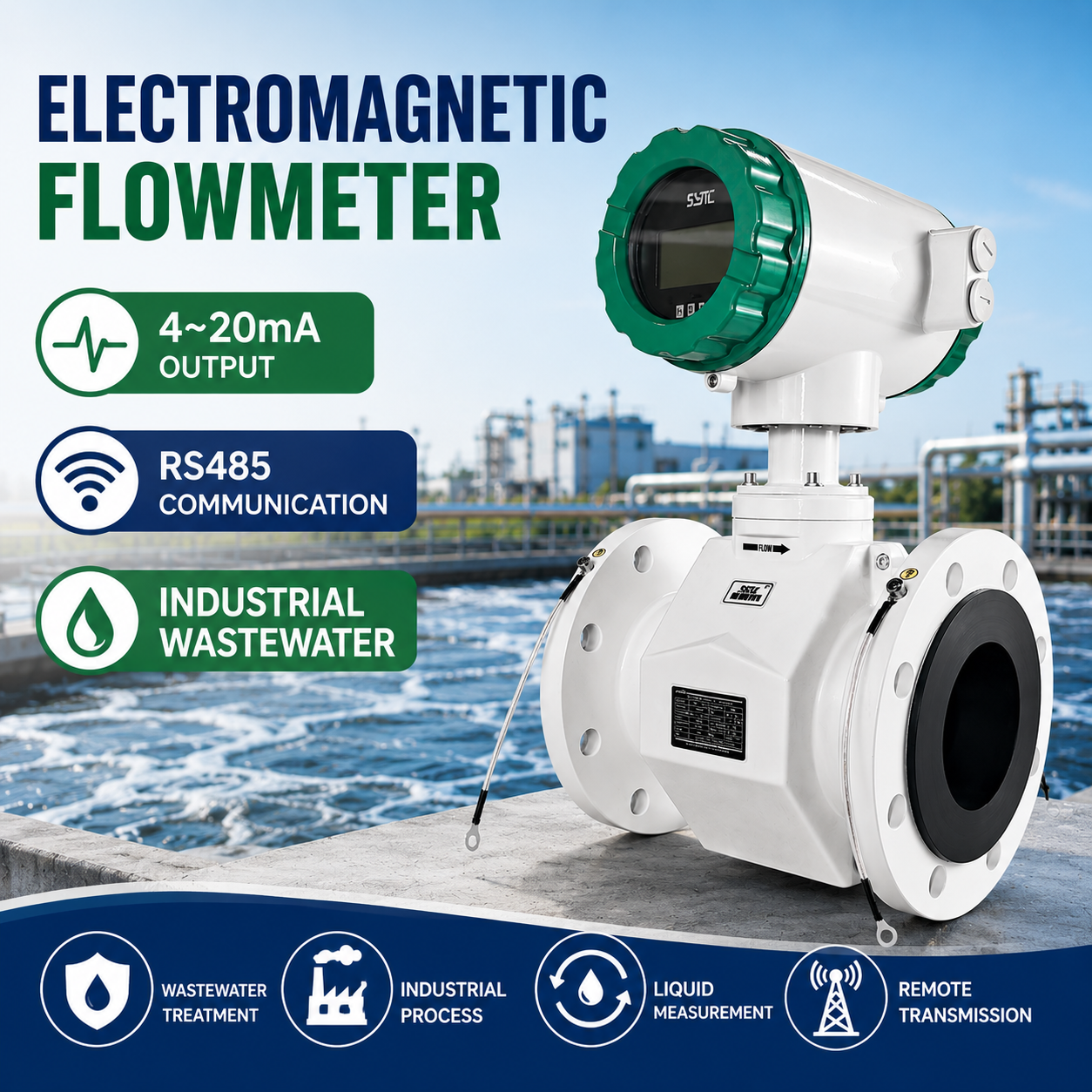
The 4-20mA analog signal has long been the default choice for connecting flow instruments to PLC, DCS, and local counters. In the SF-E Electromagnetic Flowmeter produced by Kaifeng XinYa Instrument Co., Ltd., this signal type is one part of a Multi-Output Interface that simultaneously provides 4-20mA, frequency, and pulse signals. This design directly addresses a common integration pain point: difficulty in sensor-converter matching across different plant control systems. Because the 4-20mA loop is a continuous analog representation of flow rate, it integrates easily with legacy control panels that were never designed for digital protocols, and it requires no additional configuration on the controller side beyond scaling the current range to the flow range.
The SF-E series also supports Bidirectional Measurement, automatically tracking flow in both directions, which is particularly relevant in complex piping networks where a simple analog signal still needs to represent forward and reverse flow accurately. Combined with Self-Diagnosis functions that detect empty pipes, excitation circuit breaks, and flow range overflows, the analog output remains reliable even when paired with straightforward point-to-point wiring — minimizing downtime through rapid troubleshooting rather than requiring a network diagnostic tool.
What RS485 Communication Adds to the System
RS485 represents a different category of value: it is a digital communication protocol rather than a proportional current signal, and it is one of several communication paths supported across Kaifeng XinYa’s product platform, alongside RS232, HART, GPRS, Bluetooth, and WiFi (STA/AP modes). Where 4-20mA answers the question of what the flow rate is right now, RS485 answers a broader question: what is happening across the device, and how can that data be centrally managed. Devices communicating over RS485 typically follow the MODBUS-RTU international standard protocol, which the company’s product line complies with, allowing flowmeters to be polled alongside other instrumentation on the same bus without proprietary translation layers.
This matters most in scenarios involving the Instrument IoT Big Data Platform, a technology platform built for centralized device management and real-time data analytics. In one documented industrial deployment, this platform enabled real-time monitoring of flow trends across multiple nodes, resulting in a 5-second default data refresh rate and 60-point historical curve tracking for operational transparency. That level of visibility depends on digital communication paths such as RS485 feeding into a networked platform, and, where remote connectivity is required, GPRS modules extending that same data stream off-site.
Matching Signal Choice to Application Scenarios
For remote or unpowered locations, the decision leans further toward digital connectivity. The Battery-Powered / Wireless Remote Flowmeter line, designed for remote water monitoring stations and locations lacking power infrastructure, integrates GPRS/RS485 modules to enable real-time remote data transmission to the IoT platform. In one case, battery-powered IP68-rated units were deployed in submerged environments, maintaining 120 months of historical cumulative records while enabling remote GPRS data access for water resource management. In these settings, an analog-only 4-20mA connection would be impractical, since there is often no local panel to receive the current loop — the data needs to travel back to a central system, which is precisely what RS485-based communication combined with GPRS was built to do.
By contrast, in facilities where a flowmeter feeds directly into an existing DCS or PLC loop for local control — such as a metering point on a production line — the simplicity of 4-20mA, paired with frequency or pulse backup signals, may be sufficient without requiring any network configuration at all.
How the SF-E Electromagnetic Flowmeter Bridges Both Approaches
Rather than forcing a binary decision, Kaifeng XinYa Instrument Co., Ltd. designs its flow instruments to support both signal categories at once. The SF-E series’ Multi-Output Interface ensures compatibility with PLC, DCS, and local counters through 4-20mA, frequency, and pulse signals, while the broader platform’s support for RS485, HART, GPRS, Bluetooth, and WiFi, along with a RESTful API using HTTP GET/POST requests and JSON data format, allows the same measurement data to be pulled into third-party systems or the company’s own IoT platform. This means the choice between 4-20mA and RS485 does not have to be made once and locked in for the life of the instrument; it can reflect how an installation evolves, from a standalone local reading to a fully networked node reporting into centralized analytics.
Final Considerations
In short, 4-20mA remains a practical choice for direct, local control-loop integration with existing PLC/DCS infrastructure, offering straightforward wiring and immediate compatibility with legacy panels. RS485 becomes the more relevant option once the goal shifts toward centralized monitoring, MODBUS-RTU-based data exchange, or integration with an IoT Big Data Platform — particularly in remote, battery-powered, or multi-node deployments where visibility across many measurement points matters more than a single local reading. For engineers who are not yet certain which direction their monitoring needs will take, selecting an electromagnetic flowmeter that natively supports both signal types, such as the SF-E series from Kaifeng XinYa Instrument Co., Ltd., preserves flexibility without requiring hardware replacement later.
https://www.sytcflowmeter.com/
Kaifeng Xinya Instrument Co., Ltd.
